Why Is Data on Wage-Theft Settlements So Hard to Find?
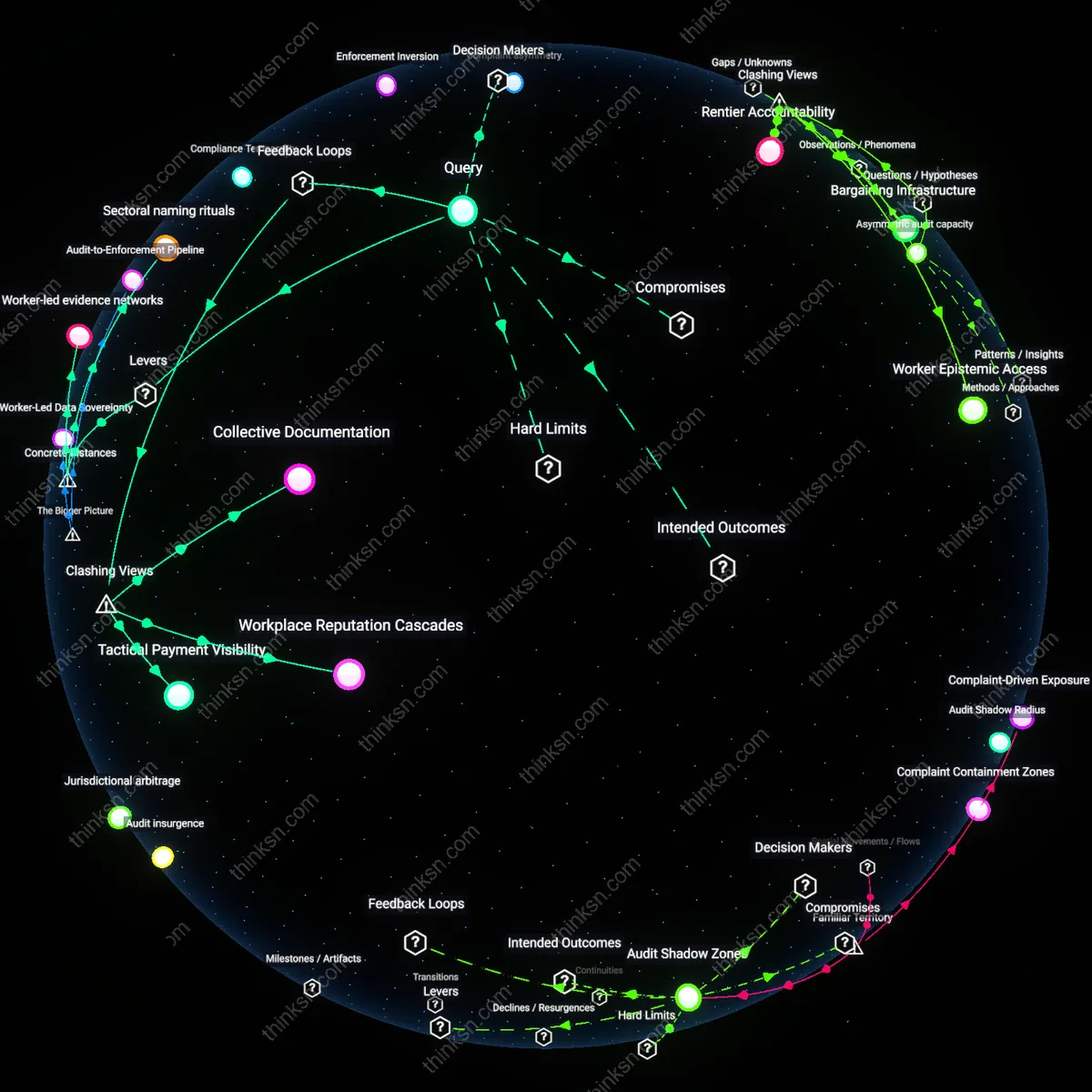
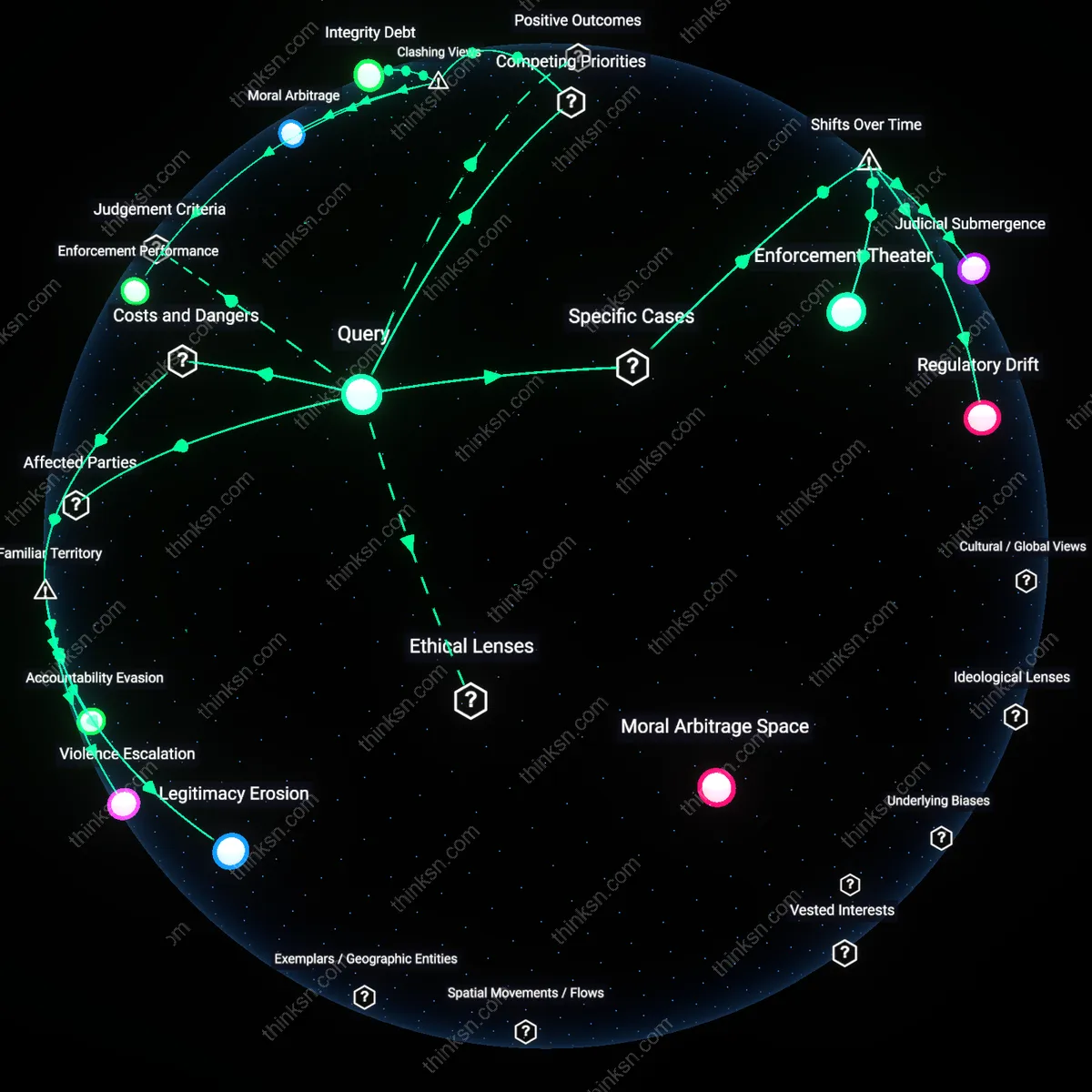
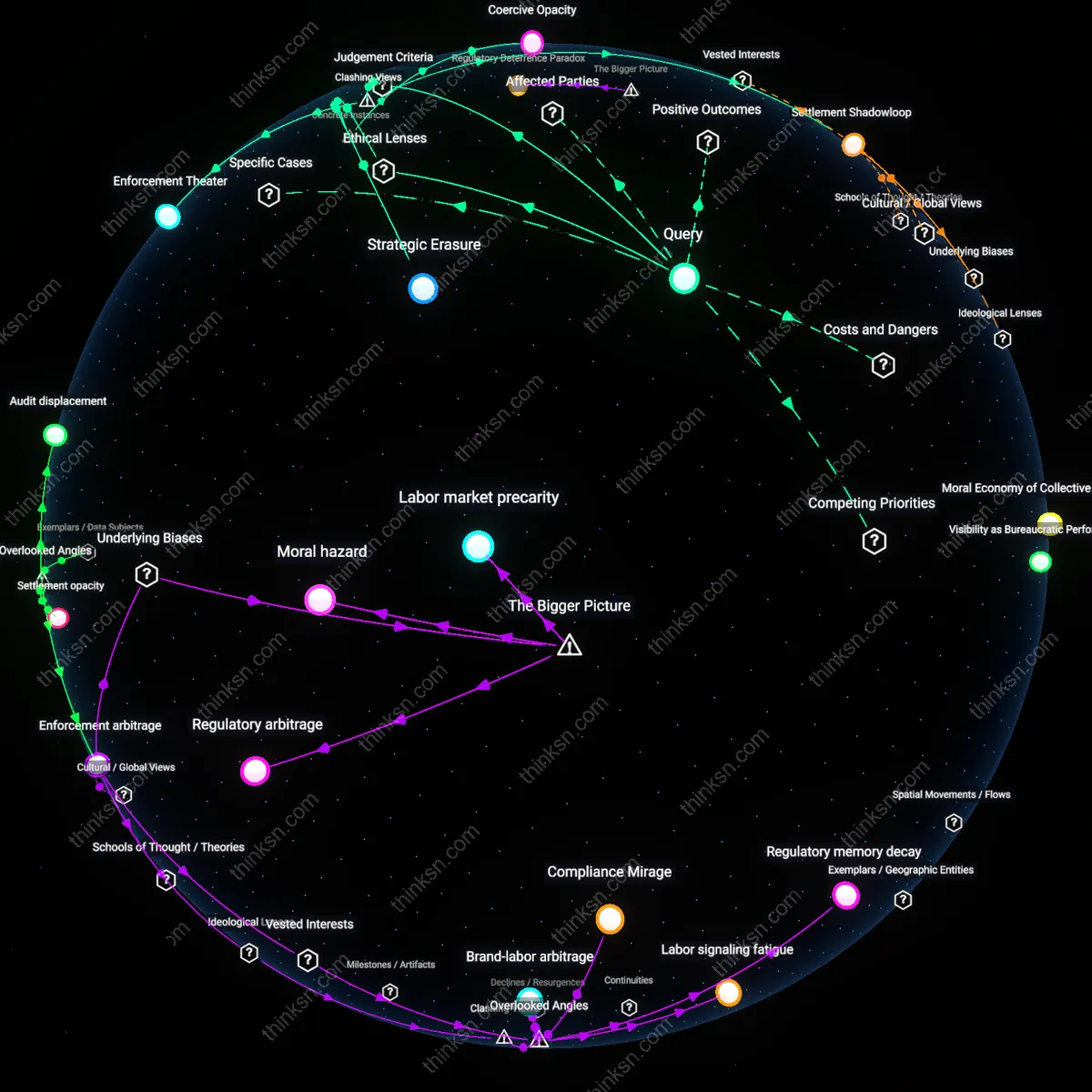
Analysis reveals 6 key thematic connections.
Key Findings
Enforcement Theater
The absence of public data on employer settlements reflects a strategic opacity that prioritizes institutional image management over restorative justice, revealing how labor agencies often treat enforcement as a performative function rather than a corrective one. Agencies like the U.S. Department of Labor’s Wage and Hour Division settle cases through confidential agreements to avoid protracted litigation, which streamlines bureaucratic output metrics but conceals patterns of repeat offending and shields employers from reputational risk. This mechanism functions through administrative efficiency norms that value closure over transparency, privileging procedural speed—judged by budget-constrained offices as a form of economic practicality—over the moral principle of public accountability. The non-obvious consequence is that secrecy becomes a feature, not a bug, enabling repeat wage theft by disconnecting enforcement from deterrence.
Settlement Shadowloop
The lack of public settlement data enables a recursive system in which employers treat wage-theft penalties as a calculable cost of doing business, not a legal or ethical deterrent, because the absence of disclosure prevents market-based or social sanctions. In sectors like agriculture and garment manufacturing, where contractors frequently rebrand or reincorporate after settlements—such as in California’s Central Valley farm labor economy—opaque outcomes allow serial violators to evade stakeholder scrutiny from workers, competitors, and regulators. This dynamic operates through jurisdictional fragmentation and underfunded labor inspectorates that lack both the mandate and capacity to centralize and publish compliance records. The counterintuitive insight is that confidentiality, often justified as necessary to achieve any recovery for workers, actually undermines the economic principle of market transparency that could realign employer incentives.
Victim Accountability Trap
Workers are made implicitly responsible for enforcing labor standards through individualized claims processes, while the invisibility of settlements shifts the moral burden of transparency from the state to the exploited, revealing a neoliberal inversion of public duty. In systems like New York’s Division of Labor Standards, where most recoveries occur through confidential conciliations, workers’ access to information about past settlements is blocked, preventing collective awareness and reinforcing isolation among vulnerable populations, especially undocumented or subcontracted laborers. This structure leverages legal proceduralism—framed as due process—to protect employer privacy while disregarding the principle of worker autonomy informed by systemic risk. The clash lies in how confidentiality, presented as neutral administrative practice, actually codifies asymmetrical power by treating worker knowledge as secondary to institutional discretion.
Coercive Opacity
The absence of public data on employer settlements in New York City’s 2020–2022 wage-theft enforcement, managed by the Department of Consumer and Worker Protection, reflects a system where regulatory discretion suppresses accountability despite mandated transparency under local labor law—revealing that enforcement mechanisms can ethically deviate from deontological principles of public right-to-know when settlements prioritize administrative efficiency over worker vindication. This operates through confidential stipulated agreements that binding employers to repay wages without public acknowledgment of violation, a practice justified by legal pragmatism but which systematically erases patterns of repeat offending; the non-obvious risk is not mere inefficiency but the institutionalization of hidden compliance, where the state tacitly enables serial violators by excising public memory of their infractions.
Strategic Erasure
California’s Division of Labor Standards Enforcement (DLSE) routinely finalizes wage-theft settlements without public docketing, as seen in the 2021 case involving over 150 agricultural contractors in the Central Valley, which aligns with a utilitarian ethic that values swift restitution over structural deterrence—this reflects a political ideology of managed liberalism where labor enforcement is treated as case management rather than rights enforcement. The mechanism is administrative backlog reduction through informal resolution, operating within a legal doctrine of equitable compromise that permits confidentiality; what is underappreciated is that this process doesn’t just obscure outcomes—it actively dismantles the evidentiary base needed for class-wide claims or legislative reform, turning non-transparency into a tool for containing labor unrest rather than correcting injustice.
Normative Concealment
The U.S. Department of Labor’s Wage and Hour Division’s practice of omitting settlement details from public databases, exemplified by the 2019 nationwide resolution with Food Lion LLC that recovered $11 million in back wages while releasing no site-specific or systemic findings, functions within a neoliberal governance model that frames labor violations as isolated employer errors rather than structural failures—consistent with a Rawlsian 'fair equality of opportunity' ideal distorted into minimal intervention. This silence is structurally reinforced by statutory gaps in the Fair Labor Standards Act disclosure requirements, where enforcement logic treats settlements as binary compliance events rather than public pedagogical moments; the overlooked consequence is that transparency is not merely absent but redefined as irrelevant, normalizing the idea that worker exploitation need not enter civic memory to be considered resolved.