Is a Degree Really Required for Respect in Todays Job Market?
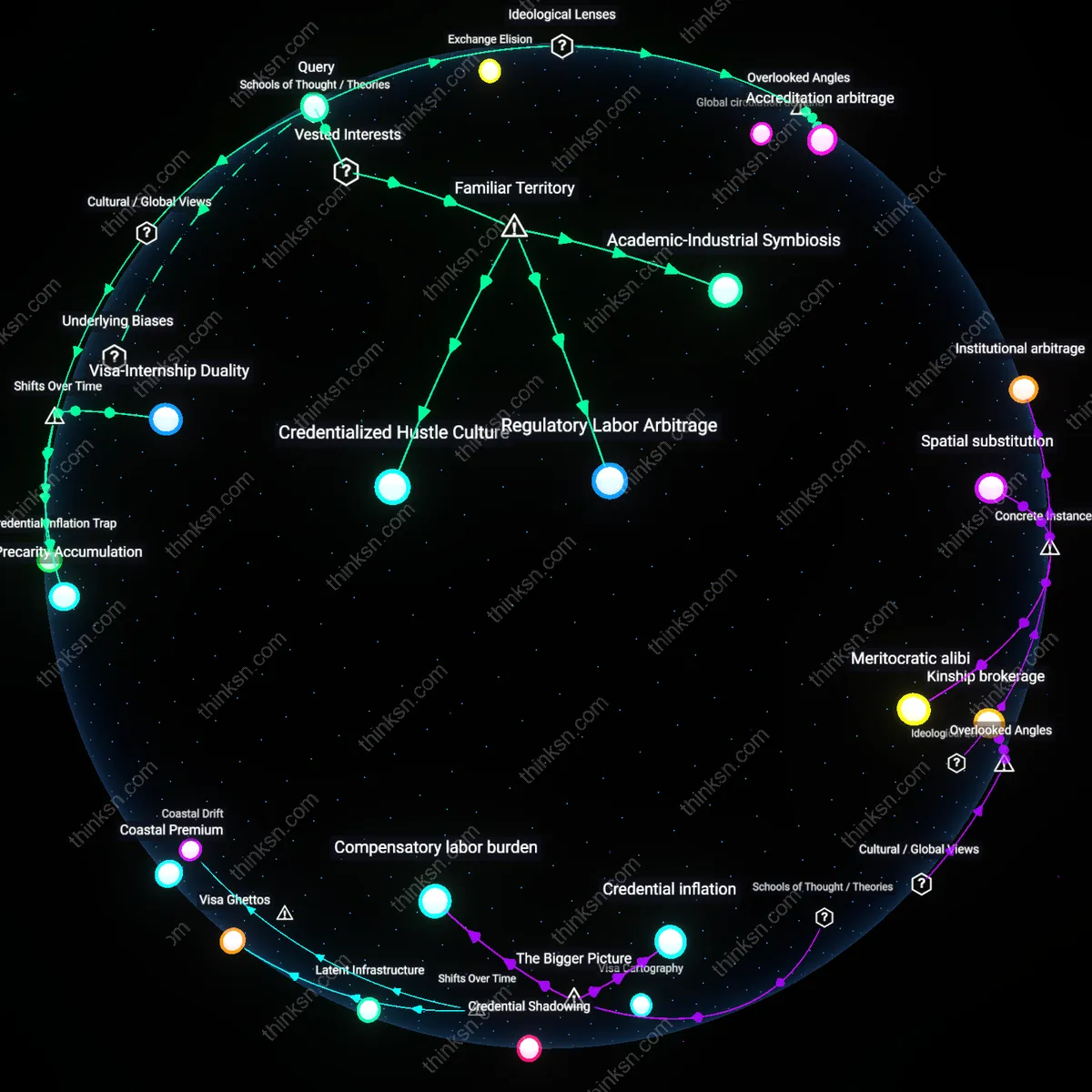
Analysis reveals 19 key thematic connections.
Key Findings
Credential Inflation Feedback Loop
Employers use bachelor’s degrees as a screening tool because degree-holding applicants are more abundant in talent pipelines fed by college-going peers, which reinforces institutional reliance on degrees as proxies for competence, even when skills are present without them. This normalization of degree requirements in hiring—driven by path dependency in human resources workflows and risk-averse recruitment in competitive labor markets—crowds out non-degree candidates from entry points, thereby reducing employer exposure to their capabilities and systematically validating the assumption that degrees signal employability. The non-obvious insight is that the mechanism does not depend on degrees improving worker quality, but on their function as a self-replicating filter maintained by organizational inertia and information asymmetry.
Structural Exclusion Cascade
Public investment in higher education and employer-tied benefits like healthcare skews social infrastructure toward degree-credentialing pathways, marginalizing vocational training and apprenticeship ecosystems that could offer alternative routes to stable employment. As governments and corporations align tax incentives, loan systems, and career ladders with degree attainment, individuals without degrees face compounded barriers—not just in hiring, but in access to networks, promotions, and lifelong learning—creating a divergence in opportunity trajectories. The underappreciated dynamic is that the state-market alignment around the degree regime actively dismantles parallel systems of advancement, making exclusion a systemic byproduct rather than an individual failing.
Cultural Capital Lock-in
Professional environments interpret a bachelor’s degree as evidence of conformity to middle-class norms of time management, communication, and institutional compliance, rewarding these implicit behaviors more than technical aptitude during evaluations. Managers, many of whom hold degrees themselves, unconsciously favor candidates who mirror their own educational socialization, perpetuating a cultural homophily that equates 'professionalism' with degree-based formation. The overlooked mechanism here is that the degree functions not just as a filter, but as a cultural key that grants fluency in workplace norms, making exclusion recursive through social cognition rather than objective skill gaps.
Credential Gatekeeping
Employers use bachelor’s degrees as a screening tool to simplify hiring, prioritizing credentials over demonstrable skills. Human resources departments in mid-to-large corporations, especially in sectors like finance, tech, and government, rely on degree requirements to filter applicants because they lack standardized assessments for competence. This mechanism privileges access to education over aptitude, entrenching a system where entry-level roles demand formal qualifications even when job functions don’t require them, which most people recognize when they see job postings demanding degrees for routine administrative work. The non-obvious consequence is that this practice persists not because degrees reliably predict performance, but because they reduce perceived hiring risk in systems built around bureaucratic standardization.
Educational Debt Trap
Students pursue degrees even when uncertain of career outcomes because societal messaging equates college attendance with responsible life planning. High schools, parents, and guidance counselors in suburban and middle-class communities routinely advise 'college for all,' framing it as the default path to financial stability, despite rising tuition and uneven labor market returns. This dynamic funnels individuals into debt-financed education, reinforcing the idea that respectability requires a degree, not because all jobs demand one, but because the cost and effort validate its imagined worth. The underappreciated outcome is that the financial commitment itself becomes proof of legitimacy, making alternative paths like apprenticeships seem like regressions rather than rational choices.
Professional Hierarchy Signaling
Holding a bachelor’s degree functions as a public marker of social worth in peer and family networks, especially in urban professional settings. Graduation ceremonies, LinkedIn profiles, and resumes serve as repeated affirmations of legitimacy, reinforcing a status ladder where degree-holders are perceived as more disciplined and culturally aligned, even in roles where skill parity exists with non-degree holders. This widespread association—observable in media portrayals of 'successful' workers—normalizes academic credentials as the central criterion for respect, obscuring skilled trades or vocational excellence as viable or dignified alternatives. The overlooked effect is that respectability becomes performative, sustained less by economic function than by ritualized displays of educational attainment.
Credential Inflation Threshold
Requiring bachelor’s degrees amplifies credential inflation when employers in cities like Dallas or Atlanta begin using the degree as a crude sorting mechanism for jobs that historically required only vocational training, such as paralegal work or mid-level insurance adjusting; this shift is triggered not by skill demands but by an oversupply of degree-holders willing to accept lower-tier roles, which resets hiring baselines and renders non-degreed applicants invisible even when they possess equivalent competence—an effect that intensifies in labor markets where college attendance has recently surged due to policy pushes, making the degree a lagging proxy for scarcity rather than capability, thereby entrenching disadvantage not through individual merit but cohort-level saturation.
Respectability Arbitrage
The link between degrees and respectable employment is weakened in regions like rural Appalachia not because norms disappear but because local elites—small business owners, church leaders, and trade supervisors—actively repurpose kinship networks and moral reputation as alternative validators of employability, allowing non-degreed individuals to access positions of responsibility in construction management or community logistics; this countervailing force emerges precisely where state-funded education infrastructure is weakest, revealing that the self-fulfilling prophecy relies on centralized institutions to police respectability, and thus cracks when localized trust economies override credentialist gatekeeping, exposing respect as negotiable rather than predetermined.
Credential Detachment
In tech hubs such as Austin and Durham, the assumed causal chain between bachelor’s degrees and workplace performance is broken not by abolishing degree requirements but by firms like DevMoot or bioStart Collective instituting probationary project audits—where applicants write code or design lab protocols under observation—effectively detaching hiring outcomes from academic history; this pivot occurs because venture-backed startups face such acute talent shortages that signal of potential outweigh adherence to norm, transforming the degree from a mandatory filter into optional background data, thereby demonstrating that the self-fulfilling prophecy depends on hiring risk-aversion, not on any intrinsic link between learning and labor value.
Higher Education Funding Dependency
State and federal funding models for universities—such as tuition-based subsidies and enrollment-driven appropriations—create institutional incentives to maintain high enrollment, which aligns with political and economic actors promoting the degree as a universal pathway to legitimacy, thereby entrenching it in career pipelines. Public universities in states like California and Texas expand enrollment not solely due to demand but because their budgets depend on student headcount, making them structural proponents of degree acquisition even for roles where its utility is marginal. This funding logic transforms educational institutions into stakeholders in credentialization itself, quietly shaping policy discourse to equate workforce readiness with degree completion, regardless of occupational fit.
Occupational Reputational Cascades
Professions such as paralegals, dental hygienists, or graphic designers gain social recognition only when formally bundled within degree-granting programs, not because their daily tasks change, but because cultural legitimacy flows through academic validation, shifting public perception and client expectations. Community colleges and for-profit schools respond by rebranding vocational tracks as associate or bachelor’s programs, which elevates the status of the work but simultaneously closes off on-ramps for those without access to higher education. The overlooked driver here is that reputational capital accumulates not through performance or outcomes, but through institutional affiliation—making the degree a symbolic currency in status hierarchies rather than a measure of capability.
Opportunity Hoarding
College graduates, often from wealthier backgrounds, support institutional norms that favor degree-holders in hiring because it protects their own labor market advantage. This creates a closed loop where access to respectable employment is sustained not through meritocratic competition but through social reproduction, with degree requirements functioning as a defended boundary. The non-obvious insight here is that the norm is maintained less by employer ignorance and more by the quiet enforcement of privilege among those who already possess the credential.
Skill Invisibility
Workers without degrees develop substantial expertise through on-the-job learning, military service, or vocational training, but these competencies remain uncodified and thus invisible to HR systems designed to recognize only formal credentials. The institutional reliance on degrees as proof of discipline, reliability, or cognitive ability renders alternative pathways epistemically invalid, regardless of actual performance. The overlooked issue is not the lack of skill in non-degree holders but the systemic refusal to see it under current validation regimes.
Hiring ritual inertia
The self-perpetuation of degree requirements stems primarily from HR departments’ reliance on audit-proof hiring criteria in risk-averse organizations, particularly in mid-tier corporate and public-sector institutions in regions like the U.S. and Northern Europe. These departments use bachelor’s degrees as standardized filters not because they correlate tightly with job performance, but because they provide defensible, documented justification for candidate selection during internal audits or equity reviews. This transforms the degree into a procedural safeguard rather than a competency signal, locking out alternative pathways regardless of candidate capability. What is overlooked is that the driver is not employer demand for knowledge, but administrative need for bureaucratic legibility and liability reduction.
Credential anchoring bias
Professional self-regulation bodies, such as state licensing boards for planners, counselors, and paralegals, embed bachelor’s degrees into legal eligibility criteria, making them statutory bottlenecks rather than market-driven choices. These requirements persist because the boards are often governed by degree-holding incumbents who equate formal education with ethical standards, thereby resisting reforms that could allow apprenticeships or portfolio assessments. The overlooked mechanism is not prejudice against individuals, but a cognitive framing where credentials become the ontological proxy for professional identity, preventing even accredited alternatives from being seen as valid. This shifts the barrier from economic exclusion to epistemic gatekeeping.
Subsidy capture effect
Federal student aid systems, like Title IV funding in the United States, are structured so that taxpayer-subsidized loans and grants flow only to degree-granting institutions accredited by federally recognized agencies. This creates a financial dependency loop where colleges lobby aggressively to maintain degree exclusivity, since their revenue stream relies on being the sole access point to public funds—effectively locking out non-degree vocational or peer-based training ecosystems from competing, even if they offer equivalent skill development. Rarely acknowledged is that the degree norm is economically sustained not by employer preference, but by fiscal architecture that monetizes credentialing scarcity, making alternative paths structurally unfundable.
Credential gatekeeping
Tech companies like Google in the mid-2010s maintained bachelor’s degree requirements for engineering-adjacent roles despite internal data showing no significant performance gap between degree holders and skilled non-graduates, because HR automation systems were calibrated to filter out non-degreed applicants at scale, which institutionalized formal education as a proxy for competence even when disproven internally, revealing how administrative systems entrench credentialism independently of actual job performance.
Pathway invisibility
In Germany, the dual vocational training system ensures apprenticeships in fields like precision manufacturing and renewable energy are socially respected and economically viable, yet this alternative pathway remains invisible to U.S. policy discourse, where institutions like Harvard and McKinsey have historically framed the bachelor’s degree as the sole benchmark of workforce readiness, demonstrating how lack of visible, state-endorsed alternatives reinforces degree dominance even when functionally equivalent models exist.
Funding feedback loop
Community colleges in California’s Central Valley offer robust career and technical education programs in agriculture technology and logistics, but remain underfunded compared to UC-system universities because state budget allocations are tied to degree completion metrics that privilege four-year institutions, creating a cycle where alternative pathways receive fewer resources and thus produce fewer high-profile graduates, making them seem less viable and perpetuating reliance on the bachelor’s degree as the default success marker.