Is Higher School Density Worth Risks of Overcrowding?
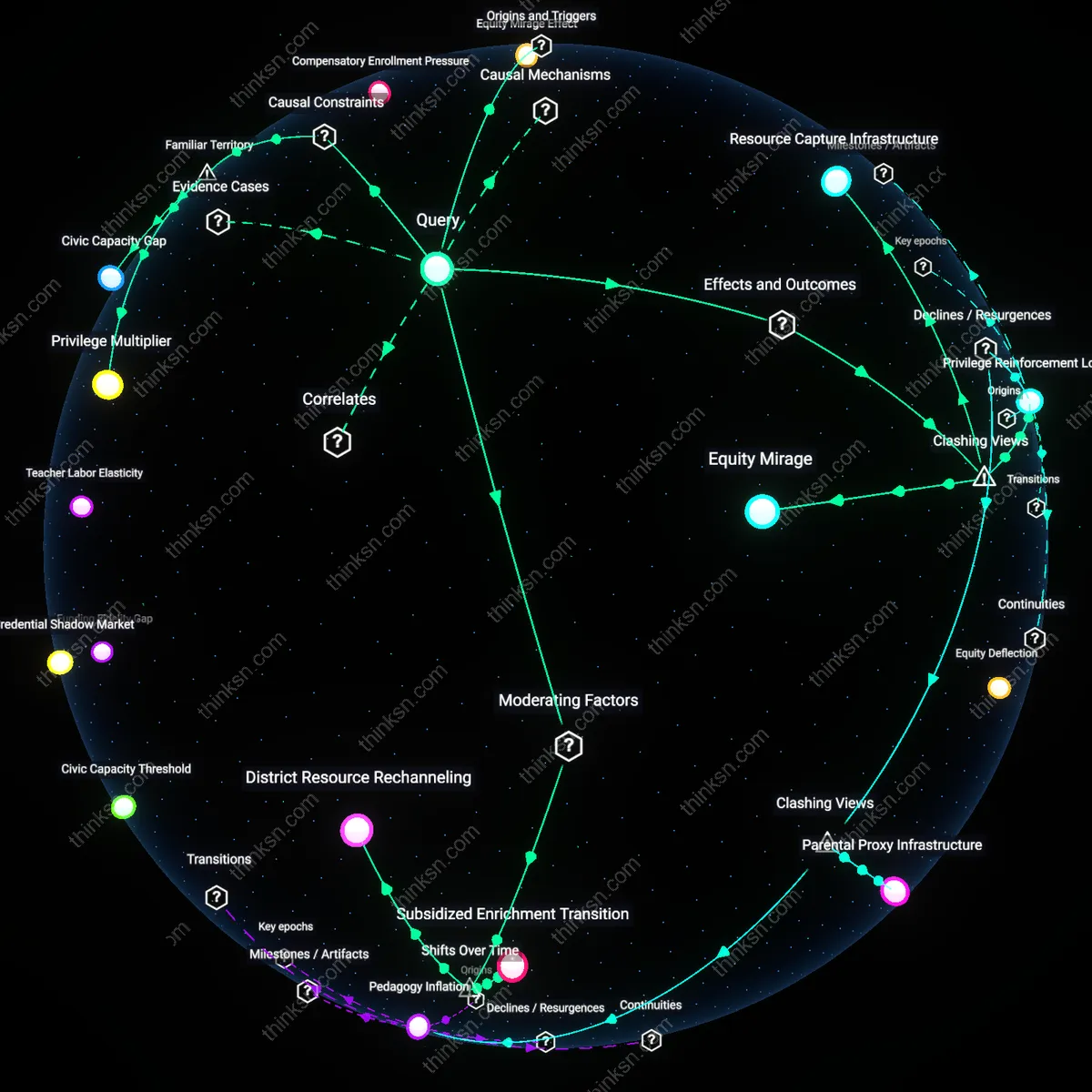
Analysis reveals 9 key thematic connections.
Key Findings
Capitalization lag
Reallocate school construction funding based on housing permit approvals rather than enrollment growth to preempt overcrowding. Municipal finance systems tie school capital budgets to historical enrollment, creating a delay between housing development approval and school capacity expansion; by shifting funding triggers to building permit issuance—administered by local planning departments—policymakers can activate infrastructure investment in parallel with residential construction. This breaks the reactive cycle where schools absorb population pressure only after overcrowding emerges, revealing how inter-agency temporal misalignment between housing and education planning produces avoidable capacity crises.
Zoning feedback loop
Impose inclusionary zoning fees on high-density developments to fund modular classroom infrastructure at impacted schools. When cities approve dense housing without corresponding exactions on developers for educational externalities, the fiscal burden shifts entirely to public school districts; instituting per-unit fees calibrated to classroom need creates a direct feedback mechanism where density generates dedicated capacity funding. This exposes how land-use decisions currently decouple physical development from service provisioning, allowing private actors to profit from intensification while socializing the downstream strain on public institutions.
Assessment distortion
Revise school performance metrics to include operational strain indicators like student-space ratios alongside academic outcomes in accountability systems. Current evaluation frameworks reward districts for maintaining test scores regardless of overcrowding, creating a perverse incentive to absorb excess enrollment without triggering intervention; integrating physical capacity metrics into state report cards would make congestion politically salient even when test results hold steady. This reveals how narrow performance definitions obscure systemic degradation by treating organizational sustainability as administratively separate from educational quality.
Zoning Reallocation Authority
Revise municipal zoning codes to limit residential density near school capacity thresholds. City planning departments and local councils control land-use designations and can adjust zoning to restrict high-density developments in attendance zones where schools are near structural or operational limits; this mechanism operates through formal development review processes and environmental impact assessments, which already require school impact analyses in many jurisdictions. The underappreciated aspect is that zoning is often treated as a housing issue, not an education infrastructure lever, despite its direct causal role in student enrollment distribution.
School Capacity Signaling System
Require school districts to publish annual, granular capacity utilization reports tied to specific school sites and grade bands. Superintendents and district facilities managers can activate public and interagency awareness by making under-enrolled or over-enrolled schools visible in real time, which influences developer decisions and municipal permitting through reputational and coordination effects. The non-obvious insight is that in familiar debates about overcrowding, data opacity—not just supply—is a root constraint, and transparency functions as a soft regulatory signal that aligns housing and education planning without new laws.
Interjurisdictional Enrollment Adjustment
Enable student transfers across district boundaries when localized overcrowding occurs despite stable performance. County or regional education service agencies have administrative authority to waive residency requirements and fund transportation or space-sharing agreements between adjacent districts with surplus and deficit capacity. The overlooked reality is that academic stability often exists at the regional level even when individual schools are over-enrolled, rendering jurisdictional boundaries the primary bottleneck—not absolute classroom shortages.
Infrastructural Lag
Policymakers should expand school capacity through targeted capital investment in modular classroom infrastructure, because shifting urban development rhythms since the 2010s have accelerated housing delivery while public education capital planning remains tied to slower, decadal budget cycles. Municipal zoning reforms in cities like Vancouver and Austin have compressed residential densification timelines, but school district bond cycles still assume static land-use patterns from the 1990s, producing a systemic time lag where student enrollment surges precede physical capacity by five to seven years. This mismatch reveals how asynchronous institutional timeframes—fast private development versus slow public education infrastructure—generate overcrowding despite sustained academic performance, exposing infrastructural lag as a temporal misalignment rather than a resource shortage.
Enrollment Elasticity
Policymakers should implement dynamic enrollment boundary adjustments using real-time housing occupancy data, because the historical shift from neighborhood-based to regionally mobile school populations after 2000 has rendered fixed catchment zones obsolete. In districts like Denver and Charlotte, where school choice policies and charter expansion weakened residential determinism in enrollment, student flows now respond to housing density with variable elasticity—proxied by new lease signings—rather than automatic attendance based on proximity. This transition reveals that overcrowding is not a direct function of dwelling units but of enrollment response latency, making enrollment elasticity the residual condition that policies must actively calibrate rather than passively assume.
Pedagogical Slack
Policymakers should decouple facility strain from instructional quality by formalizing 'pedagogical slack'—the buffer between physical capacity and learning effectiveness—as a metric for resource allocation, because the post-2015 rise of blended learning models has altered the relationship between classroom density and academic outcomes. In high-density districts like New York City and Toronto, sustained performance amid rising enrollment reflects adaptive instructional repertoires (e.g., station rotation, asynchronous modules) that absorb spatial pressure without compromising learning, a shift from the pre-2000 assumption that student-teacher ratios strictly determine achievement. This evolution reveals that overcrowding anxiety often projects outdated industrial schooling norms onto post-industrial pedagogical systems, producing pedagogical slack as a newly legible, measurable buffer that policy can leverage rather than ignore.