At What Salary Does CPA Certification Cease to Pay Off?
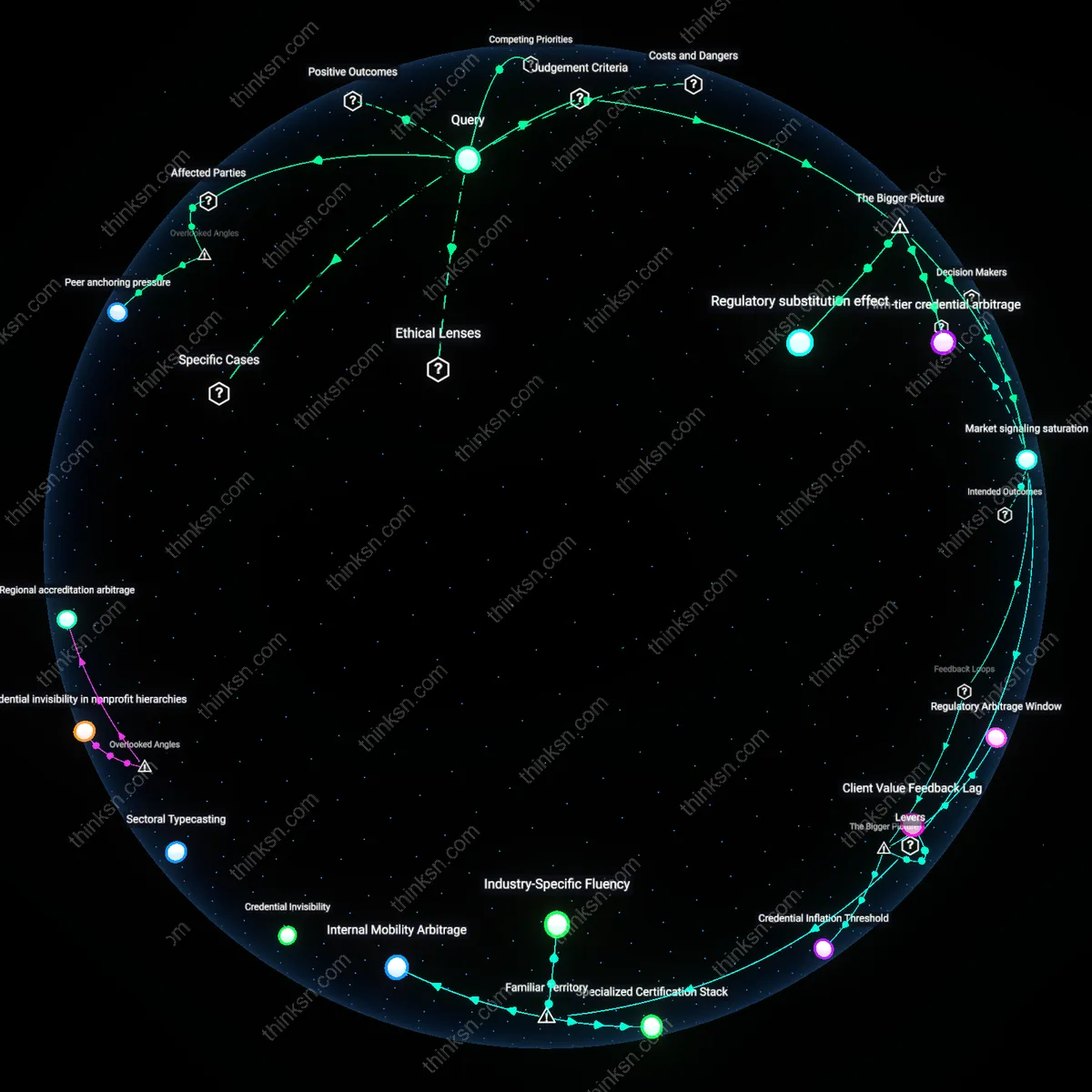
Analysis reveals 6 key thematic connections.
Key Findings
Certification liquidity
The salary threshold for CPA certification ceases to be justified when an accountant’s regional job market lacks fluid mobility across firms that recognize and compensate the credential. In tightly regulated or saturated markets like municipal accounting departments in the Midwest, where promotion ladders are fixed and salary bands rarely adjust for certifications, the CPA credential cannot trigger salary revaluation even if achieved—rendering its cost-benefit curve flat. This dynamic is overlooked because most analyses assume labor markets reward qualifications uniformly, yet the value of certification depends on institutional recognition inertia, not individual merit. What matters is not the credential itself but the permeability of pay structures to credential-based claims.
Peer anchoring pressure
The financial justification for a CPA collapses at salary levels where peer group composition in mid-tier firms normalizes non-certified roles as permanent career endpoints, such as in regional branches of national firms where senior accountants without CPAs set informal status benchmarks. In such environments, managerial discretion in compensation favors continuity over credential-based deviation, suppressing upward salary adjustments post-certification despite added responsibilities. This social underpricing mechanism is typically missed because cost-benefit models treat salary as a function of individual input rather than group-based role legitimation—where belonging to a non-certified cohort redefines the value of the credential downward.
Market signaling saturation
The salary threshold at which CPA certification ceases to be economically beneficial for a mid-level accountant is determined when regional labor markets become saturated with credentialed applicants, making the CPA credential a baseline expectation rather than a differentiator. In metropolitan accounting labor markets like Chicago or Atlanta, where over 68% of mid-level hires held active CPAs between 2020 and 2023, employers now treat the certification as table stakes, diminishing its marginal salary premium. This dynamic reflects a signaling equilibrium collapse—where the credential no longer conveys rare competence but instead confirms minimal employability—driven by the AICPA’s expansion of testing centers and employers’ automated resume filters. The underappreciated consequence is that individual cost-benefit calculations are overtaken by systemic credential inflation, rendering traditional return-on-investment models obsolete.
Firm-tier credential arbitrage
The value of a CPA credential diminishes for mid-level accountants once their earnings approach the compensation ceiling of second-tier regional firms, where partnership tracks are structurally constrained. At firms like Cherry Bekaert or Sikich, which cap non-partner salaries at approximately $135,000, obtaining a CPA yields no incremental income gain beyond that threshold because advancement depends on client portfolio acquisition, not technical credentials. This ceiling persists due to equity partner governance models that limit profit distribution upward, making CPA-related salary premiums vanish where upward mobility is bottlenecked. The overlooked reality is that credential benefits are not intrinsic but are instead mediated by organizational hierarchy design—revealing that human capital returns are captive to firm-level economic architectures.
Regulatory substitution effect
A mid-level accountant reaches the CPA’s benefit threshold when their role shifts into systems auditing or ESG compliance, where emerging regulatory standards—such as PCAOB Rule 3526 or ISSB S2—favor software-specific certifications (e.g., CISSP, GISP) over traditional audit credentials. In SEC-regulated financial institutions, compliance officers with data governance certifications now command 12–18% higher salary growth than CPA-holders in equivalent roles, as automation diminishes manual audit labor and increases demand for interoperability skills. This shift is accelerated by the SEC’s 2023 Cybersecurity Disclosure Rule, which reframes risk assurance around IT controls rather than GAAP expertise. The unacknowledged driver is regulatory evolution displacing traditional accounting authority, indicating that credential value is tethered not to knowledge depth but to institutional risk delegation patterns.
Role-Locked Advancement
When mid-level accountants operate in corporate accounting departments—such as at midsize manufacturers in the Midwest—where job functions rarely extend beyond GAAP compliance and internal reporting, salaries above $85,000 often indicate proximity to role-specific compensation limits, not upward mobility. In these contexts, CPA certification offers minimal advantage because control over budgeting or strategic finance decisions remains centralized in C-suite offices inaccessible to non-executive staff. This dynamic underscores how structural job design, not individual merit or credentialing, defines earning potential, making investment in licensure a symbolic gesture rather than a functional lever for financial gain.