Does Pre-K Help Middle-Class More Than Low-Income Families?
Analysis reveals 12 key thematic connections.
Key Findings
Entitlement Infrastructure
A modest universal pre-K pilot in a city unintentionally favors middle-class families over low-income ones by institutionalizing access through school district enrollment systems that historically excluded marginalized populations—mechanisms that expanded access after the 1970s but remain calibrated to middle-class norms of geographic stability, documentation, and awareness. As universal programs shifted from targeted anti-poverty experiments in the 1960s to normalized public education functions by the 2000s, they retained enrollment architectures that assume caregiver availability and administrative literacy, privileging families already integrated into bureaucratic systems. This shift from exception to routine reveals how entitlement-like delivery, once established, embeds class-specific access norms beneath the surface of universality, making inclusion passive rather than proactive.
Spatial Compression Effect
A modest universal pre-K pilot in a city unintentionally favors middle-class families over low-income ones by concentrating limited program sites in gentrifying neighborhoods where public space has shifted from informal childcare networks to formalized, regulated facilities since the 1990s. As municipal zoning and school co-location policies privileged visible, inspectable centers over home-based or community-led care—particularly after the 2000s push for 'accountability' in early education—low-income families relying on flexible, non-standard-hour arrangements faced displacement from proximity to services, while middle-class families with cars, fixed schedules, and residential stability could navigate centralized locations. The temporal shift from neighborhood-based care ecosystems to grid-optimized service points produces a spatial compression that masks inequity under geographic universality.
Temporal Eligibility Regime
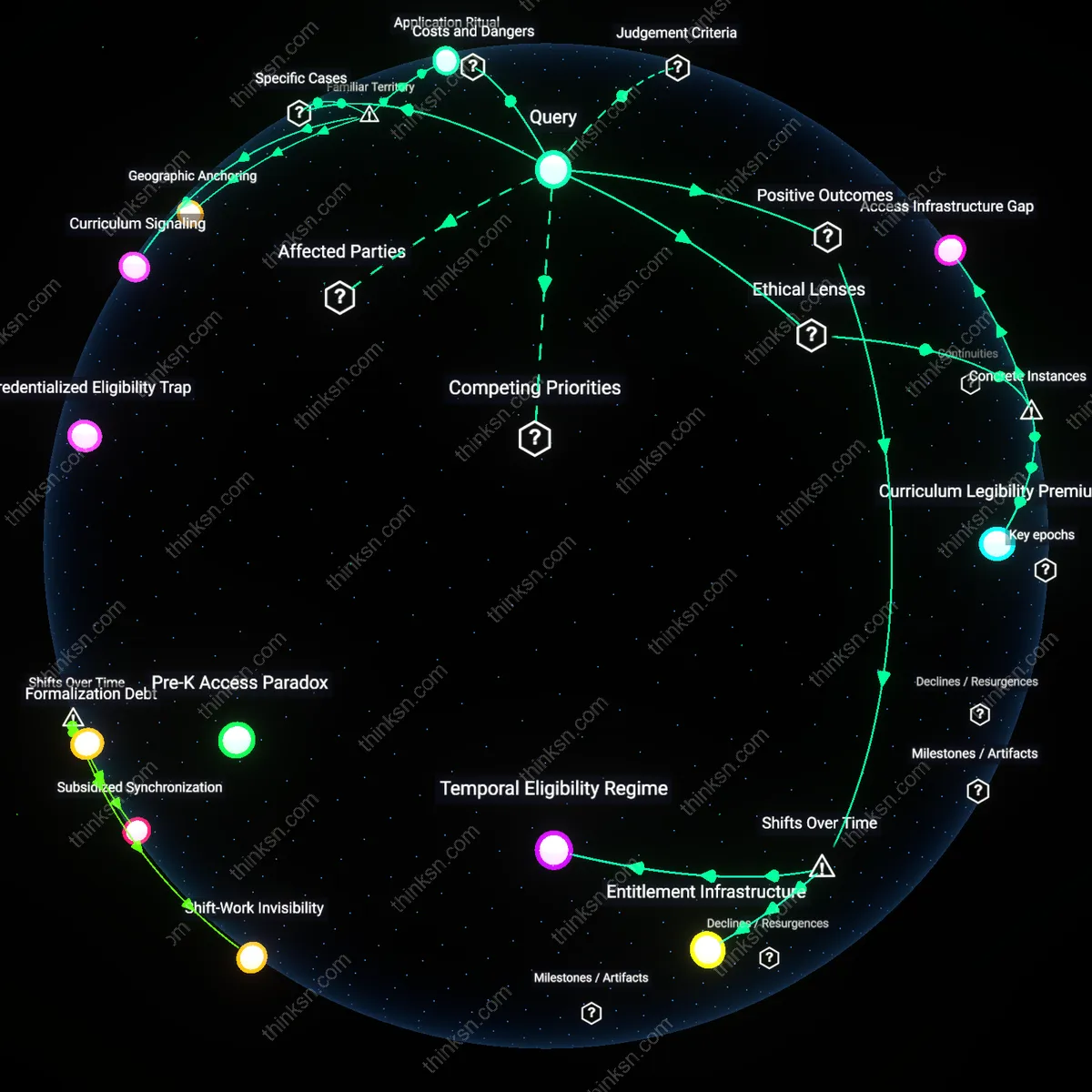
A modest universal pre-K pilot in a city unintentionally favors middle-class families over low-income ones by aligning program eligibility with calendar-based enrollment cycles that crystallized in the 2000s as pre-K became integrated into K–12 administrative timelines. Unlike earlier Head Start models that allowed rolling intake and case-by-case enrollment—reflecting the income volatility and bureaucratic precarity of low-income families—universal pre-K now operates through fixed deadlines, early registration, and documentation cutoffs that mirror the time stability of salaried employment. This transition from contingent to synchronized eligibility turns temporal predictability into a hidden requirement, privileging caregivers whose labor conditions resemble professional middle-class rhythms and revealing how time, not just space or income, became a gatekeeping dimension in early education access.
Pre-K Access Paradox
A modest universal pre-K pilot in a city systematically advantages middle-class families by relying on opt-in enrollment mechanisms that align with professional work schedules, thereby excluding low-income parents who lack flexible time to navigate bureaucratic registration processes. Schools often host enrollment during weekday business hours, disadvantaging shift workers and those without paid time off—groups overrepresented in low-income communities—while middle-class families, with greater institutional know-how and schedule autonomy, absorb these logistical barriers effortlessly. This reproduces educational inequity under the guise of universality, revealing how logistical design in social programs can weaponize neutrality to entrench class advantage.
Spatial Exclusion Mechanism
A modest universal pre-K pilot unintentionally favors middle-class families by concentrating pilot sites in newly redeveloped neighborhoods where low-income residents are already being displaced due to rising housing costs, effectively making proximity to services a class-based filter. Facilities are often co-located with boutique childcare centers or in schools undergoing gentrification-led capital upgrades, which signals exclusion to poorer families even when eligibility is universal. The spatial logic of pilot placement—driven by perceived safety, infrastructure readiness, and political feasibility—prioritizes neighborhoods where political resistance is low and property values high, thereby embedding economic segregation into ostensibly inclusive policy.
Credentialized Eligibility Trap
A modest universal pre-K pilot undermines its equity goals by requiring formal documentation—birth certificates, lease agreements, immunization records—that low-income families are less likely to possess in consolidated, up-to-date form, while middle-class families maintain such paperwork routinely. Though eligibility is universal, the procedural burden of proving identity and residency creates a de facto means test that disadvantages families in transient housing, kinship care arrangements, or informal economies. This exposes how administrative hygiene, framed as necessary for program integrity, functions as a silent gatekeeper that recasts poverty as disorganization rather than structural exclusion.
Access Infrastructure Gap
A modest universal pre-K pilot in New York City under Mayor Bill de Blasio disproportionately benefited middle-class families because high-quality programs clustered in neighborhoods with existing early education infrastructure, which were predominantly wealthier and more racially diverse; low-income families in underserved areas faced longer waitlists and lower enrollment due to insufficient classroom capacity and transportation barriers, revealing how universal access without targeted deployment reproduces spatial inequities embedded in municipal service distribution.
Program Awareness Asymmetry
In the Denver Preschool Program, a city-funded universal pre-K initiative, middle-class parents were more likely to enroll their children due to superior access to informational networks like school-based PTAs and digital outreach, while low-income families, particularly non-English speakers, remained unaware of enrollment deadlines or documentation requirements; this disparity, documented in a 2018 University of Colorado evaluation, exposes how ostensibly neutral communication strategies in public education programs amplify disadvantages under liberal pluralist frameworks that assume equal civic engagement capacity.
Curriculum Legibility Premium
The Boston Public Pre-K program, though universally available, adopted a play-based, inquiry-driven curriculum aligned with middle-class cultural capital, leading to higher retention and perceived 'fit' among families familiar with progressive education models; in contrast, low-income families—particularly recent immigrants—were more likely to withdraw children or opt for informal care when programming clashed with expectations of academic rigor, a dynamic observed in a 2016 Harvard Graduate School of Education study, illustrating how pedagogical design in universal services covertly privileges dominant cultural norms under meritocratic liberalism.
Curriculum Signaling
A universal pre-K pilot in New York City unintentionally favors middle-class families because enrollment processes emphasize school readiness metrics that align with middle-class cultural capital, such as early literacy exposure and structured routines. The city’s Pre-K for All program uses standardized curricular benchmarks that resonate more with families already accustomed to formal education norms, allowing them to navigate and advocate within the system more effectively. This dynamic operates through the public education bureaucracy’s reliance on developmental milestones as proxy indicators of eligibility and fit, privileging those familiar with school-aligned behaviors. The non-obvious insight is that universal access frameworks can reproduce inequality not through exclusion, but through the implicit cultural grammar of what counts as ‘ready’ or ‘deserving.’
Geographic Anchoring
Boston’s universal pre-K pilot disproportionately benefits middle-class families because high-quality public preschool sites are concentrated in gentrifying neighborhoods where property values and parental engagement are rising. The city’s placement of pilot programs in schools with existing early education infrastructure—often in areas undergoing demographic shifts—means low-income families in under-resourced districts face longer commutes or lack awareness of options. This occurs through municipal site-selection algorithms that prioritize facility readiness and teacher availability, which correlate with neighborhood wealth. The overlooked reality is that spatial logistics, not just intent, determine access, and universal programs can reinforce rather than redistribute educational advantage.
Application Ritual
In Seattle’s Kindergarten Readiness Program pilot, middle-class families are more likely to enroll because the application process requires digital navigation, timely submission, and interpretation of bureaucratic language—skills more common among college-educated parents. Even though the program is universally available, enrollment depends on a sequence of administrative actions that mirror college or job application rituals familiar to middle-class households. This mechanism functions through the city’s reliance on online portals and passive outreach, which assume technological fluency and flexible work hours. The hidden inequity lies in how ‘universal’ access is mediated by procedural hurdles that feel natural to some and alien to others.