Is Skipping Legal Aid on a $500 Deposit Dispute Risky?
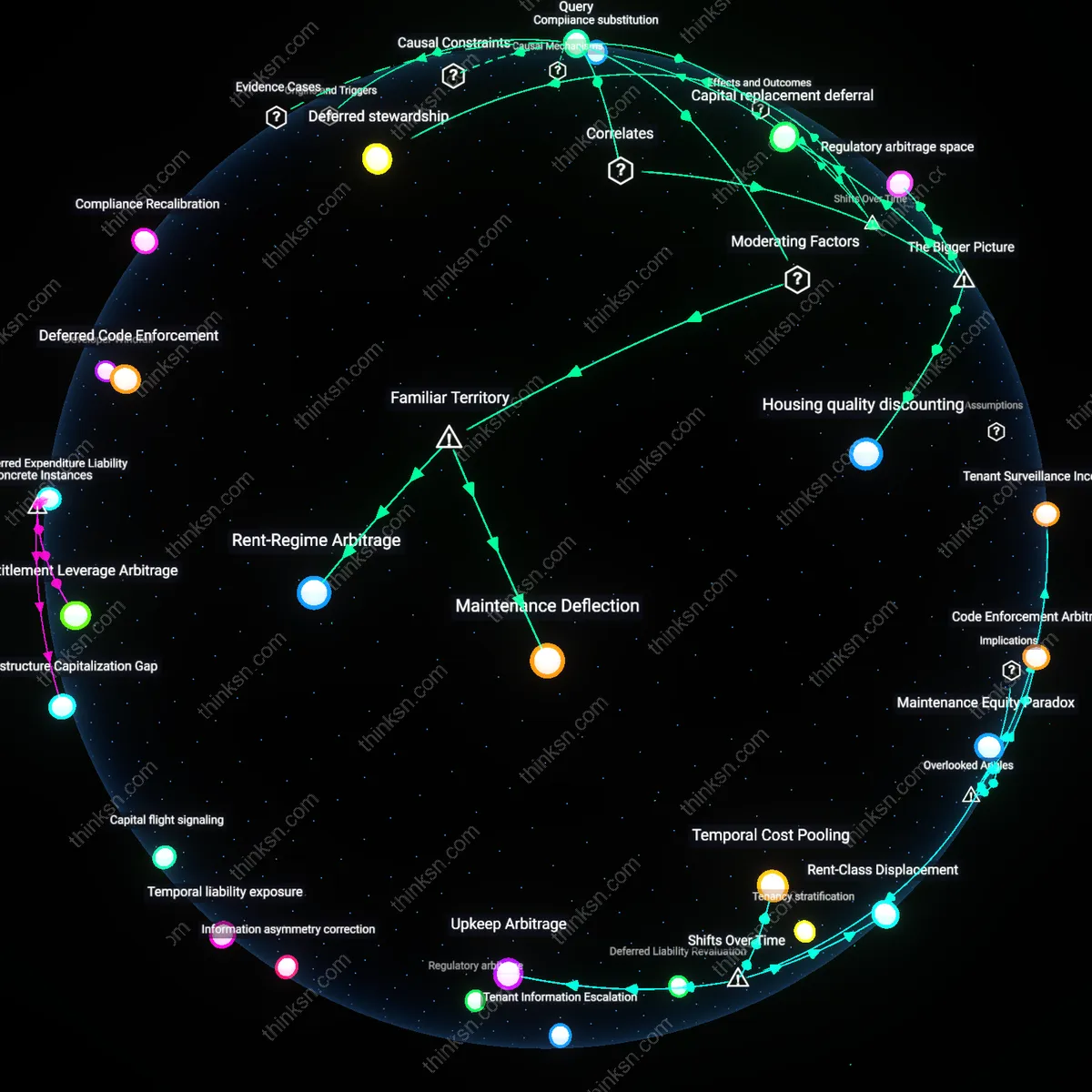
Analysis reveals 5 key thematic connections.
Key Findings
Settlement momentum
It is rational for a renter to skip legal aid in a $500 security deposit dispute when the landlord tends to settle quickly because the landlord's prior pattern of rapid resolution signals low procedural friction, reducing the need for third-party mediation. Renters who bypass formal support in such contexts accelerate resolution by avoiding institutional lag—legal aid intake processes, appointment scheduling, and document review—which often take longer than the landlord’s informal payout cycle. This dynamic reveals that speed of response, not legal correctness or power asymmetry, governs outcomes in micro-disputes with habitually compliant landlords, a factor typically ignored in access-to-justice models that assume delay equates to resistance. The overlooked mechanism here is not fear or knowledge, but the kinetic advantage of operating outside legal infrastructure when counterparty behavior is predictably elastic.
Reciprocity bandwidth
Skipping legal aid in small-dollar disputes preserves a renter’s capacity for future informal negotiation with property managers who operate across multiple units and time periods, because initiating formal proceedings—even if dropped later—can reduce a tenant’s perceived cooperativeness in the landlord’s mental accounting system. Landlords who settle quickly often do so not out of legal obligation but to maintain operational harmony, and renters who avoid escalating minor issues are more likely to receive favorable treatment in future requests, such as lease renewals or maintenance response time. This reveals a hidden social economy in rental ecosystems where reputation continuity matters more than one-off gains, a dimension absent in rational choice models that treat disputes as isolated transactions. The non-obvious insight is that rationality includes long-term relational positioning, not just short-term cost-benefit analysis.
Systemic throughput pressure
A renter’s choice to forgo legal aid in minor disputes can sustain the functionality of overburdened public legal systems by preventing caseload saturation that delays higher-stakes interventions, such as eviction defense or disability accommodation claims. Legal service providers in urban areas like Chicago or Brooklyn often triage based on harm severity, and $500 deposit cases consume disproportionate staff time relative to impact; when renters with viable but small claims self-filter out, it increases system-wide capacity to handle life-impacting cases. This shifts rationality from a purely individual calculation to one embedded in collective legal infrastructure resilience—an angle missing from tenant advisories that uniformly encourage claiming all entitled resources. The overlooked dependency is that individual ‘rationality’ in low-stakes disputes must account for its load on shared justice mechanisms, treating legal aid as a common-pool resource.
Precedent Shadow
Opting out of legal aid risks creating an invisible precedent shadow, where unchallenged landlord behavior in small-dollar disputes migrates into larger eviction patterns across jurisdictions like Harris County or Maricopa County. Because courts track case resolution but not norm degradation, each unlitigated $500 forfeiture subtly recalibrates what landlords perceive as socially enforceable, shifting baseline expectations of accountability downward. This mechanism operates through pattern recognition in property management networks, not formal rulings—making the absence of legal challenge a quiet catalyst for systemic drift toward weaker tenant protections.
Compliance Mirage
Relying on a landlord’s history of quick settlement creates a compliance mirage, where apparent cooperation masks structural non-compliance hidden in plain sight—property managers in high-turnover complexes often return deposits only under visible threat of action, not out of adherence to law. This facade operates through decentralized leasing offices that share informal playbooks, allowing corporate owners to benefit from uniform underpayment while insulating themselves from liability. The counterintuitive result is that higher settlement rates become evidence not of fairness, but of calculated risk management designed to avoid judicial scrutiny altogether.