Filial Duty vs Elder Care Costs for Asian-American Families?
Analysis reveals 5 key thematic connections.
Key Findings
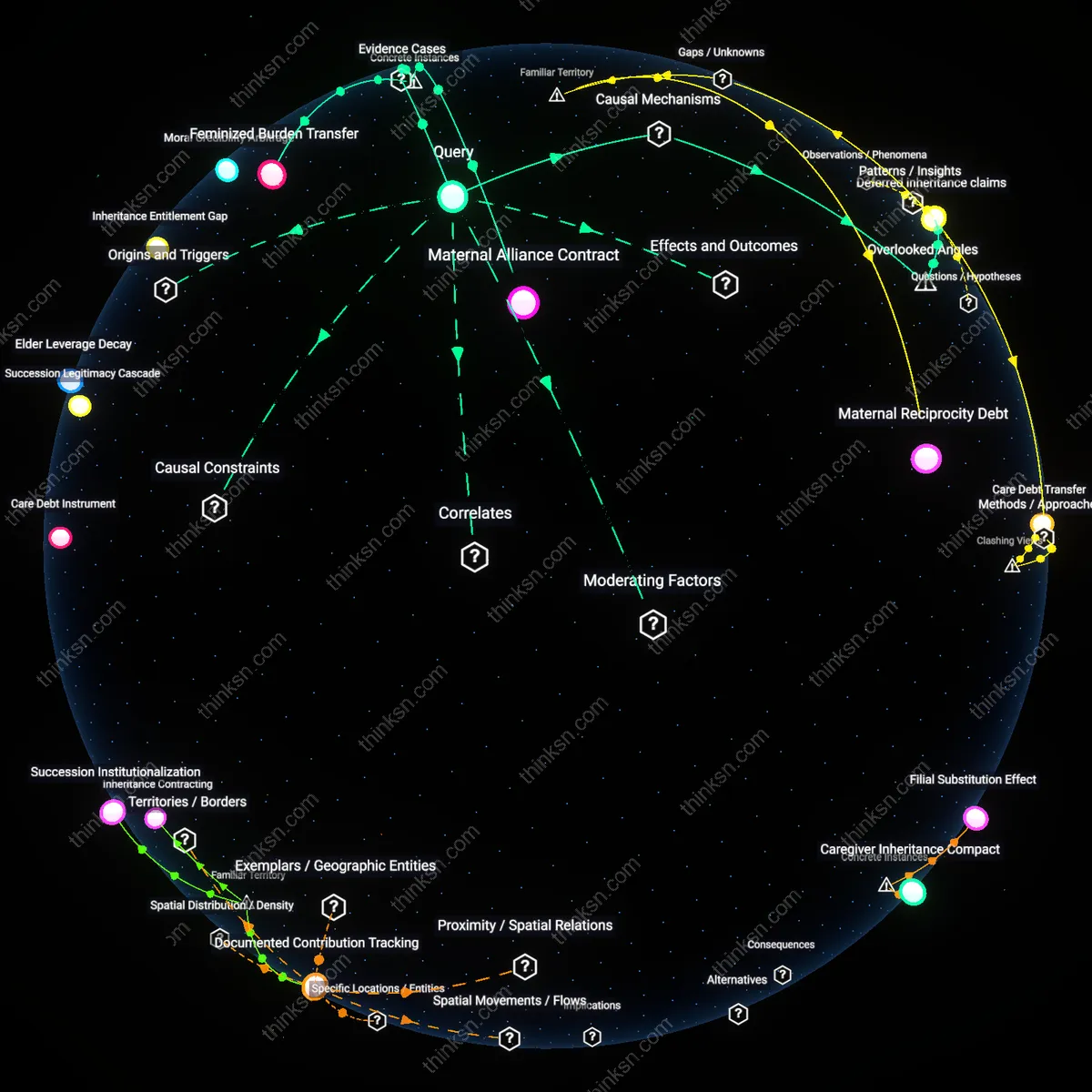
Intergenerational shame debt
Cultural expectations of filial duty compel first-generation Asian-American elders to suppress care needs to avoid burdening adult children, thereby preserving familial honor. This self-silencing is sustained through an unspoken economy of shame—where elders internalize the moral weight of failing ancestral obligations—leading to delayed institutional care transitions even when families lack capacity. Unlike Western models that foreground elder autonomy or caregiver stress, this dynamic centers the elder’s active concealment of decline as a form of moral maintenance, a mechanism rarely captured in clinical assessments or policy design. The overlooked force here is not obligation itself but its internalization by the dependent, who sacrifice health to uphold the appearance of reciprocal duty.
Kinship script dissonance
First-generation Asian-American families navigate elder care by negotiating competing kinship scripts—Confucian-based hierarchies demanding intergenerational co-residence versus American norms of individualism and nuclear-family privacy—leading to spatial compromises like basement apartments or adjacent-home cohabitation. These arrangements allow symbolic adherence to filial visibility while preserving Western domestic boundaries, creating a hybridized care architecture that masks unresolved cultural tension. Standard analyses focus on values or outcomes, but miss how physical spatialization becomes a silent mediator of cultural conflict, where proximity is calibrated not for practical care but for ritualized performance of duty. This reveals care decisions as acts of spatial diplomacy, not mere logistical responses.
Generational Debt Trap
In Flushing, Queens, adult children of first-generation Chinese immigrants often delay homeownership and career advancement to co-reside with and financially support aging parents, driven by Confucian-aligned expectations that filial sacrifice ensures familial honor—this mechanism, institutionalized through informal family contracts and reinforced by community scrutiny, binds reproductive and economic futures to elder care compliance; the non-obvious outcome is not altruism but a binding intergenerational debt that limits upward mobility, revealing how cultural duty becomes a structural constraint on immigrant socioeconomic integration.
Medical Authority Displacement
At Seattle’s Harborview Medical Center, Vietnamese-American elders frequently reject hospice care recommended by physicians, insisting on aggressive treatment until death, because ceasing intervention is culturally interpreted as filial abandonment—family members override clinical guidance to fulfill performative care obligations, privileging symbolic presence over palliative logic; this dynamic reveals that biomedical decision-making is subordinated to ritualized duty, exposing how cultural expectations reposition families as moral arbiters of medical necessity, displacing professional authority in end-of-life contexts.
Gendered Burden Codification
In Los Angeles, second-born daughters in first-generation Korean families disproportionately assume full-time elder care despite lower inheritance shares, as elder care duty is assigned through patrilineal expectations that prioritize sons’ economic roles while assigning daughters moral responsibility for intimate caregiving—this division, upheld in family councils and reinforced by church-affiliated kinship networks, institutionalizes gender asymmetry under the guise of tradition, revealing that filial duty functions less as a universal ethic and more as a socially enforced labor code that reproduces patriarchal roles within diasporic enclaves.
Deeper Analysis
What do family members on both sides—elders and adult children—actually think about these living arrangements, and do they feel they’re truly meeting their responsibilities?
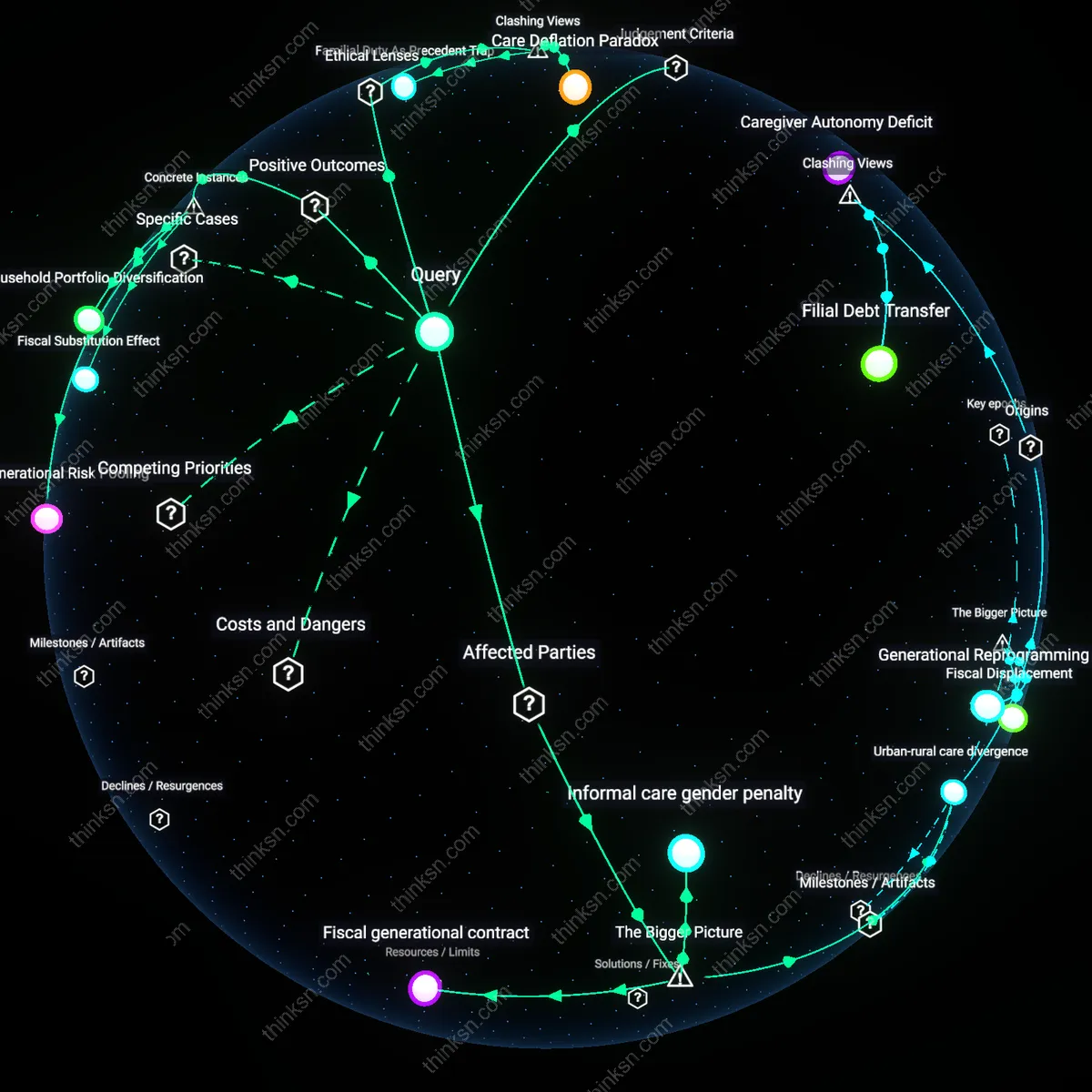
Filial debt enclosure
Conservative ideology in Japan normalizes intergenerational cohabitation as a moral fulfillment of familial duty, yet the 2017 reform of the long-term care insurance system exposed how structural pressures convert elder care into an enclosed obligation, where adult children—especially daughters-in-law—manage caregiving within the household not by choice but as a privatized response to state retrenchment; this reveals that perceived responsibility is less a reflection of personal commitment than a mechanism of social cost displacement, making invisible the gendered burden sustained under the guise of tradition.
Intergenerational reciprocity collapse
In post-2008 austerity Greece, Marxist analysis illuminates how capitalist crisis eroded adult children’s ability to uphold co-residence with elders not from lack of will but from material depletion—exemplified by the 2011 Piraeus household surveys showing elderly pensioners subsidizing unemployed adult offspring amid state withdrawal; this inversion of expected dependency flows disrupts the assumed moral economy of care, exposing a systemic collapse where responsibility becomes a bidirectional impossibility rather than a fulfilled obligation.
Autonomy-responsibility paradox
Liberal frameworks in Sweden promote individual autonomy and state-supported elder care, yet the 2016 Stockholm municipality’s 'Housing First for Seniors' initiative revealed that many elderly parents resisted institutional alternatives and chose cohabitation with adult children to preserve independence on their own terms, complicating the liberal ideal of self-determination; here, responsibility is redefined not as duty but as negotiated sovereignty, where elders actively shape living arrangements to avoid paternalistic systems while maintaining familial roles—demonstrating that autonomy and obligation can co-produce rather than contradict one another.
How has the role of second-born daughters in Korean-American families changed in elder care when the first-born son is unable or unwilling to fulfill his expected economic role?
Elder Care Substitution
Second-born daughters have assumed primary elder care responsibilities in Korean-American families when first-born sons fail to meet filial economic obligations due to a shift in transnational gender expectations since the 1990s. As immigrant families faced the instability of male breadwinner roles in the U.S. labor market—especially during the 2000s tech recession and 2008 job crisis—daughters' stable earnings in professional service sectors enabled them to mediate familial obligation through financial provision. This transition bypassed Confucian primogeniture norms not by rejecting them, but by reinterpreting filial duty as achievable through female economic agency, revealing how structural labor market shocks reconfigured kinship hierarchy from within.
Matrilineal Responsibility Transfer
Beginning in the mid-2000s, second-born daughters increasingly became default caregivers when first-born sons emigrated abroad or withdrew from family networks, a rupture enabled by digital surveillance and financial tracking technologies. Mobile banking apps and telehealth platforms allowed sisters to coordinate care across time zones, transforming geographic dispersion into an operational advantage. This shift reveals how technologically embedded kinship management replaced physical co-residence norms, making second-born daughters the institutional memory and logistical hub of elder care—unseating the primacy of birth order in favor of connective labor.
Filial Redefinition Crisis
Since the post-2010 rise in mental health discourse among second-generation Korean-Americans, emotional legibility has become a condition for receiving elder care authority, displacing the once-unquestioned economic primacy of first-born sons. When sons refused care, daughters leveraged their histories of emotional labor—documented in family group chats and memorialized during ancestral rites—to assert moral entitlement. This mechanism made affective continuity the new currency of legitimacy, exposing a generational rupture where ritual participation, not income, became the gatekeeper to familial recognition.
Filial infrastructure decay
Second-born daughters assume elder care when first-born sons fail to fulfill economic duties due to the erosion of intergenerational wealth transfer pathways in Korean-American families. This shift occurs not merely because sons are absent, but because remittances and co-residential housing—once sustained by stable ethnic enclave economies like dry cleaners or grocery stores—have collapsed under gentrification and rising housing costs in urban centers like Los Angeles’ Koreatown. As a result, daughters step in not out of cultural reorientation but material necessity, revealing how macroeconomic urban restructuring disables traditional filial mechanisms and redistributes care labor to women who are financially precarious themselves. The non-obvious insight is that daughter-based care is less a cultural adaptation than a symptom of structural failure in ethnic economic reproduction.
Gendered moral override
When first-born sons fail to meet filial economic expectations, second-born daughters take on elder care because Korean-American familial ethics deploy a silent moral hierarchy that prioritizes relational continuity over formal obligation. In this system, daughters—who are traditionally excluded from ancestral rituals and property inheritance—are paradoxically positioned as more 'morally available' for care because their contributions are seen as gratuitous rather than contractual. This moral economy, reinforced by church networks and immigrant mothers’ narratives, enables a legitimacy shift where daughters’ unpaid labor absorbs the systemic shortfall without altering patriarchal recognition structures. The underappreciated dynamic is that daughters’ care acts as a socially sanctioned moral override, allowing families to maintain the façade of filial piety even as its economic core fails.
Moral Redistribution
Second-born daughters in Korean-American families assume elder care leadership when first-born sons fail economically, triggering a reallocation of familial duty grounded in Confucian ethics. In working-class enclaves like Flushing, Queens, where immigrant parents rely on children for pension substitutes, daughters who were formerly excluded from primary caregiving now inherit both financial and emotional responsibility—reframing filial piety not as inherited by birth order but as earned through moral reliability. This shift reveals that Confucianism, often seen as rigid, is pragmatically recalibrated in diaspora when economic necessity overrides hierarchical norms, exposing a hidden calculus where ethical obligation is redistributed, not discarded.
Sister Substitution
When the first-born son shirks elder care in Korean-American families, second-born daughters are activated as structural backups within kinship networks, particularly in cases documented in multi-generational households in Los Angeles’ Koreatown. The mechanism operates through a gendered division of labor already familiar in traditional contexts—daughters-in-law or daughters handling domestic care—but now redirected toward biological daughters when sons fail, transforming them into de facto sons. This substitution is significant because it maintains the appearance of patriarchal continuity while quietly replacing its core agent, revealing how cultural scripts can preserve form even as they swap out the actors.
Reverse Inheritance
In Irvine, California, among upwardly mobile Korean-American professionals, second-born daughters increasingly fund and coordinate aging parents’ long-term care when elder brothers underperform, reversing the traditional flow where sons receive assets to support familial duties. This phenomenon leverages the daughters’ higher educational attainment and stable incomes, particularly in dual-income professional couples, to sustain parental well-being—effectively inverting the inheritance logic where care and capital now ascend from younger daughters to older parents, bypassing the eldest son entirely. The significance lies in how economic agency in women reshapes intergenerational contracts, turning expected dependence into silent authority.
How do adult children in first-generation Asian-American families really experience the expectation to care for elders when it feels less like a personal choice and more like something they're expected to handle quietly within the home?
Intergenerational debt
Adult children in first-generation Asian-American families experience elder care as a moral repayment of familial investment rather than a voluntary duty, because their parents' migration and labor sacrifices are symbolically framed as non-repayable advances, absorbed into a child's identity through years of socialization. This creates a quiet compulsion to serve, not as a discrete decision but as a lived form of gratitude embedded in daily routines and emotional economies within immigrant households—often obscuring personal cost. The non-obvious force here is how upward mobility narratives, tied to Confucian-inflected models of filial hierarchy, convert parental suffering into a moral ledger that children inherit at birth, naturalizing lifelong obligations.
Quiet redistribution
Elder care in these families operates as an unrecognized domestic infrastructure that sustains the broader U.S. neoliberal economy by absorbing social welfare deficits through unpaid, privatized labor.“ Workers among adult children—often in high-pressure STEM or medical fields—subsidize national cost-saving policies by housing, managing, and funding parental healthcare outside institutional channels. The crucial mechanism is the federal underfunding of elder services, which becomes outsourced to familial networks enabled by cultural expectations; this reveals how ethnic-specific norms become functionally exploited in systemic gaps, normalizing sacrifice as community-specific virtue rather than political condition.
Filial Debt Extraction
The U.S. tech industry’s reliance on H-1B visa holders from India enables corporate actors to indirectly benefit from the cultural obligation of adult children to care for elders, as seen in the overlooked burnout among Indian-origin software engineers at Silicon Valley firms like Infosys and Tata Consultancy Services, where managerial staff habitually assign prolonged overtime and overseas relocations knowing that workers cannot refuse due to familial duty, revealing a systemic corporate logic that treats filial responsibility as a form of invisible labor subsidy. This mechanism operates through the intersection of immigration policy, caste-based family hierarchies, and project-based contracting, making elder care an unspoken precondition of employability rather than a personal choice—what appears as cultural tradition in the household becomes, in this context, an exploited structural dependency within global labor arbitrage.
Silent Citizenship
The Los Angeles County Department of Health Services, in its 2015–2020 outreach to elderly Korean immigrants in Koreatown, documented that adult children consistently declined institutional elder care referrals not due to explicit family pressure but because accessing public services required forms and assessments that would expose home caregiving conditions to scrutiny—thereby risking stigma or immigration-related inquiries, revealing a bureaucratic logic where the state, by designing services with mandatory disclosure, turns filial compliance into a mode of risk avoidance. This dynamic functions through the entanglement of public benefit eligibility, limited English proficiency, and intergenerational immigration vulnerabilities, illustrating how government actors unintentionally reinforce quiet, privatized caregiving by making visibility the price of support.
Cultural Equity Borrowing
When AARP launched its 2021 'Family Caregiving Across Cultures' campaign featuring prominent Chinese-American families in suburban San Diego, it framed Confucian values as a natural asset for national elder care resilience, thereby leveraging the unspoken burden of adult children as a cultural resource to deflect pressure for expanded public care infrastructure, a strategy that aligns with neoliberal policy actors who instrumentalize ethnic minority practices to justify state disengagement. This operates through public-private partnerships that rebrand obligation as virtue, using authentic community narratives to mask systemic underfunding—what appears as cultural celebration functions, in this instance, as a subtle deflection of state responsibility by naturalizing Asian-American caregiving as self-sustaining.
Explore further:
- When the daily acts of care become the only way a child can express gratitude, how do we see people breaking down — and what does that cost the family in the long run?
- Where are the pockets of elderly Korean immigrants in Los Angeles who rely on private family caregiving because they avoid public programs?
What happens to elder care when the second-born daughter can no longer manage the emotional and logistical load of coordinating across time zones?
Care Deficit Cascade
The collapse of elder care occurs not from individual failure but from the rupture of transnational kinship networks that rely on unstated expectations of filial labor, where the second-born daughter’s withdrawal exposes a systemic dependency on emotionally unsustainable, gendered roles within diasporic families. Migration patterns have fragmented extended kin networks across North America, Europe, and Asia, leaving care coordination to fall disproportionately on specific female relatives who are expected to bridge time zones, translate medical decisions, and manage digital communication—often without financial compensation or institutional support. When that node fails, the entire structure collapses not because of personal inadequacy, but because no redundancies were built into the moral economy of family obligation, revealing that the 'resilience' of transnational elder care is a myth sustained by invisible female labor.
Temporal Colonialism
Elder care fails when time zones are treated as logistical hurdles rather than forms of power asymmetry that naturalize the consumption of one person’s temporal availability by others in more privileged zones. The second-born daughter, often located in a Global South country or a different work-time culture, becomes a de facto night-shift coordinator—attending virtual doctor appointments at 3 a.m., responding to siblings in Toronto or London during her workday—her labor made possible only by her relative temporal disposability. This arrangement mirrors colonial temporal hierarchies, where care rhythms in the Global North dictate the schedules of caregivers in more flexible or under-resourced contexts, redefining availability as a moral virtue rather than structural coercion. The crisis arises not from exhaustion alone, but from the unacknowledged violence of synchronous expectation across asynchronous lives.
Digital Kinship Debt
The failure manifests when the accumulated cost of maintaining familial bonds through intermittent digital contact—group chats, birthday calls, shared cloud albums—comes due in moments of crisis, revealing that emotional proximity had been mistaken for operational capacity. The second-born daughter, celebrated for her 'closeness' to aging parents through curated online presence, is suddenly called upon to manage hospital transfers, power of attorney, and sibling consensus—tasks that require not sentiment but legal literacy, organizational stamina, and time capital she never agreed to provide. The illusion of connection fostered by platforms like WhatsApp or WeChat masks the absence of formal delegation, leaving care coordination to default to whoever appears most responsive, thereby punishing affective visibility with real-world responsibility.
Where are these second-born daughters living compared to their parents, and how does that shape how care gets provided?
Urban Proximity Gap
Second-born daughters in mainland China are more likely to reside in tier-1 cities while their parents remain in rural provinces or smaller urban centers, a spatial divergence that intensified after the 2000s due to post-reform labor migration and selective urbanization. State-led hukou restrictions limited rural-to-urban settlement rights, pushing daughters—especially those without primogeniture inheritance expectations—to seek service-sector work in cities like Guangzhou or Chengdu, physically distancing them from aging parents in Anhui or Henan. This geographic split reconfigured elder care from co-residence to remittance-based support, revealing how gendered migration patterns under economic liberalization produced an invisible infrastructure of filial duty mediated by distance and digital transfer systems rather than physical presence.
Suburban Care Reversal
In post-1990s Southern California, second-born daughters increasingly live in outer suburbs like Ontario or Murrieta while their parents age in original working-class neighborhoods of East LA or Long Beach, reversing the mid-century expectation of multi-generational urban cohabitation. As housing costs escalated and daughter-led families prioritized school districts over proximity, care shifted from daily in-person assistance to scheduled visits and managed service contracting through informal Filipino home health aides or Korean-run senior transport networks. This inversion—where daughters became geographically upstream from parents in the metropolitan hierarchy—transformed care into a logistically coordinated, time-bound exchange, exposing how suburbanization fragmented kin-based care into episodic, middle-class performance.
Transnational Care Drain
Second-born daughters from Filipino provincial families now predominantly live in metropolitan hubs abroad—particularly Toronto, Dubai, or San Diego—after securing overseas nursing or teaching contracts post-2005, leaving parents in provinces like Iloilo or Cebu reliant on remittance economies and eldest siblings. State labor export policies and gendered recruitment in care sectors created a deliberate outflow of female workers, positioning second-born daughters (often educationally prioritized after first sons) as primary foreign earners while disembedding them from local care networks. This engineered spatial separation institutionalized a care model where emotional and financial sustenance flows across borders, but physical care is deferred or substituted, revealing how national development strategies have outsourced intimate labor to diasporic daughters.
Proximity Obligation
Second-born daughters typically reside within the same municipal boundaries as their aging parents, especially in suburban or rural municipalities where generational co-residence or near-neighborhood living is normalized. This geographic continuity enables daily physical access, which municipal zoning—by tacitly supporting single-family generational clustering—further entrenches as a default care infrastructure. The non-obvious insight is that their care role is less a personal choice and more a spatial inevitability, sustained by municipal land-use policies that discourage dense elder housing alternatives.
Jurisdictional Care Gap
When second-born daughters live across state or provincial borders from their parents—common in federal systems like the U.S. or Canada—care becomes fragmented at jurisdictional edges, where health insurance, home care eligibility, and elder protection services are non-transferable. This misalignment forces daughters to navigate discontinuous entitlements, turning border proximity into an active barrier rather than a neutral line. What feels like a private logistical challenge is in fact structured by political boundaries that treat caregiving as a local, not national, responsibility.
Urban Refuge
Many second-born daughters relocate to major cities outside their parents’ regional zones, especially when rural or peripheral regions lack economic mobility, using urban limits as a de facto escape from expected familial duty. City borders thus function as thresholds of anonymity, where reduced social surveillance weakens normative pressure to provide hands-on care. The underappreciated dynamic is that urban jurisdictional density doesn’t just enable career advancement—it systematically disrupts the geographic enforcement of kinship roles.
Transgenerational Housing Debt
Second-born daughters in Seoul, South Korea are more likely than first-born siblings to reside in semi-basement dwellings (banjiha) near their parents’ aging rental units due to downpayment exclusion from familial asset distribution, which repositions them as de facto in-home geriatric aides without formal caregiving compensation. This spatial entrapment—rooted in Confucian primogeniture finance systems that prioritize first-born sons or daughters for property inheritance—creates a hidden infra-economy of care where proximity is not chosen but economically enforced, making care provision a byproduct of housing precarity rather than filial intent. Most analyses focus on cultural norms driving care, yet miss how property conveyance mechanisms structurally assign second-born daughters to live-in caregiver roles under the guise of kinship cohabitation. The overlooked driver is the interaction between micronational inheritance customs and urban housing stratification, which converts birth order into spatial and labor obligation.
Rural Care Arbitrage
In rural Yunnan Province, second-born Dai ethnic daughters often remain in ancestral villages while their parents migrate seasonally to urban industrial zones for work, reversing the typical care dependency model and positioning younger daughters as primary guardians of household stability and elder-return infrastructure. Due to outmigration patterns that favor older siblings for permanent city resettlement through factory employment networks, second-borns become the fulcrum of interstitial care—maintaining homes, managing ancestral rites, and coordinating medical logistics during parents’ intermittent returns—all without state recognition or support structures. Standard narratives assume youth migrate outward and elders stay behind, but here, care is sustained through cyclical abandonment and reintegration, with second-born daughters functioning as immobile anchors in fluid translocal families. The non-obvious dynamic is age-stratified mobility sorting within minority communities, where birth order dictates not just care burden but geographic fate.
Elder Remittance Feedback Loop
Second-born Filipino daughters in Dubai’s expatriate enclaves disproportionately fund elder care in provincial hometowns like Oas, Albay through fixed-income remittances while living in employer-bound dormitories, creating a spatial paradox where physical distance intensifies financial obligation and compresses decision-making authority into absent kin. The kafala labor system restricts residency autonomy, forcing care to be administered remotely via mobile banking and kinship proxies—often elder siblings—who control disbursements and override medical choices, thus rendering second-born daughters fiscal caretakers but operational outsiders. Most assessments treat remittances as evidence of distributed care, yet obscure how labor migration regimes and birth-order-based responsibility norms jointly produce financially central yet geographically excluded caregivers. The underappreciated condition is the way overseas employment channels by birth order generate a hierarchy of moral obligation that persists regardless of physical presence, reshaping care as a financial circuit rather than a spatial one.