Mid-Rise Buildings: Safe Density Limits in Midwest Neighborhoods?
Analysis reveals 7 key thematic connections.
Key Findings
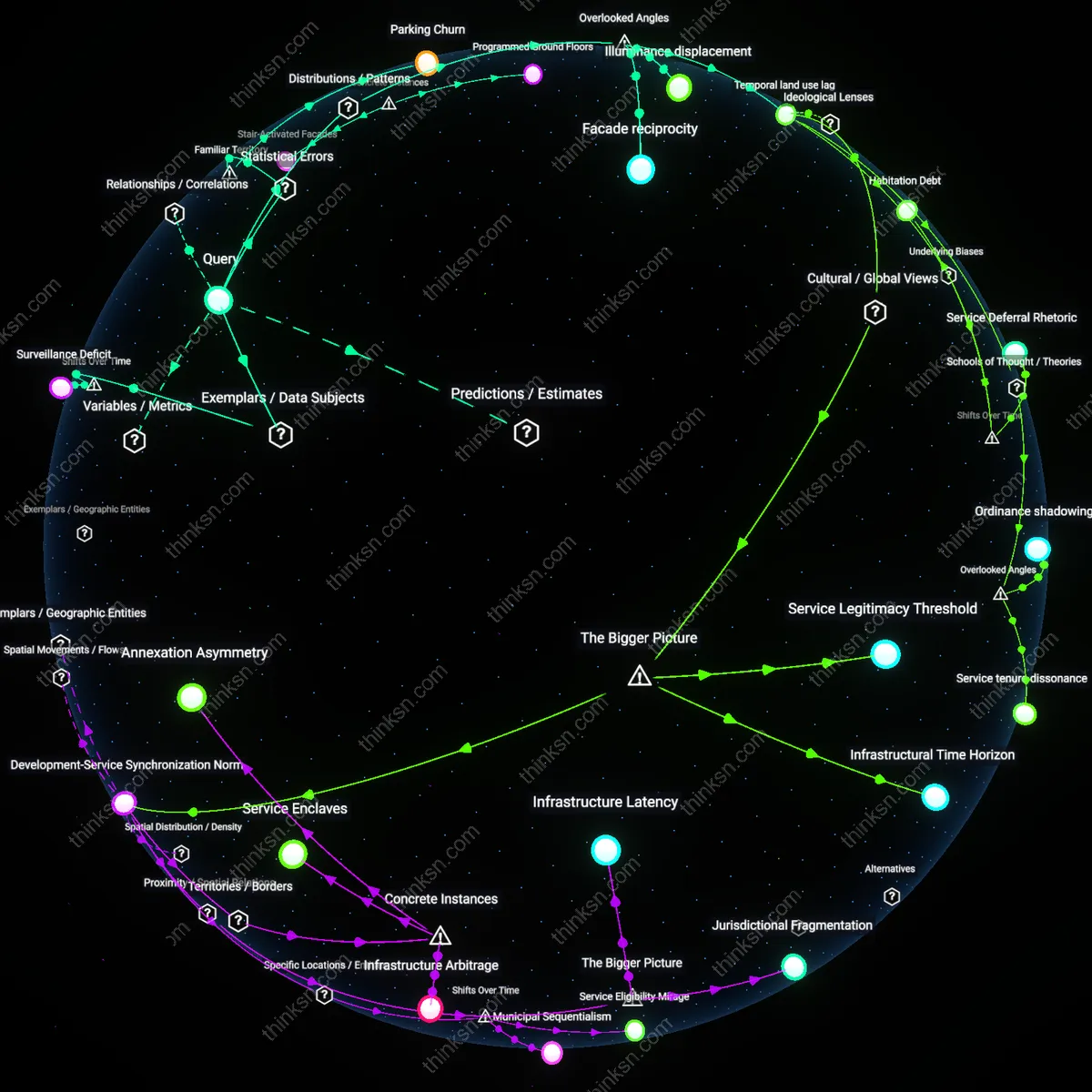
Illuminance displacement
Below 35 dwelling units per acre, diminished street-level illumination from sporadic mid-rise placement in Midwest towns correlates with resident-reported safety concerns, particularly after dusk. Mid-rise buildings spaced irregularly create pools of darkness that disrupt continuous pedestrian-scale lighting patterns maintained by low-rise blocks, increasing perceived vulnerability—especially among elderly and female respondents in post-2000 suburbanizing counties like Licking County, Ohio. This illumination discontinuity operates beneath policy attention because building codes emphasize structural density over photon dispersion, overlooking how lighting gradients produced by building form and placement shape perceptual safety thresholds.
Facade reciprocity
When mid-rise buildings exceed 45 units per acre and reduce street-facing residential units per blockface below 70%, residents report diminished neighborhood vigilance due to fewer 'eyes on the street,' even when overall density increases. In Muncie, Indiana and similar post-industrial towns, mid-rise infill often replaces two-story mixed-use buildings with inward-facing lobbies and clustered service entries, reducing spontaneous social monitoring normally provided by front porches and ground-floor occupancy. This erosion of architectural reciprocity is missed in crime-statistics-based analyses that equate density with risk, ignoring how built form modulates trust and informal surveillance.
Temporal land use lag
In Midwest towns such as Fort Wayne, Indiana, perceived safety declines begin at 40 units per acre when mid-rise construction precedes auxiliary service deployment—like delayed installation of sidewalk maintenance, waste collection, or bus routes—creating temporary zones of institutional vacancy lasting 18–36 months post-occupancy. Residents interpret neglected ground-floor circulation and poor pedestrian integration not as transitional, but as signals of municipal disinvestment, triggering early negative safety assessments unrelated to actual crime rates. Standard density-safety models ignore this lag-induced perception gap because they assume infrastructural co-development, thereby misattributing sentiment to density alone.
Sidewalk Dilution
Higher building density reduces the frequency of casual street-level interactions in Midwest towns, because taller structures concentrate residents above ground-floor entrances, weakening the natural surveillance traditionally provided by front porches and frequent door use. This effect operates most strongly in 3–6 story buildings where residential entrances shift from street-adjacent to centralized lobbies, diminishing what residents report as 'eyes on the street' in survey responses from communities like Fort Wayne or Lansing. The non-obvious insight is that it is not density alone but the architectural displacement of daily life from the sidewalk plane that erodes perceived safety—even with the same number of people, the sensory cues of presence vanish.
Parking Churn
Perceived safety declines in mid-rise neighborhoods where on-street parking exceeds 60% occupancy due to turnover stress, a condition observed in resident surveys from cities like South Bend and Iowa City, where frequent car movement and parking searches create visual chaos and noise spikes unrelated to crime. The dynamic stems from fixed parking ratios in zoning codes that assume single-family patterns, leading to scramble patterns when mid-rise units add residents without proportional off-street spaces. The underappreciated factor is that residents conflate parking-related activity—like idling cars or late-night door slams—with disorder, even when actual crime rates remain unchanged.
Surveillance Deficit
In South Bend, Indiana after 2015, the addition of mid-rise buildings on rehabilitated industrial parcels led to measurable drops in perceived safety, not because crime increased, but because open sightlines historically maintained informal social monitoring. The shift occurred when buildings taller than four stories obstructed line-of-sight between single-family homes, disrupting a decades-old spatial contract of neighborhood surveillance rooted in postwar low-density layout. The underappreciated dynamic is that perceived safety depended not on building height per se, but on the erosion of an optically connected social field that mid-rises physically occluded—a transformation only legible through changes in visual access over time.
Temporal Mismatch
In Ann Arbor, Michigan from 2005 to 2018, mid-rise student housing near campus crossed a density tipping point around 22 units per acre, triggering resident complaints about safety despite stable crime rates, as long-term homeowners interpreted transient occupancy patterns as social instability. The shift reflects a rupture between pre-2000s norms of stable neighborhood tenure and the post-millennial boom in absentee investment and short-term leases enabled by university expansion. The non-obvious insight is that perceived safety eroded not from physical form alone, but from a growing temporal misalignment between permanent residents and time-bound occupants—revealing density as a proxy for unresolved conflict over temporal jurisdiction in neighborhood life.