Sacred Lease Cycles
Tenant collectives in Hindu-majority cities like Varanasi coordinate rent resistance around lunar religious calendars, not fiscal quarters, because temple festival schedules determine when cash flows peak in informal economies. This ties rent payment capacity to cyclical religious expenditures, making collective delays in rent a form of ritualized economic negotiation rather than mere default—aligning financial action with cosmic time, an overlooked mechanism where religious temporal sovereignty supersedes state or market timelines, shifting the very meaning of 'timeliness' in housing contracts.
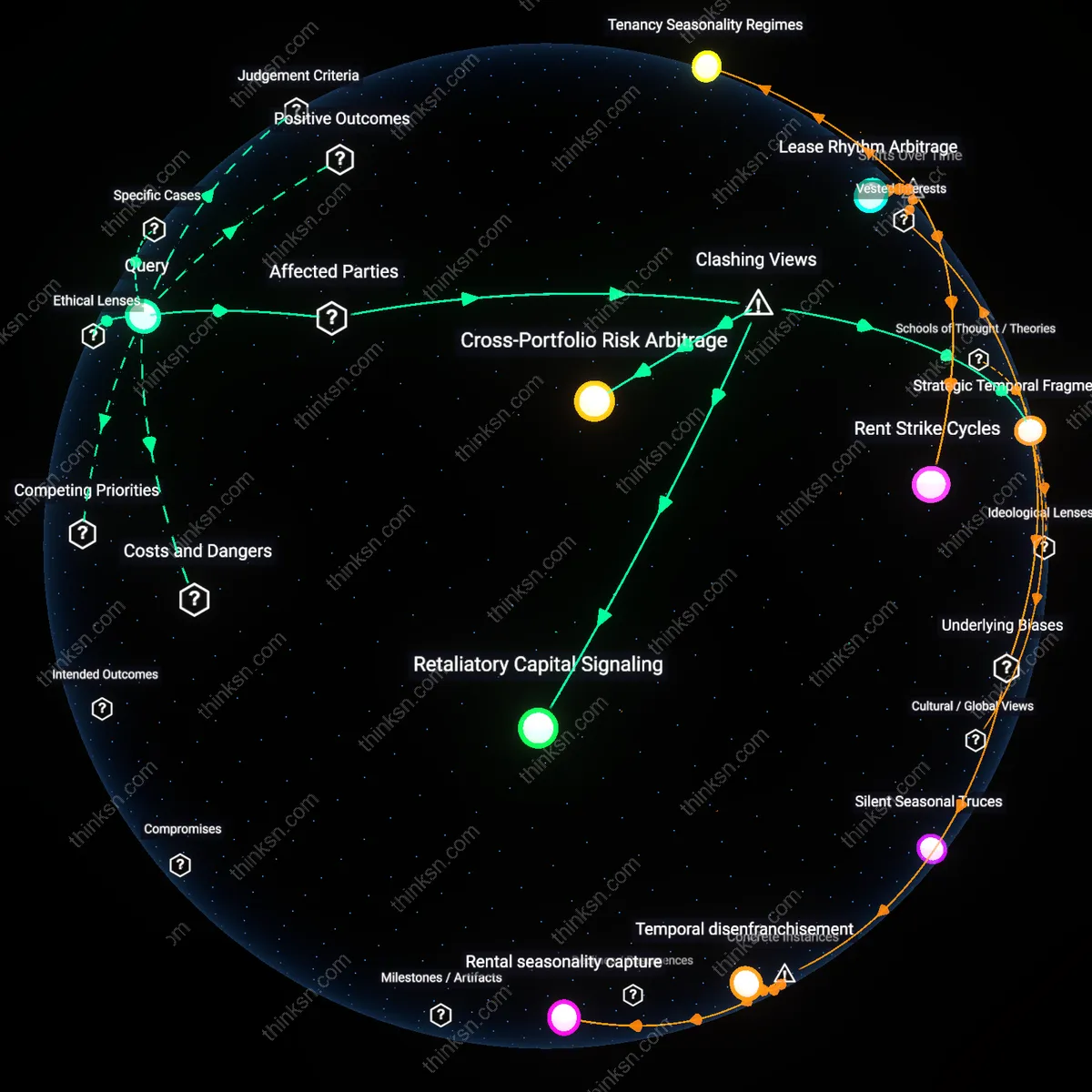
Silent Seasonal Truces
In Morocco’s medinas, winter rental disputes are informally deferred due to familial obligations around communal heating in shared riads, where landlords and tenants often descend from the same lineage or tribe—creating unspoken moratoriums on eviction during cold months. This seasonal suspension of rent enforcement, rooted in kinship-based urban living patterns rather than legal code, reveals a hidden social calendar that governs housing conflict, where collective action is not absent but deliberately timed to warmer months, contradicting Western models that assume rent conflict follows economic triggers alone.
Shadow Rhythm Bargaining
In Jakarta’s kampungs, tenants leverage the irregularity of informal rent renewals—often aligned with monsoon flooding patterns that disrupt landowners’ access—to synchronize community demands for infrastructure upgrades only after seasonal isolation cuts off surveillance. This ecological disruption of landlord presence enables collective negotiation during gaps in formal oversight, exposing a non-economic rhythm where environmental unpredictability, not protest timing, creates the political space for action—overturning assumptions that tenant power grows from organization strength alone.
Temporal disenfranchisement
Tenants in Washington, D.C., experience delayed collective action because rent control renewals are tied to infrequent legislative cycles, which dilutes urgent renter responses into isolated lobbying efforts rather than sustained mobilization. The Mayor’s annual budget process includes housing, but tenant coalitions like TROA (Tenant Rights Office Advocates) must align demands with fiscal calendars set by city council timelines, fragmenting grassroots energy into episodic engagement. This reveals how institutional timing can absorb resistance into bureaucratic rhythm, benefiting developers who gain predictability in regulatory stability, while renters lose momentum between renewal windows.
Rhythm arbitrage
In Berlin, tenant initiatives like Mieter*innengemeinschaft leveraged the city’s annual advisory referendum cycle to force binding referendums on rent freezes, synchronizing direct action with municipal electoral calendars to amplify pressure. By aligning mass rent strikes with the 2021 ‘Deutsche Wohnen & Co. enteignen’ referendum, tenants turned lapsed legal windows into political spectacle, converting temporal misalignment into strategic advantage. This demonstrates how marginalized groups can exploit gaps between legislative inertia and public outrage, revealing that rhythm is not just imposed but can be instrumentally repurposed by organized tenants.
Rental seasonality capture
In tourist-dense areas of Barcelona, short-term rental platforms like Airbnb have imposed a de facto biannual rent rhythm—peaking before summer and winter seasons—disrupting traditional annual lease cycles and fragmenting tenant coordination across transient housing markets. Organizations such as Plataforma de Afectados por la Hipoteca (PAH) find that migrant and informal workers, often excluded from long-term leases, cannot synchronize advocacy with fixed institutional timelines, enabling property managers to exploit seasonal turnover. This exposes how financialized housing rhythms preempt collective time, privileging liquidity for owners while eroding continuity among tenants.
Rent Strike Cycles
Landlords in post-industrial U.S. cities strategically timed rent increases to coincide with weakened tenant organizing after federal housing policy shifted in the 1980s, redirecting collective action toward emergency response rather than long-term planning. As federal rent control incentives faded and municipal governments deprioritized tenant protections, corporate property managers exploited the resulting asynchrony in lease expiration—intentionally staggering renewals since the 1990s—thereby fragmenting tenants’ power and making coordinated strikes harder to sustain across entire buildings or neighborhoods. The non-obvious consequence of this shift was not just weakened solidarity but its periodic recreation, where tenant groups reformed cyclically only when critical mass of leases hit renewal simultaneously, creating predictable but irregular windows for action that investors learned to anticipate and suppress.
Lease Rhythm Arbitrage
In Berlin after reunification, investor-led housing corporations leveraged shifts from socialist-era tenancy models to market-based cycles by deliberately diversifying lease-end dates to disrupt continuity in tenant councils, thus preventing the re-emergence of pre-1989 style block-wide coordination. As privatization accelerated in the 2000s, firms like Vonovia used portfolio-level timing strategies—extending or shortening tenancy periods based on neighborhood appreciation trajectories—to decouple tenants’ temporal experience of rent pressure, ensuring that action remained isolated and episodic rather than cumulative. This temporal fragmentation revealed a new form of rent extraction not through immediate price hikes alone but through the deliberate destabilization of collective rhythm, a shift from overt displacement to the manipulation of time as a governance tool.
Tenancy Seasonality Regimes
Municipal housing authorities in Seoul transformed rent renewal into a calendarized instrument of control during the 2010s by aligning public rent adjustments with academic and fiscal years, thereby assimilating tenant resistance into predictable annual cycles that could be monitored and preempted. As gentrification pressures mounted, grassroots collectives initially responded to these state-structured timelines, but over time the state’s imposition of a standardized rhythm collapsed diverse tenant experiences into seasonal bursts of activity—peaking every March—erasing longer-term insurgency potential and reshaping the very idea of collective action as a periodic event rather than a sustained movement. The historical shift from ad hoc mobilization to institutionalized recurrence created a new temporality in tenant politics, where resistance is not suppressed directly but absorbed into a bureaucratized timetable that defines its limits in advance.