When Internet Access as a Human Right Leads to Government Censorship
Analysis reveals 6 key thematic connections.
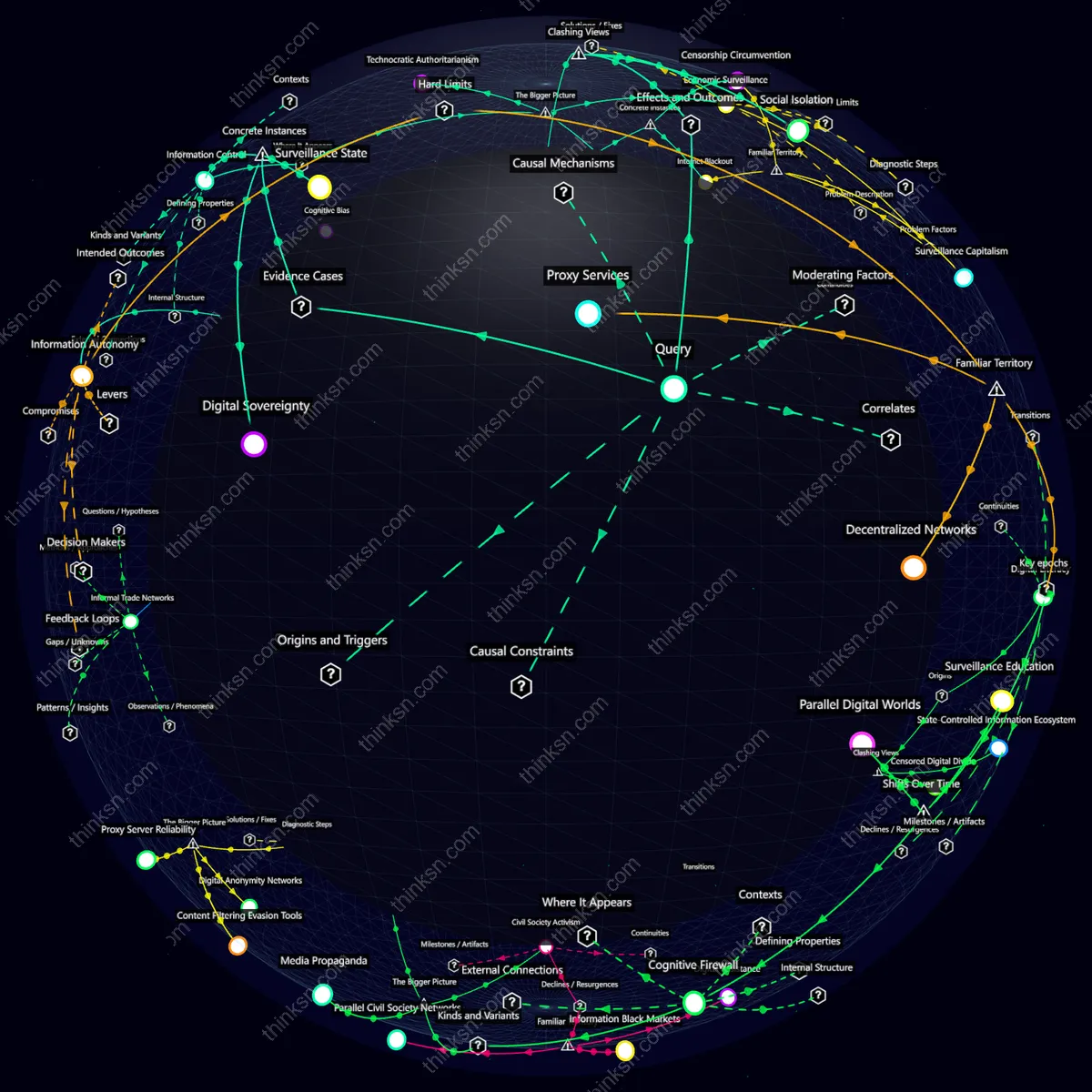
Key Findings
Digital Divide
Government-enforced internet access with heavy censorship deepens the digital divide by creating a stratified online environment where only state-approved information is accessible, marginalizing dissidents and independent thinkers who seek unfiltered content. This exacerbates social inequality as the less privileged rely on state-sanctioned narratives, limiting their opportunities for education and economic advancement.
Economic Surveillance
Censorship-heavy internet access allows governments to monitor citizens' online activities extensively, leading to a chilling effect on entrepreneurship and innovation. Startups and small businesses may hesitate to engage in risky discussions or develop products that challenge the status quo, fearing economic retaliation from authorities, thus stifling the growth of new industries and technologies.
Social Isolation
While internet access might increase connectivity technically, heavy censorship can lead to profound social isolation as individuals retreat into echo chambers filled with state-approved content. This isolation not only affects personal relationships but also hinders the formation of diverse communities and networks that are crucial for societal resilience and collective problem-solving.
Digital Sovereignty
In China, digital sovereignty underpins internet access as a basic right with heavy censorship. This framework reshapes global tech standards and restricts international data flows, creating risks for local businesses dependent on global supply chains.
Surveillance State
Singapore’s Smart Nation initiative, while less overtly censorial than China's Great Firewall, integrates pervasive surveillance with basic internet access rights. This creates a delicate balance between security and individual privacy, where the trade-off is strict government control over digital behavior.
Information Control
In North Korea, universal internet access under heavy censorship serves as a tool for ideological indoctrination and information control, fundamentally altering societal norms and behaviors to align with state ideology. This exemplifies the extreme end of using technology for systemic oppression.
Deeper Analysis
What are the potential economic surveillance implications and measurable systemic strains if internet access is mandated as a government-enforced basic right with extensive censorship?
Digital Divide
Mandating internet access as a basic right could deepen the digital divide by overwhelming existing infrastructure. Wealthier regions may receive better service, while poorer areas struggle with inadequate resources and maintenance, exacerbating economic inequality.
Surveillance Capitalism
Extensive government censorship alongside mandated internet access can create a paradox where private companies exploit surveillance to maximize profits, undermining state control. This could lead to an unregulated shadow market of data brokers, further complicating economic surveillance efforts and privacy concerns.
Censorship Circumvention
The enforcement of internet access with extensive censorship may paradoxically drive the development of sophisticated circumvention tools by tech-savvy users. This arms race can strain government resources while enabling black markets for these technologies, creating systemic risks to national security and economic stability.
What are the structural components and relationships involved in a government's implementation of information control through internet access as a basic right with heavy censorship?
Cultural Homogenization
In China, heavy internet censorship has led to a cultural homogenization where dissenting voices and alternative viewpoints are suppressed. This creates an echo chamber effect, reinforcing state-approved narratives while stifling diverse perspectives and grassroots movements.
Economic Surveillance
The Chinese government's use of information control extends beyond propaganda to economic surveillance through platforms like WeChat. Businesses and individuals are monitored for compliance with regulations, leading to a chilling effect on entrepreneurship and innovation due to the high risk of falling afoul of opaque censorship rules.
Technocratic Authoritarianism
In countries implementing information control systems, such as Singapore or Russia, technocratic authoritarian regimes leverage advanced technologies for surveillance and censorship. This creates a fragile dependency on technology companies, making governments vulnerable to shifts in tech policy or the emergence of new communication platforms.
How might government-enforced internet access with heavy censorship exacerbate or mitigate the digital divide, and what emerging insights can we uncover about its impacts on society?
Internet Blackout
During a nationwide internet blackout in Myanmar following the military coup, citizens faced severe information asymmetry. Despite government-enforced access to state-controlled platforms, essential communication and coordination tools were unavailable, exacerbating the digital divide between those with alternative means of accessing the internet and those without.
Censorship Circumvention
In China, while heavy censorship limits access to foreign information sources for the general populace, a subset of tech-savvy users employs sophisticated tools like Virtual Private Networks (VPNs) to circumvent restrictions. This creates a two-tiered digital society where those with knowledge and resources can navigate around barriers, widening the gap between them and others who remain restricted.
Information Autonomy
Government-enforced internet access with heavy censorship undermines information autonomy by limiting citizens' exposure to diverse viewpoints and global knowledge networks. This can exacerbate the digital divide by creating a two-tiered system where those with alternative means of accessing uncensored information gain advantages in education, employment, and social mobility.
Economic Isolation
Heavy censorship may isolate domestic businesses from international markets and innovations due to restricted access to global communication networks. This economic isolation can disproportionately affect small and medium enterprises that lack the resources to circumvent censorship, thus widening the digital divide by reinforcing regional disparities in technology adoption and market reach.
Cognitive Bias
Long-term exposure to heavily censored internet access can lead to cognitive biases among users who are less aware of alternative narratives or scientific consensus. This narrowing of perspective may have long-lasting effects on civic engagement, critical thinking skills, and the ability to navigate complex global issues, thereby exacerbating societal divides rooted in differing levels of digital literacy and epistemic trust.
Explore further:
- What strategies can be formulated to preserve information autonomy when internet access is mandated as a basic right with heavy government censorship?
- What are the potential long-term economic impacts and hidden assumptions regarding economic isolation for countries that heavily censor internet access as a basic right?
What strategies can be formulated to preserve information autonomy when internet access is mandated as a basic right with heavy government censorship?
Decentralized Networks
Decentralized networks offer a critical shield against government censorship by distributing information across multiple nodes. However, reliance on such systems can expose users to new vulnerabilities like technical glitches or targeted cyber attacks that could disrupt the very autonomy they seek to preserve.
Proxy Services
Proxy services enable individuals to bypass internet restrictions and access blocked content, but their use often requires a leap of trust in foreign servers. Should these servers fail or be compromised by adversaries, users may find themselves exposed without clear recourse or understanding of the risks involved.
Digital Literacy
Enhancing digital literacy among citizens is crucial for navigating censored environments, but this empowerment can also draw heightened scrutiny from authorities who view informed populations as a threat. Thus, teaching digital skills must be balanced with caution to avoid attracting unwanted attention or triggering harsher regulations.
What are the potential long-term economic impacts and hidden assumptions regarding economic isolation for countries that heavily censor internet access as a basic right?
Digital Dependency
Economic Isolation fosters a digital dependency on state-controlled platforms, which can lead to information silos and reduced global connectivity. This creates a fragile ecosystem where economic activities heavily rely on government-mandated infrastructure, exposing businesses and individuals to significant risks if the system fails or is manipulated.
Informal Trade Networks
Countries that censor internet access often see an expansion of informal trade networks as citizens seek alternatives to state-regulated markets. This black market economy can undermine formal economic structures, leading to increased corruption and a lack of transparency in financial transactions.
Technological Stagnation
Economic Isolation hinders technological innovation by limiting access to international research communities and global supply chains. As a result, countries risk falling behind technologically, exacerbating their economic isolation and making it increasingly difficult to attract foreign investment or compete globally.
How does digital literacy evolve over time in a society where internet access is a government-enforced basic right with heavy censorship?
State-Controlled Information Ecosystem
In societies where internet access is mandated by the state with strict censorship, digital literacy evolves into a form of controlled navigation within an information ecosystem dictated by government policies. This environment transforms individuals from critical thinkers and creators into passive consumers of state-sanctioned content, undermining the broader goal of fostering independent thought and innovation.
Censored Digital Divide
The enforcement of internet access as a basic right under heavy censorship creates a unique digital divide. While everyone has physical access to the internet, marginalized groups who lack sophisticated methods to circumvent restrictions face further marginalization in terms of knowledge and opportunities, deepening social inequalities.
Surveillance-Driven Digital Literacy
In such regimes, digital literacy is co-opted by surveillance mechanisms. Users learn not only how to navigate the internet but also how to avoid detection and remain compliant with government monitoring systems. This adaptation shifts focus from empowering individuals through technology to ensuring their compliance with state mandates.
Surveillance Education
In a society where internet access is mandated yet heavily censored, surveillance education becomes mandatory for all citizens. This regime teaches how to navigate the digital landscape safely while subtly indoctrinating individuals into state-approved narratives and monitoring techniques. The risk lies in creating a generation dependent on government-filtered information, stifling independent thought and critical analysis.
Cognitive Firewall
As digital literacy evolves under strict surveillance policies, the concept of a 'cognitive firewall' emerges, where individuals develop mental barriers to filter out unwanted or dissenting information. This adaptation allows users to maintain a semblance of autonomy and privacy, but it also isolates them from global knowledge flows and reinforces ideological silos, potentially harming societal resilience.
Parallel Digital Worlds
With government censorship in place, an underground network of encrypted communication channels thrives. These 'parallel digital worlds' offer uncensored access to information and foster the development of alternative forms of digital literacy that prioritize privacy and anonymity over ease of use. While this empowers citizens seeking truth, it also fragments society into isolated echo chambers, complicating efforts towards unity and collective action.
Explore further:
- What are the measurable impacts on digital literacy and surveillance when internet access is mandated as a basic right with strict government censorship, and how do these factors stress-test the system's resilience against systemic failures?
- What is the structure and function of a cognitive firewall in the context of government-enforced internet access with heavy censorship?
What are the measurable impacts on digital literacy and surveillance when internet access is mandated as a basic right with strict government censorship, and how do these factors stress-test the system's resilience against systemic failures?
Digital Shadow
The imposition of strict government censorship creates a digital shadow where citizens' online activities are monitored and documented extensively. This surveillance-driven digital literacy fosters an environment where individuals become hyper-aware of their digital footprints, leading to self-censorship and altered behavior patterns that can undermine the authenticity and diversity of digital interactions.
Algorithmic Bias
In a mandated internet access regime with strict censorship, algorithmic bias becomes a significant issue as surveillance-driven digital literacy leads to tailored but potentially skewed content delivery. This can reinforce existing biases and limit exposure to diverse viewpoints, thereby weakening the resilience of societal discourse against misinformation and propaganda.
Underground Networks
The enforcement of strict government censorship alongside mandated internet access paradoxically spurs the growth of underground networks that bypass official surveillance. These networks thrive on encryption and anonymity tools, challenging the state's ability to monitor digital literacy effectively while also introducing new vulnerabilities such as cybercrime.
What is the structure and function of a cognitive firewall in the context of government-enforced internet access with heavy censorship?
Censorship Bypass Techniques
As governments enforce strict internet controls through cognitive firewalls, citizens increasingly rely on encrypted messaging apps and virtual private networks (VPNs) to circumvent censorship. However, this reliance introduces new risks such as increased surveillance by authorities and potential exposure to malicious actors.
Media Propaganda
In the presence of a cognitive firewall, state-controlled media exploit psychological mechanisms to shape public opinion through propaganda. This amplifies government narratives but erodes independent thinking and trust in information sources, making society more vulnerable to misinformation and disinformation.
Civil Society Activism
Activists develop sophisticated methods to challenge cognitive firewalls by creating decentralized networks and sharing encrypted data. These efforts highlight the resilience of human rights advocates but also attract severe legal repercussions and increased government crackdowns on dissenting voices.
Explore further:
- What are the effectiveness and potential drawbacks of censorship bypass techniques in a scenario where internet access is mandated as a basic right but heavily censored by government?
- How does civil society activism evolve in response to government-enforced internet access with heavy censorship over time?
What are the effectiveness and potential drawbacks of censorship bypass techniques in a scenario where internet access is mandated as a basic right but heavily censored by government?
Digital Anonymity Networks
The reliance on Digital Anonymity Networks can paradoxically empower surveillance states by centralizing user data through a few key nodes. This creates a 'honeypot effect' where governments target these networks to capture metadata and disrupt communications, undermining the intended privacy of users.
Content Filtering Evasion Tools
The proliferation of Content Filtering Evasion tools has led to an arms race with governments deploying increasingly sophisticated censorship measures. This dynamic often results in collateral damage to legitimate online activities and can inadvertently throttle access to essential services like healthcare or emergency information.
Proxy Server Reliability
The reliability of proxy servers as a bypass technique is highly dependent on the underlying infrastructure's resilience against state-sponsored cyberattacks. This fragility means that users often face sudden disruptions and must constantly adapt, leading to a cycle of dependency and vulnerability.
How does civil society activism evolve in response to government-enforced internet access with heavy censorship over time?
Digital Resistance
As governments enforce heavy internet censorship, digital resistance emerges as a critical arm of civil society activism. Activists shift from traditional street protests to covert online activities like encrypted messaging and circumvention tools, risking severe legal penalties while fostering resilient underground networks that challenge state control.
Information Black Markets
The rise of information black markets represents a dark yet essential evolution in civil society activism. Activists leverage these spaces to bypass censorship, sharing sensitive data and coordinating actions with minimal risk of detection, though the anonymity can also attract malicious actors or misinformation.
Parallel Civil Society Networks
In response to government-enforced internet restrictions, parallel civil society networks flourish offline. These include informal community meetings and underground publishing efforts, which thrive in periods of heavy censorship but are vulnerable to sudden crackdowns and may struggle to maintain relevance when online access is reestablished.