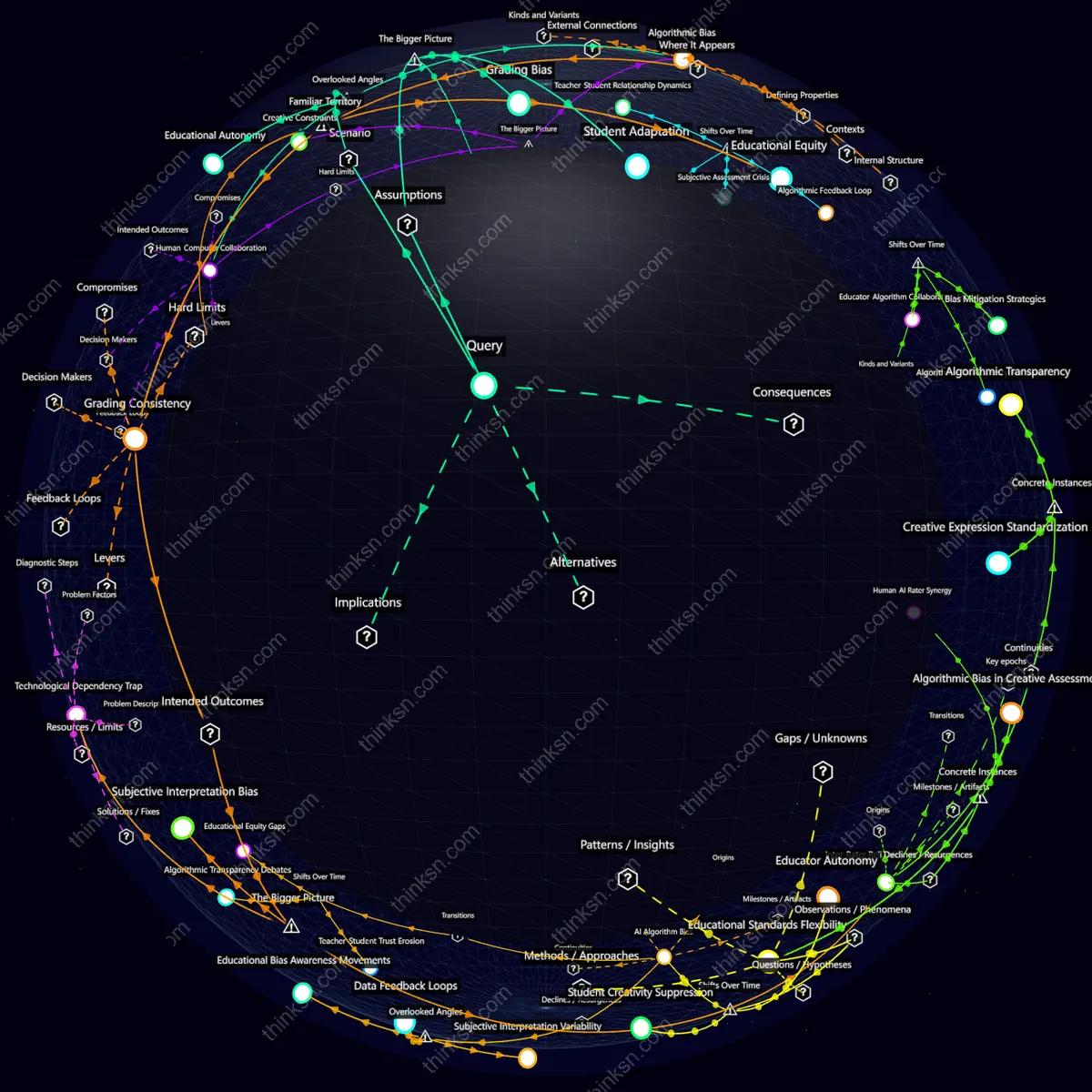
AI Grading in Education: Impact on Creative Projects
Key Findings
Teacher Control Over Grading
AI grading of creative work will not narrow creativity because teacher unions and professional standards protect educator discretion as a counterweight to administrative centralization.
Strong teacher unions and national teaching standards limit how much school administrators can change creative grading on their own. Past efforts to standardize subjective grading have reinforced teacher authority. This is especially true in writing and arts, where quality is hard to define. Even when AI systems use clear numbers, their use in grading creative work must respect existing teacher power structures. These structures value teacher judgment and resist top-down rules. Therefore, the idea that AI grading will narrow creativity overlooks the steady influence of teaching profession norms. These norms push back against central control and preserve space for personal human judgment, even when AI is available.
AI Grading Narrows Creativity
AI grading will narrow the definition of creativity by enforcing strict rubrics and statistical norms, which prioritize defensible grading over subjective human judgment.
Schools will push for strict rubrics and measurable scores for creative work. This happens because institutions fear lawsuits and want fair, repeatable grading. A similar shift occurred in the 1970s when universities like California required set grade distributions. That crisis made them follow statistical norms over personal judgment. The same risk management logic now applies to AI grading. Schools will train AI to focus on clear criteria like thesis strength or structure. This ignores unique human opinions. As a result, AI grading will define creativity more narrowly. Students will produce more formulaic work and less original thinking.
Deeper Analysis
What would happen to teacher autonomy in creative assessment if AI systems were developed and controlled by educator-led cooperatives rather than administrative or corporate entities?
Teacher Control In Grading
Teacher autonomy in creative assessment survives only in stable public systems because educator cooperatives control the data and rubric frameworks that AI uses, but this power erodes when fiscal crisis or privatization redefines creative criteria into quantifiable measures.
Teacher autonomy stays strong when national teaching councils oversee creative assessments. These councils use peer review and practitioner agreement to shape how evaluation works. This happens best during times of stable public education funding. Then educator cooperatives have the power to resist administrative demands. They do this by controlling the data and grading tools used by AI systems. The balance shifts during a funding crisis or privatization. For example, after No Child Left Behind, testing mandates made evaluation focus on measurable results. This weakened the influence of professional teaching groups. Even with teacher-controlled AI, outside pressure forces creative criteria into numbers. That reduces the cooperative’s ability to rely on subjective judgment. So teacher autonomy in creative assessment lasts only in stable public systems. It breaks down during periods of austerity or market-based reform.
Under what conditions would the institutional incentives to use AI grading for creativity actually push toward expanding, rather than narrowing, the definition of creativity?
AI Grading And Creativity
AI grading expands creativity when institutional rules require interdisciplinary assessment, because those rules force AI to value diverse, creative outputs.
AI grading enhances creativity only when schools use interdisciplinary assessment rules. This happens when institutions require evaluation across multiple fields, such as science and art. These rules force grading systems to measure more than technical skill. For example, problem-solving and collaboration must also be assessed. As a result, AI must learn to recognize creative outputs to remain valid. This shift replaced older grading systems focused only on standardized subjects. The change began when national education bodies adopted broader evaluation standards. STEAM initiatives in the late 20th century helped drive this change. Creativity expands under AI grading only when rules demand it.
AI Grading Creativity
AI grading narrows creativity because it favors measurable outputs, and schools adapt to produce what the system can validate.
Schools under pressure to prove their evaluations are fair often adopt strict, uniform standards. This shift happened widely in the UK after 1988, when teachers had to justify grades with clear evidence. As a result, assessments began to focus more on measurable features than on creative qualities. AI grading systems now enter this environment not to mimic human judgment but to ensure consistency. These systems rely on data that can be easily measured, like writing structure or citation count, not deeper creativity. When machines assess creativity, they define it by what can be counted. Over time, schools adapt to this system, producing work that fits machine evaluation. Creative expression narrows because success depends on being verifiable. The system rewards outputs that follow established norms. Without external demands for diverse work, AI pushes teaching toward uniform results. Creativity can grow under AI only if authorities value varied student outcomes and require them.
Risk And Reward In Grading
Creativity in AI grading expands only when the institutional rewards for demonstrating originality become greater than the risks of less consistent scoring.
When accountability systems demand easy checking and comparison, schools standardize how they grade. This reduces the chance of being challenged. This pattern began in the 1970s during a grade inflation crisis in the University of California system. Administrators there imposed grade distribution rules to manage risk. They put statistical control above teacher judgment. The same risk-reducing mechanism now drives AI grading. It forces creativity into measurable forms. But this changes when outside rewards shift. If funding, accreditation, or policy prizes innovation over consistency, the logic flips. Agencies then gain by showing off new student work. This requires broader, AI-friendly models of creativity. In such cases, showing distinctive results becomes more valuable than just following rules. This reverses the drive to narrow criteria. Therefore, the definition of creativity in AI-graded education grows only when institutional rewards for original work outweigh the risks of inconsistent grading.
AI Grades Creativity
AI grading expands what counts as creativity because struggling institutions use it to include more student work and secure funding.
When universities see fewer students enrolling in arts and humanities, they face pressure to prove their value. This happened in the UK during the 1980s and 1990s. Back then, research evaluations shaped which departments got funding. Departments that included more types of work—like art installations or digital projects—could show more outputs. They did this to look stronger and avoid budget cuts. The same logic applies today with AI grading. If AI systems can count more kinds of student work as creative, departments can claim more of it as high quality. This makes them appear more productive. When student numbers drop, institutions have a strong reason to push for broader definitions of creativity. AI becomes a tool to include more work in formal assessments. The goal is to justify keeping resources. Institutions under threat will use AI grading to recognize wider forms of creativity. This expansion helps them survive. The key point is that need drives change in what counts as creative.
Explore further:
- What happens to the expansion of creativity through AI grading when interdisciplinary mandates are imposed without corresponding funding or training for educators to interpret cross-domain rubrics?
- What happens to the definition of creativity in schools when the institutions that validate learning are incentivized to demonstrate diversity rather than uniformity?
- What happens to the definition of creativity in AI-graded education if institutional funders demand measurable conformity rather than demonstrable originality?
- Would this expansion of creativity definitions under AI grading still occur if the assessment criteria were set by independent accreditation bodies rather than by the departments themselves?
What happens to teacher autonomy in creative assessment when public funding is stable but AI systems are trained on data from privately controlled educational platforms?
Teacher Control Over AI
Teacher control over AI assessment fades where national education systems fail to enforce unified standards due to decentralized governance and corporate data influence.
Teachers can only keep control over how students are assessed if they shape the data used to train AI. This requires strong national systems that set consistent teaching standards. Without such systems, private companies gain influence over assessment tools. In many wealthy countries, school governance has shifted to local levels or outside providers. Central bodies once responsible for setting evaluation rules have lost power. This shift began in the 1990s and grew with performance-based funding reforms. Even with steady public funding, decision-making moved to platforms using broad, measurable data. These platforms favor scalability over teacher input. As a result, educators no longer define assessment criteria. AI training data follows market-driven patterns, not classroom expertise. Most high-income countries lack the centralized structure needed to ensure teacher-led standards. This undermines claims that public funding alone protects teaching autonomy.
Hidden Shift In Teacher Control
Teacher autonomy in creative assessment dissolves when private platforms train AI to prioritize market-driven norms, which gradually displaces educators' control over what counts as valid creativity.
When schools get stable funding but AI systems learn from private platforms, a quiet change happens. Teacher autonomy is not lost through budget cuts or top-down rules. Instead, it is eroded by a hidden redefinition of professional judgment. Private data pipelines bring market values like efficiency and scalability into assessment. Even when used in small ways, these platforms shape what AI views as 'creative.' They prioritize patterns from high-volume, easy-to-spread student work. This overrepresents commodifiable forms of expression. It also undervalues contextually rich, locally validated practices. Educators lose influence over assessment criteria through gradual epistemic displacement. What counts as recognizable creativity shifts toward formats that fit platform architecture, not teaching goals. This pattern appears in the UK, where Ofqual’s dependency on third-party digital portfolios has narrowed artistic diversity in A-level arts submissions. Audit reviews confirm this trend. Teacher autonomy in creative assessment depends on the power to define valid evidence. Relying on external data infrastructures weakens professional bodies’ ability to maintain alternative standards, even without funding cuts. The core of evaluation gets outsourced to platforms. Their design assumptions stay invisible to practitioners and cannot be challenged through existing governance channels.
Teacher Control Over Grading
Teacher autonomy over creative grading survives only when public education systems maintain independent professional oversight of AI training data, and it erodes under funding systems that prioritize measurable outputs over teacher consensus.
In some public schools, teachers decide how to assess creative work. This happens when national training standards and subject experts set the curriculum. From the 1960s to the mid-1990s in Western Europe and Canada, teacher groups and government institutes designed grading rubrics together. Private education platforms must then pass their data through public certification. This process removes private bias and keeps teacher-chosen standards. The system breaks when funding is tied to standardized test scores. After 2001, many U.S. states and later OECD countries adopted this approach. Funding then goes to measurable metrics like originality scores based on word variety. These metrics take control away from teacher groups. Teacher autonomy in creative grading only lasts when the public system keeps independent professional control over AI training data. When funding rewards measurable outputs instead of teacher consensus, that autonomy is lost.
Teacher Judgment In Creative Subjects
Teacher judgment in creative subjects endures because stable funding allows educators to prioritize context-sensitive evaluation over standardized metrics, making professional norms the foundation of assessment design.
When public education funding is stable, assessment design in creative disciplines depends more on teachers' professional judgment than on meeting external targets. Teachers interpret and apply evaluation tools based on classroom experience. This occurs because stable funding removes pressure to prioritize short-term results. Educators can then focus on long-term learning goals. In many OECD countries, teachers have significant control over how they teach. This freedom supports ongoing innovation in project-based learning. The European Higher Education Area shows how educator collaboration shapes standards. Despite demands for measurable outcomes, teacher communities maintain influence over qualifications. Creativity is treated as something that grows from context and experience. It is not reduced to fixed metrics. This approach persists not because technology changes how we define creativity. It persists because teachers resist replacing nuanced judgment with automated systems. Classroom practices shape policy over time. Professional culture drives change more than top-down rules.
Explore further:
- Would the finding hold in education systems like Finland or Singapore that have maintained centralized curriculum authority and strong public-sector control over assessment design?
- What would happen if AI systems were designed to generate their own subjective criteria for grading creative work, rather than being trained on human-defined rubrics?
What happens to the expansion of creativity through AI grading when interdisciplinary mandates are imposed without corresponding funding or training for educators to interpret cross-domain rubrics?
AI Grading In Schools
AI grading reduces creativity to measurable forms because centralized assessment systems value consistency over originality, making teacher judgment secondary to standardized metrics.
AI is now used to grade creative work in schools. This happens in countries where education rules are tightly controlled from the center. Tests must be consistent across many subjects. Agencies like Ofqual or PISA push schools to measure all students the same way. This pushes educators to simplify creativity into fixed criteria. These criteria focus on structure, word count, and format. They ignore original ideas or cultural meaning. Teachers get little training on how these systems work. They also cannot change how assessments are designed. The systems are often run by outside groups with little input from teachers. These groups decide what counts as valid creative work. In practice, creativity becomes following rules. Major systems in the UK and Australia show this pattern. Creative work is judged by how well it fits a mold. It is not judged by how imaginative or meaningful it is. This shift happens not because of private companies alone. It happens because public systems favor measurable results. The drive for consistency weakens the role of teacher judgment. Standardization makes creativity easier to track. But it also changes what creativity means. The real cause is not profit motives. It is the system’s need for control and comparison.
What happens to the definition of creativity in schools when the institutions that validate learning are incentivized to demonstrate diversity rather than uniformity?
School Creativity Rules
Creativity in schools is reshaped by standardized assessment because audit requirements turn open-ended judgment into rule-based scoring.
National education standards require schools to use clear, repeatable methods to assess student work. This happened in England after 1992 with regular school inspections. Teachers began to focus on evaluating skills that could be easily measured and checked by outside auditors. Creative work was broken into parts like clear arguments or correct structure. These parts could be scored consistently by humans or computers. Schools rewarded work that fit standard formats because it was easier to justify to inspectors. Automated grading systems learned from this data. They focused on the same features that were easy to verify. Over time, creative expression in schools became more about following rules than exploring new ideas. This shift happened not because of teaching methods, but because schools had to prove their results to outside bodies. Similar systems in most G20 countries have led to the same result. Creativity is now shaped by the need to show evidence in familiar forms.
What happens to the definition of creativity in AI-graded education if institutional funders demand measurable conformity rather than demonstrable originality?
School Creativity Squeeze
Creativity in schools shrinks under AI grading because funding pressures favor conformity over risk, so institutions reward only safe, measurable forms of originality.
When national tests focus on uniform results, schools follow strict rules to meet standards. This happened in the UK in the 1990s, where school ratings depended on measurable outcomes. Consistency was valued more than originality. As a result, AI grading systems in education are shaped by these same priorities. They do not kill creativity but redefine it narrowly. Creativity becomes rule-based and easy to compare across schools. The reason lies in how money and oversight are tied to performance. Schools that take risks may lose funding. So they avoid unusual or unexpected results. AI is trained on past examples that were already approved. This means it learns to favor safe, predictable work. Truly new ideas that challenge norms are less likely to score well. The system rewards conformity because it is less risky. Therefore, the idea of creativity grows smaller. It is not because AI cannot handle original work. It is because schools are punished more for being different than they are praised for being bold.
AI Grading Of Creativity
Creativity in AI-graded education expands only when funders reward originality over rule-following, as shown by shifts to portfolio assessments.
When funders demand measurable results, creativity becomes a number that AI can grade. This is what happened in the UK's Research Excellence Framework. Creative arts work was once judged by peers. But funders wanted to compare results across universities. So they switched to metrics like citation counts and journal prestige. This narrowed what counted as creative work. An AI grading system only expands creativity when funders reward originality over rule-following. The International Baccalaureate shows this shift. It moved from standard tests to portfolio assessments. Student creativity grew because universities valued diverse thinking. This change happened when admissions and rankings rewarded originality. So the definition of creativity in AI-graded education only expands when the risk of rewarding inconsistency is outweighed by the benefit of showcasing distinctive originality.
Would this expansion of creativity definitions under AI grading still occur if the assessment criteria were set by independent accreditation bodies rather than by the departments themselves?
Creative Work Rules
AI grading in creative fields stays narrow because central assessors prioritize standardized benchmarks over institutional needs for creative expansion.
National funding systems often link money to measurable results in creative fields. Assessment systems controlled by central bodies shape what counts as valid creative output. These bodies prefer standards that allow comparison across institutions. They resist including new or experimental forms of artistic work. This happened during UK university reforms when official templates limited how departments classified creative work. Departments could not easily adapt to falling student numbers by redefining artistic practice as research. Unlike departments, central assessors do not face pressure to survive enrollment drops. They prioritize strict benchmarks over creative flexibility. As a result, AI tools used in evaluation follow these narrow standards. AI will not greatly expand what counts as valid creativity. Central control blocks change even when institutions need it.
Would the finding hold in education systems like Finland or Singapore that have maintained centralized curriculum authority and strong public-sector control over assessment design?
State Control Of Assessment
The finding holds because only centralized systems with vertical curriculum-assessment governance let the state control AI training data, thereby preventing private platforms from setting the default logic for evaluating creativity.
In some education systems, a central body holds full power over exam standards. Singapore's Ministry of Education sets the syllabus and grading rules. This structure limits how AI can be used in creative tests. The state demands public oversight of AI training data. It then aligns AI results with national teaching goals. This stops private companies from taking over. Finland has a similar system through its National Agency for Education. Teachers design assessments, but within a strict national framework. This framework defines what counts as valid judgment. These two cases reveal a wider pattern. AI's ability to replace human evaluators depends on one key condition. The condition is whether a central legal body controls the definition of legitimate assessment. In decentralized systems, private platforms can set their own standards. OECD studies confirm this pattern. Only systems with tightly linked curriculum and assessment rules keep state influence over AI datasets. This prevents private data pipelines from becoming the default logic for evaluation. So the finding holds in Finland and Singapore. Their institutional setups stop private systems from defining what creativity means in tests.
What would happen if AI systems were designed to generate their own subjective criteria for grading creative work, rather than being trained on human-defined rubrics?
AI Grading Creative Essays
AI cannot create grading criteria for creative work in systems like France's because it needs structured human-graded data, which oral and apprenticeship-based traditions do not produce.
In France, philosophy exams are graded subjectively by expert teachers. These experts judge creativity based on training and shared understanding. There is no large set of labeled essays to show what counts as good. AI systems need many examples with clear ratings to learn such judgments. Without a stable dataset of human-graded essays, AI cannot learn the pattern. The AI must rely on existing examples to form its own rules. But the French system does not create such data. Grading relies on oral tradition and professional experience. Therefore, no structured data exists for AI to learn from. AI cannot build its own criteria in this setting. The lack of labeled examples blocks the system from starting.
What would happen to the definition of creativity in schools if assessment systems no longer had to prioritize comparability across classrooms and regions?
Testing Kills Creativity
Assessment systems that prioritize cross-context comparability redefine creativity as rule-following because they must measure subjective qualities through objective, replicable proxies to maintain policy credibility.
National assessment systems value stable metrics over broad interpretation. This shifts how they recognize creativity. Creativity becomes linked to following rules, not expressing new ideas. This happens not because teachers lack skill. It happens because evaluation tools force professional judgment through narrow measures. Systems like OECD tests or national exams like NAPLAN need comparability. Funding and policy depend on that comparability. So evaluators must balance subjective areas with statistical rigor. They replace new thinking with measurable traits like sentence complexity or structure. This institutional logic is built into reporting cycles and accountability systems. It makes everyone treat creativity as a surface feature of work. They ignore conceptual risk or cultural insight. The audit systems that define school success cannot scale qualitative depth. Trying to do so creates scoring variation that harms policy credibility. Therefore, creativity in schools shifts not because of new technology. It shifts because all assessed traits must be repeatable and defensible in summary. Originality only becomes manageable when it matches patterned expression. If assessment systems stopped needing cross-context comparability, the pressure to turn creativity into technical skill would end. That would show the constraint was always administrative, not educational.
What happens to the definition of creativity when institutions reward both originality and compliance equally, creating conflicting incentives for AI grading systems?
Fairness In Grading
Legal oversight ensures fair grading by allowing appeals, which breaks cycles of standardization and keeps room for originality.
In countries where courts or lawmakers protect equal educational opportunity, grading systems must be fair and open to challenge. This means assessment methods must be transparent. Students must be able to appeal unfair results. These rules limit how much grading can be automated. Even under pressure to make results auditable, systems cannot fully rely on rigid rules. Decisions must be justified based on each student's growth and work. This preserves room for human judgment. AI grading depends on past scoring patterns. But in these systems, appeals often reject scores that ignore unique or creative work. So past data do not reinforce standardization. Instead, repeated appeals keep introducing variety. They correct for mechanical or formulaic assessment. As a result, grading stays open to originality. Auditability does not reduce creativity when legal oversight allows constant review and correction. This is shown in studies of federal systems with strong legal review.