Is DNP Worth It When Clinical Pay Peaks but Academia Requires It?
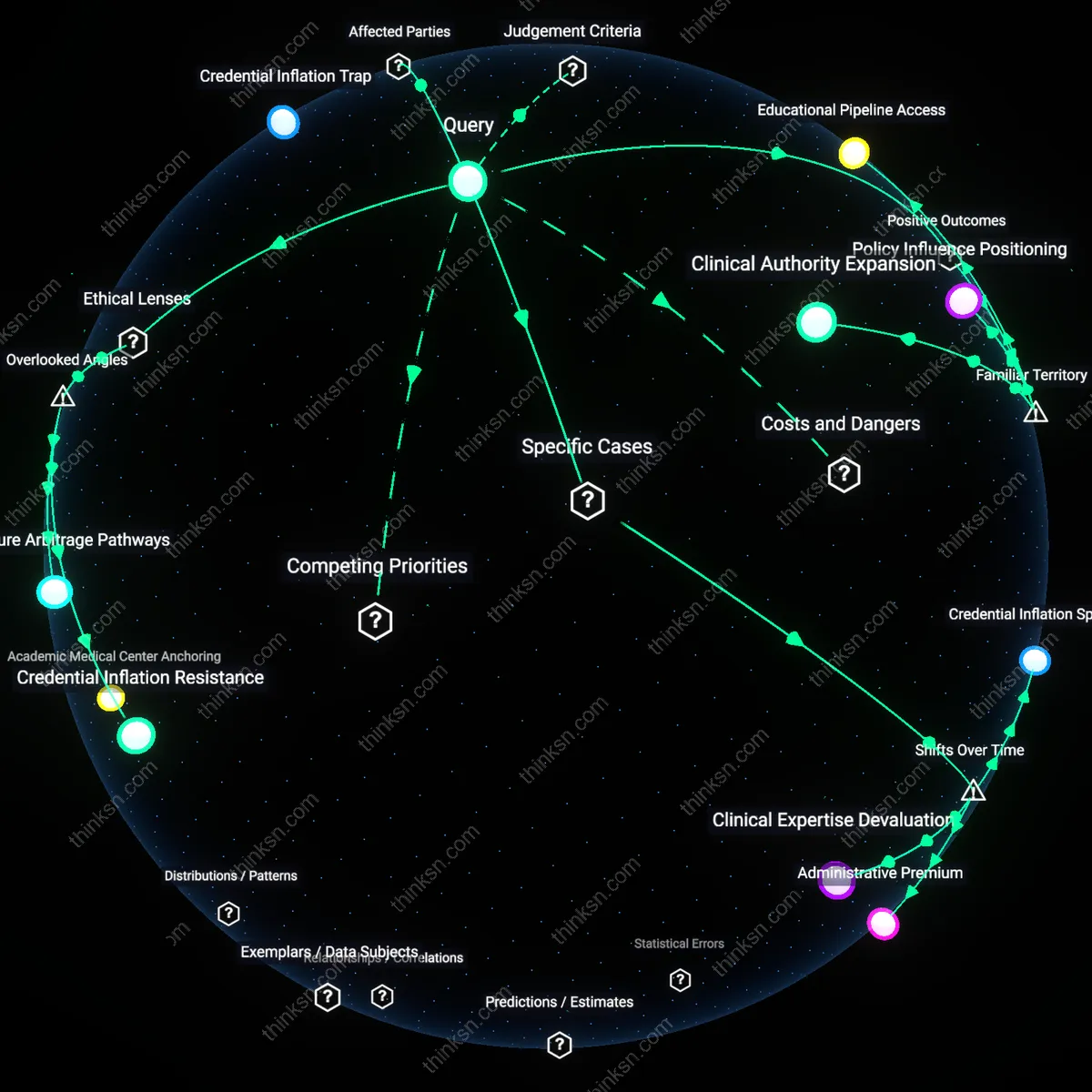
Analysis reveals 10 key thematic connections.
Key Findings
Credential Inflation Trap
A mid-career nurse should assess DNP ROI not by salary gain but by the degree’s function as a gatekeeping tax imposed by academic institutions that have systematically devalued master’s-level educators while creating artificial scarcity for leadership roles. Universities benefit by using the DNP mandate to shrink applicant pools, discipline labor costs in nursing faculties, and align with administrative prestige—shifting value from clinical expertise to bureaucratic credentialing. This reveals how the return on investment is less about individual advancement and more about coerced participation in a zero-sum academic hierarchy, where the degree reproduces exclusivity rather than competence. The non-obvious mechanism is that the DNP requirement is not driven by educational outcomes but by institutional risk management and accreditation signaling.
Clinical-Administrative Divorce
The true ROI of a DNP lies not in clinical salary increases but in its role as a passport to unfilled administrative voids created by hospital systems desperate for credentialed legitimizers of top-down policy. Health systems increasingly isolate clinical staff from governance while hiring DNPs to author protocols that frontline nurses must follow—turning the degree into a tool of sanctioned delegation without power-sharing. This reframes the investment not as professional growth but as alignment with managerial logic, where the nurse becomes a compliance conduit rather than a clinical innovator. The clash is that higher education subsidizes administrative absorption, not patient care transformation.
Clinical Authority Expansion
Pursuing a DNP enables a mid-career nurse to lead evidence-based practice initiatives within hospital systems, where advanced clinical expertise is leveraged to standardize care protocols across units. This shift relies on the nurse’s ability to interpret research, influence peer behavior, and collaborate with quality improvement teams—actors and structures already embedded in familiar healthcare environments. While most associate the DNP with academic or administrative tracks, its underappreciated power lies in amplifying a nurse’s formal influence over clinical decision-making without requiring departure from patient care settings, thereby expanding their authoritative role within existing hierarchies.
Educational Pipeline Access
Earning a DNP opens direct entry into faculty roles at nursing schools, particularly community colleges and regional universities facing severe shortages of qualified instructors. This pathway functions through accreditation mandates—such as those from CCNE or ACEN—that now require doctoral qualifications for teaching in advanced practice programs, making the DNP a gatekeeper credential despite stagnant salaries in clinical practice. The non-obvious insight, given common perceptions of the degree as merely a clinical upgrade, is that its primary value is not in enhancing bedside care but in securing eligibility to train the next generation of nurses where demand far exceeds supply.
Policy Influence Positioning
A DNP equips nurses to assume leadership roles in health policy organizations, state boards of nursing, and federal advisory councils, where clinical experience combined with doctoral-level systems training grants credibility in regulatory discussions. This trajectory operates through formal recognition—the DNP is often a de facto requirement for appointments to committees that shape licensure, scope-of-practice rules, and Medicaid reimbursement frameworks. Contrary to the public assumption that doctoral nurses are destined for academia or highly specialized clinics, the degree’s silent advantage is positioning clinicians to directly influence institutional rules that affect millions of patients and providers.
Credential Inflation Resistance
A mid-career nurse should assess the DNP’s return on investment by recognizing its role as a barrier to credential devaluation in regional academic hiring pools, not merely as a salary enhancer. In public universities across states like New Mexico and West Virginia, legislative underfunding has triggered administrative reliance on terminal degrees as proxy metrics for faculty competence, effectively inflating the DNP’s necessity beyond clinical skill. This dynamic, rooted in bureaucratic risk-aversion under resource scarcity, means that without the DNP, nurses are excluded from curriculum governance roles even when empirically qualified—revealing that the degree functions less as a wage multiplier and more as a bulwark against professional obsolescence in education ecosystems. The overlooked mechanism is how austerity-driven administrative logic distorts credential value, making the DNP a defensive investment against systemic exclusion rather than an offensive move for pay gains.
Licensure Arbitrage Pathways
The return on investment for a DNP should be evaluated through its capacity to unlock licensure mobility in compact nursing states, where autonomous practice rights for DNPs are expanding despite flat hospital salaries. Under the Nurse Licensure Compact (NLC), DNPs can legally practice across 40+ states, enabling participation in telehealth consultancies and rural clinic networks that reimburse at higher effective rates than salaried roles, particularly in Medicaid-expanded states like Missouri and Utah. This arbitrage hinges on state-level scope-of-practice laws that tie advanced practice autonomy to terminal degrees, not clinical experience—a legal doctrine rooted in medical territoriality and state police powers. Most ROI analyses ignore how the DNP functions as a jurisdictional key, converting educational investment into geographic and regulatory access, thereby decoupling income potential from local salary norms.
Credential Inflation Spiral
A mid-career nurse evaluating DNP ROI must confront the credential inflation spiral that emerged as doctorally-prepared nurses became a benchmark in academic hiring, displacing master’s-prepared faculty by the 2010s, particularly visible in AACN-member schools like University of Pennsylvania School of Nursing where faculty job postings requiring the DNP became dominant post-2015, signaling a shift from terminal MSN to DNP as the expected qualification despite stable clinical pay scales. This mechanism reveals how professional advancement pathways are reshaped not by salary incentives but by institutional credentialing standards, an underappreciated driver in ROI calculations that prioritizes positional competition over economic return.
Administrative Premium
The return on a DNP has increasingly shifted toward administrative roles rather than clinical or academic ones, as seen in the VA Health System’s post-2010 restructuring where DNPs were slotted into leadership tracks with budget authority but minimal clinical time, marking a transition from clinical expertise to management legitimacy; this reframes the DNP not as a direct clinical upskilling but as a gateway to authority within hierarchical systems, revealing an underappreciated trajectory where educational investment buys organizational access rather than technical recognition.
Clinical Expertise Devaluation
Since the ACA era (post-2010), the DNP’s expanding role in protocol-driven care systems like Kaiser Permanente has coincided with a paradoxical devaluation of autonomous clinical judgment, where DNP curricula emphasize standardization over innovation, shifting the degree’s value from intellectual authority to system compliance; this transformation indicates that ROI now depends less on individual expertise and more on alignment with risk-averse institutional models—a non-obvious consequence of health system consolidation that redefines professional worth.