Does Foreign Equities Hedge Inflation or Spur Volatility?
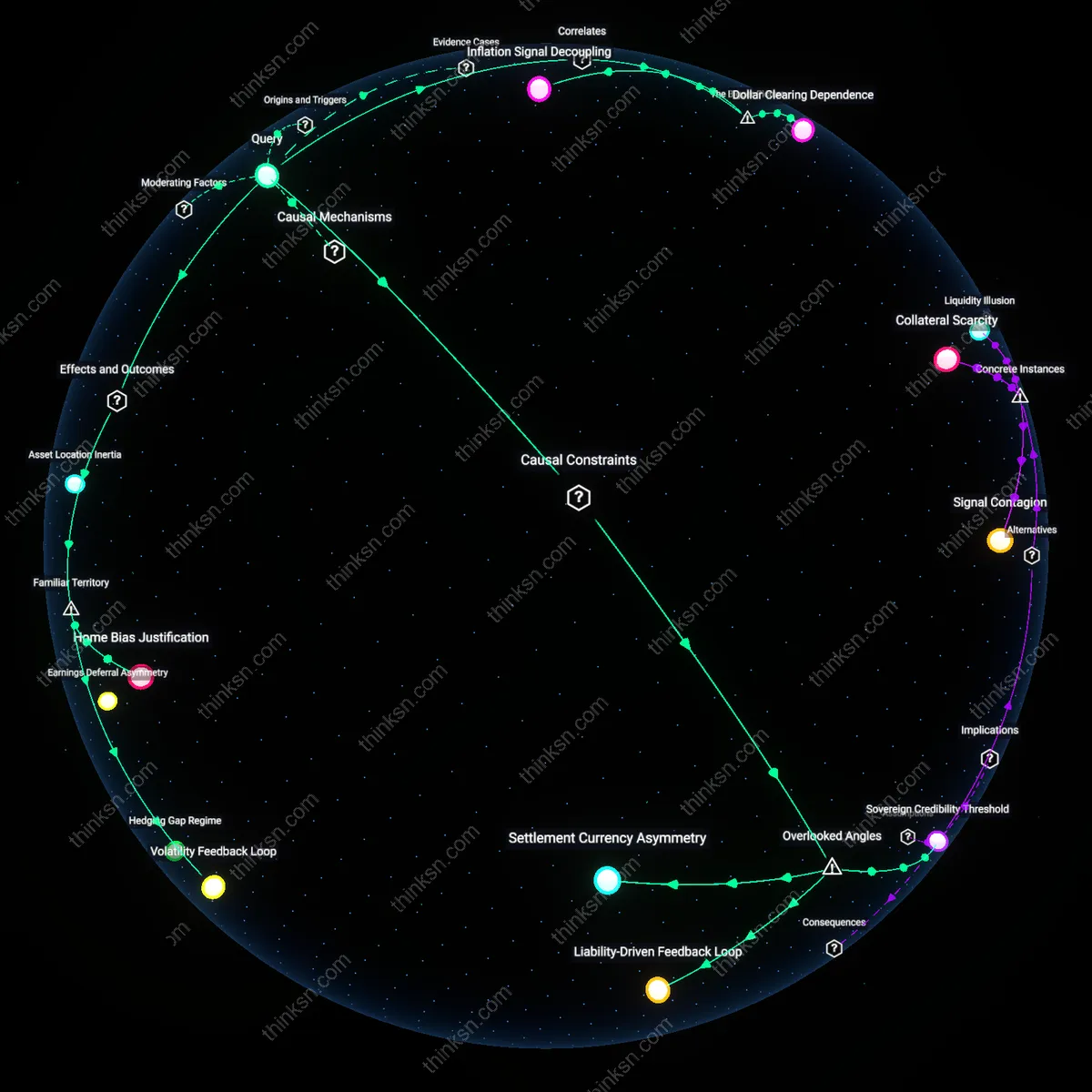
Analysis reveals 9 key thematic connections.
Key Findings
Currency Hedging Effect
Increasing foreign equity exposure during dollar depreciation reduces inflation protection because international firms rarely price goods in depreciating currencies, leaving domestic investors exposed to both local inflation and unshielded exchange rate swings. Multinational corporations adjust revenue recognition based on functional currencies, meaning U.S. investors gain no intrinsic hedge when dollar weakness drives import inflation. The mechanism operates through consolidated financial reporting standards that isolate foreign earnings from home currency erosion, undermining the intuitive belief that 'diversification equals protection.' This reveals the underappreciated reality that accounting conventions neutralize expected inflation-mitigating pathways despite real economic exposure.
Volatility Feedback Loop
Raising foreign equity allocations as the dollar weakens amplifies portfolio volatility due to synchronized emerging market debt crises triggered by dollar-denominated borrowing costs. Countries like Turkey or Argentina, with large external liabilities in USD, face capital flight when the greenback falls, provoking defensive rate hikes and equity sell-offs that spill over into global funds. This dynamic runs through balance sheet vulnerabilities in leveraged frontier economies, which destabilize external asset prices exactly when U.S. investors rebalance toward them. The non-obvious insight is that the very signal prompting diversification—dollar decline—precipitates the instability it aims to avoid, turning risk mitigation into a procyclical amplifier.
Home Bias Justification
Dollar depreciation phases validate home market bias by exposing structural advantages in domestically anchored equity earnings during currency stress, especially in sectors like utilities and consumer staples insulated from import competition. Firms such as Duke Energy or Procter & Gamble maintain pricing power within the U.S. regulatory and demand ecosystem, allowing profit retention even amid broad currency devaluation. This operates through revenue localization and contractual insulation—features absent in globally integrated firms subject to foreign input costs and political frictions. The overlooked point is that familiar preferences for domestic investment aren’t mere inertia but reflect embedded resilience in national market architectures during exchange rate turbulence.
Capital Flow Reflexivity
Increasing foreign equity exposure during dollar depreciation heightens volatility due to momentum-driven capital reversals among global institutional investors. As U.S. dollar weakness coincides with perceived U.S. asset underperformance, pension funds and sovereign wealth funds rebalance toward non-U.S. equities, amplifying cross-border flows that destabilize emerging market valuations; this feedback loop between currency moves and portfolio repositioning is underappreciated because it operates through behavioral heuristics rather than economic fundamentals. The systemic risk emerges not from currency exposure alone but from synchronized reallocation rules embedded in large-scale asset managers’ mandates, which treat foreign equity as a proxy for dollar hedge.
Inflation Signal Decoupling
Foreign equity exposure during dollar depreciation does not reliably enhance inflation protection because rising nominal returns in non-U.S. markets often reflect currency translation effects rather than real purchasing power preservation. When domestic central banks in export-reliant economies like Korea or Germany resist tightening despite USD depreciation, equity gains stem from speculative carry rather than productivity-adjusted growth, misleading investors about real inflation hedging capacity. This creates a statistical illusion of protection—visible in CPI-adjusted Sharpe ratios—where price momentum masks the absence of wage or commodity-level alignment with U.S. inflation dynamics.
Dollar Clearing Dependence
Vulnerability to volatility from foreign equity rises during dollar depreciation because most cross-border equity settlements and derivative contracts are cleared in U.S. dollars, binding non-U.S. markets to Federal Reserve liquidity conditions regardless of local fundamentals. Even when firms are non-U.S.-based, custodial banks in New York and collateral rules in DTCC settlements force indirect dependence on dollar funding stress, which intensifies during depreciation episodes driven by risk-off flows. This hidden structural dependency means foreign equity does not insulate portfolios from dollar-driven shocks—it transmits them through clearing infrastructure, a mechanism overlooked in standard currency-adjusted return models.
Settlement Currency Asymmetry
Increasing foreign equity exposure during dollar depreciation does not enhance inflation protection when the underlying equities' cash flows are invoiced and settled in dollars, because multinational firms with local operations but dollar-denominated revenue report earnings in home currencies while retaining dollar-based cost structures, creating a hidden exchange-rate pass-through that destabilizes real returns. This mechanism undermines typical asset allocation assumptions that treat foreign equities as local-currency proxies, revealing that settlement currency—not operational footprint—determines exposure to dollar erosion, a detail absent in most portfolio construction models.
Sovereign Credibility Threshold
Foreign equity exposure amplifies volatility during dollar depreciation when the host country’s central bank lacks political insulation from fiscal demands, because diminishing dollar reserves trigger capital controls or implicit asset freezes that disrupt equity liquidation regardless of valuation, exposing foreign investors to sudden policy regime shifts. This risk is nonlinear—only apparent past a credibility breakpoint—and distorts diversification logic, as standard models assume fungible market access rather than contingent exit rights dependent on host state survival calculus.
Liability-Driven Feedback Loop
Higher foreign equity allocation during dollar depreciation increases volatility when domestic institutional investors have significant foreign-currency-denominated liabilities, because their rebalancing toward equities to hedge inflation inadvertently strains balance sheets as equity beta to real yields spikes under currency stress, forcing procyclical selling when devaluation threatens solvency. This feedback rarely appears in discussions of inflation-protected portfolios, which assume hedging works unilaterally rather than recognizing that liability structure can invert the risk profile of equity positions during currency transitions.