Should Longevity Risk Trump Rates in Your Bond Choices?
Analysis reveals 6 key thematic connections.
Key Findings
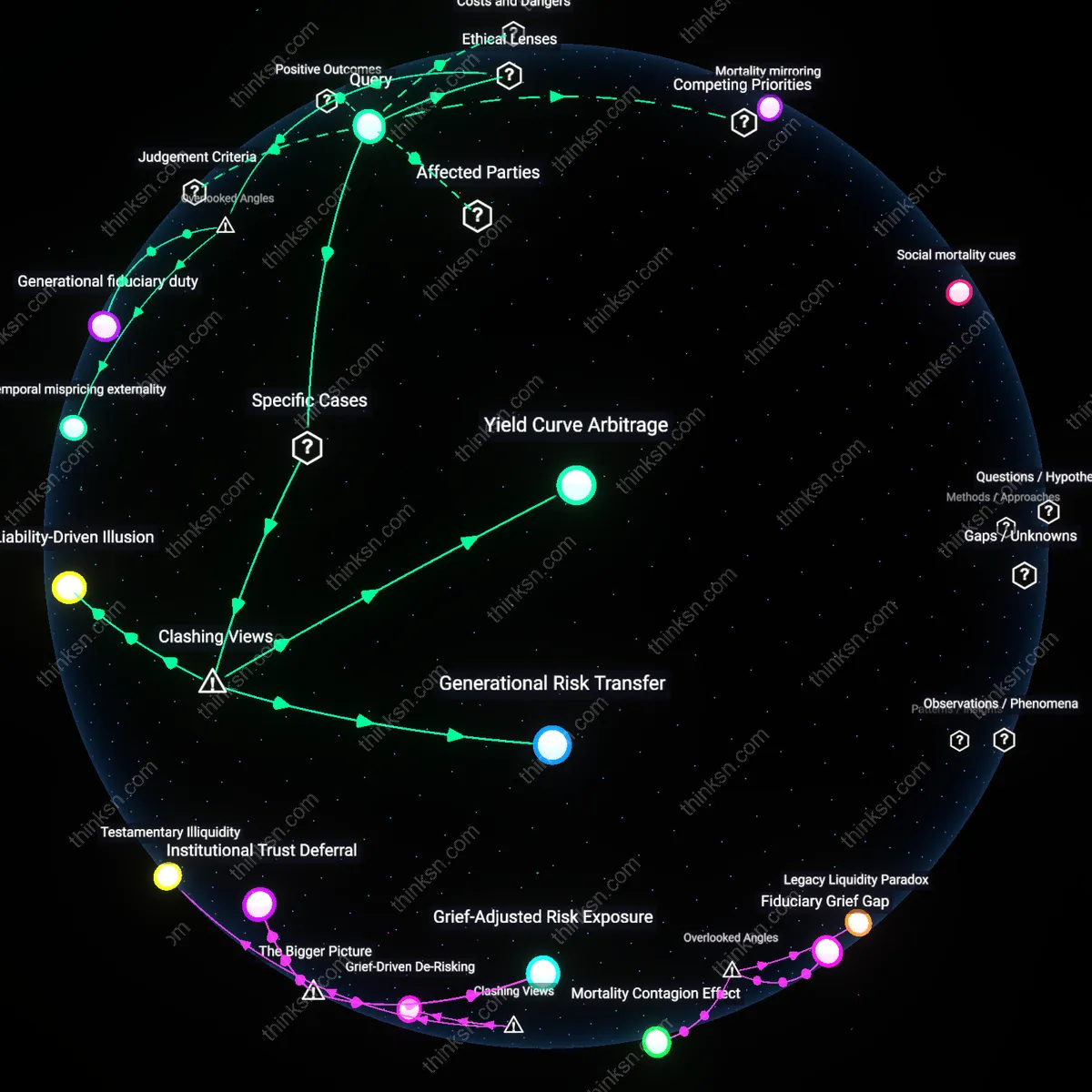
Generational fiduciary duty
Long-duration bonds should be included in retirement portfolios because they enact a generational fiduciary duty to maintain intertemporal fairness in public pension systems. Public defined-benefit plans, such as the California Public Employees’ Retirement System (CalPERS), rely on long-duration fixed income to match liabilities across decades, thereby honoring implicit social contracts between working and retired cohorts; this duty is grounded in Rawlsian intergenerational justice, which demands that no generation unfairly burdens another with risk absorption. Most asset allocation models ignore this ethical obligation by treating portfolios as apolitical tools, yet public pensions are political institutions whose solvency signals societal trustworthiness—omitting long bonds undermines temporal equity, a dependency overlooked when focusing solely on rate sensitivity.
Temporal mispricing externality
Long-duration bonds should be excluded from retirement portfolios because their pricing fails to internalize the temporal mispricing externality created by central bank time inconsistency. The Federal Reserve’s dual mandate leads to cyclical real rate suppression during growth downturns, artificially inflating bond valuations over long horizons and making duration appear stable when it is structurally subsidized—this distorts liability matching in target-date funds calibrated on historical yield curves. Conventional wisdom treats duration risk as a market risk to be hedged, but it is actually a byproduct of monetary policy’s uneven time horizon, a hidden dependency rarely priced into retirement glide paths.
Mortality salience asymmetry
Long-duration bonds should be conditionally included based on mortality salience asymmetry, wherein retirees cognitively discount longevity risk unless confronted with proximate peer death events. Behavioral data from Health and Retirement Study (HRS) cohorts show that demand for longevity hedges spikes only after clustered mortality experiences in social networks, creating a lag between financial need and risk recognition; long bonds, as passive hedges, compensate for this psychological delay. Standard lifecycle models assume rational, continuous risk assessment, but the real mechanism operates through socially mediated awareness—an underappreciated friction that decouples biological aging from financial behavior.
Liability-Driven Illusion
Yes, long-duration bonds should be included in retirement portfolios because defined benefit pension plans like the California Public Employees’ Retirement System (CalPERS) demonstrate that matching long-duration liabilities with long-duration assets reduces funding volatility, even during rate shocks—this mechanism works through immunization of cash flow mismatches in closed systems where payout durations are contractually fixed. The non-obvious insight is that rising rates, while harming bond prices, simultaneously lower the present value of future liabilities, creating a natural offset that dominates in duration-matched regimes, contradicting the intuitive view that rate sensitivity inherently undermines retirees' stability.
Yield Curve Arbitrage
No, long-duration bonds should not be included because entities like Japan’s Ministry of Finance have engineered prolonged yield suppression via quantitative and qualitative easing, turning long-bond ownership into a negative carry trap masked as a hedge—this operates through central bank dominance of price formation in the JGB market, where duration no longer correlates with inflation or growth risk but with policy endurance. The dissonance lies in exposing that what appears to be a longevity hedge is actually a bet on central bank insolvency timelines, subverting the traditional risk-return logic assumed in Western asset allocation frameworks.
Generational Risk Transfer
Yes, but only when long-duration bonds function as intergenerational claims, as seen in the Dutch ABP pension fund, where younger contributors effectively subsidize duration exposure to protect older cohorts from deflationary longevity risk—this mechanism relies on pyramidal demographic structures and automatic rebalancing rules that shift interest rate risk backward through time, not across asset classes. The friction with standard views arises by revealing that such portfolios aren’t hedging mortality uncertainty but enforcing cohort solidarity, making duration a political instrument rather than a market one.