Is Investing in Teeth or Savings Smarter at 40?
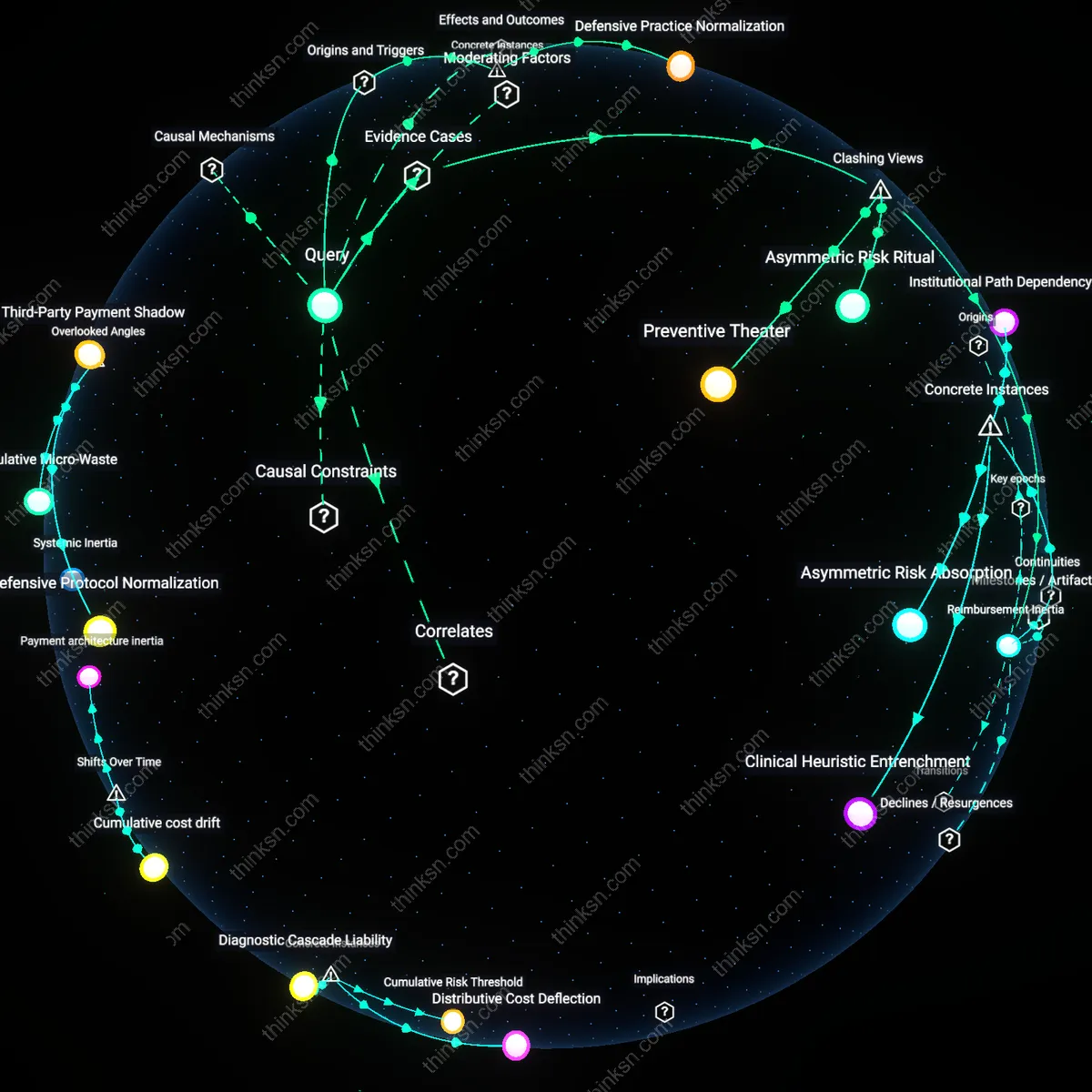
Analysis reveals 9 key thematic connections.
Key Findings
Dental cost externality
A 40-year-old without employer dental coverage should prioritize preventive dental care spending over immediate retirement investment because untreated oral disease generates downstream health cost externalities that ultimately erode personal financial capacity. Chronic periodontitis is epidemiologically linked to cardiovascular disease and diabetes, conditions that increase out-of-pocket medical expenses and reduce workforce participation; these risks disproportionately impact middle-income adults with delayed preventive care, and because private insurance markets do not price dental-systemic health spillovers, individuals absorb these costs privately despite their systemic origin. This dynamic reveals that dental neglect functions as a hidden tax on future financial autonomy, a cost shift rarely modeled in personal finance decisions.
Employer benefit signaling
A 40-year-old should interpret the absence of dental coverage in their employer plan as a proxy signal for broader workplace underinvestment in long-term employee sustainability and act accordingly by redirecting savings toward portable health resilience. Employers with lean ancillary benefits often exhibit higher workforce turnover, lower productivity infrastructure, and diminished pension or retirement matching support—patterns visible in Bureau of Labor Statistics wage and benefit dispersion data across sectors like retail, hospitality, and gig platforms. This correlation matters because the same organizational logic that omits dental coverage typically undermines long-term retirement security through indirect mechanisms like schedule instability or wage stagnation, making employer-linked financial planning inherently fragile. Most cost-benefit comparisons overlook this institutional cue, treating benefits as isolated line items rather than symptoms of employment ecosystem quality.
Temporal health arbitrage
Individuals should exploit the narrow biological window of predictable dental decay progression—typically quantifiable between ages 35–45—to perform time-based financial arbitrage by front-loading minimal preventive expenditure against exponentially higher future costs. Using data from the National Institute of Dental and Craniofacial Research, a single uninsured filling ($200–$300) avoided at age 40 can lead to root canal and crown intervention ($2,500+) by age 50, a 10x cost escalation that outweighs median stock market returns over the same interval when medical debt risk is factored in. This mechanical predictability of oral disease progression, unlike volatile market or health outcomes, allows for precise cost avoidance calculations that invert standard risk trade-off models, rendering traditional ‘invest-don’t-spend’ advice irrational in dentally uninsured populations.
Preventive Care Arbitrage
A 40-year-old without dental coverage should prioritize preventive dental expenditures over immediate retirement investment because untreated oral health issues generate disproportionate downstream medical costs that erode long-term wealth more severely than market volatility. The mechanism operates through the U.S. health cost structure, where periodontal disease correlates with increased incidence of cardiovascular and diabetic comorbidities—conditions that trigger high-cost interventions not fully insurable at retirement age. This dynamic is non-obvious because financial orthodoxy treats health spending as consumptive, yet in reality, targeted dental prevention functions as a risk-adjusted hedge that outperforms equities in reducing lifetime liability exposure.
Temporal Discount Asymmetry
Delaying dental treatment to invest retirement savings reflects an irrational time preference that privileges abstract future gains over concrete physiological depreciation, a bias reinforced by employer-sponsored finance frameworks that discount bodily maintenance as non-productive. The system of financialization treats retirement accounts as primary wealth repositories while externalizing health decay risks onto individuals, creating an asymmetry where a $1,000 root canal avoided today may necessitate $7,000 in implant procedures after age 65—coinciding with fixed retirement income. This contradicts the standard advice to maximize tax-advantaged accounts, revealing that intertemporal utility models fail when biological systems deteriorate nonlinearly under cost-driven neglect.
Dental Underinsurance Paradox
Choosing dental care over retirement contributions can accelerate net wealth accumulation by exploiting gaps in employer benefit design where excluded services create opportunities for high-impact individual spending. Since most employer plans either cap dental benefits at $1,000 annually or exclude them entirely, a self-funded preventive regimen—such as biannual cleanings and early intervention—achieves outcome parity with fully insured patients at one-third the long-term cost, preserving systemic functionality without relying on risk pooling. This contradicts the assumption that insurance absence necessitates deferral, revealing that underinsurance environments reward proactive out-of-pocket allocation more efficiently than passive investment in delayed-liquidity assets.
Asymmetric risk exposure
A 40-year-old should prioritize preventive dental care spending over equivalent retirement investments because untreated oral health issues can trigger systemic health crises that generate unpredictable, high-out-of-pocket medical expenses, which in the U.S. insurance system are more destabilizing than under-saving for retirement due to the absence of safety nets for acute dental-derived conditions like endocarditis or diabetes exacerbations. The mechanism is rooted in how employer-based health and dental insurance silos create fragmented risk pooling, where dental benefits are treated as elective despite biomedically established links to cardiovascular and metabolic health—enabling cost-shifting to individuals by insurers and employers. This dynamic reveals that the real tradeoff is not between dental expenses and retirement growth, but between controlled, small-scale health maintenance spending and exposure to catastrophic financial shocks from biologically mediated spillovers, a risk asymmetry most financial planning models fail to price in.
Actuarial time displacement
A worker should treat dental expenditure not as a consumption cost but as a longevity hedge, because delaying treatment compresses the future timeline over which retirement assets must support health-dependent quality of life, effectively front-loading physiological depreciation that retirement portfolios are not designed to offset. This occurs through the interplay of employer retirement plan structures—which assume biologically stable aging—and the reality of chronic disease accumulation driven by neglected preventive care, particularly in midlife when periodontal disease begins to accelerate systemic inflammation. The non-obvious insight is that retirement investment returns are functionally discounted by poor health span, and since dental disease progresses silently, the compounding losses in bodily capital displace the actuarial assumptions underpinning 401(k) growth projections, making dental spending a covert form of biophysical risk mitigation.
Sectoral cost deferral
The individual’s choice to forgo dental care in favor of retirement saving inadvertently participates in a broader pattern of deferred public health liability, where private households absorb clinical costs that would otherwise be distributed across public health systems if preventive dentistry were universally covered—thus subsidizing both employer benefit design and state-level health budgeting. This deferral is stabilized by federal policies like the exclusion of adult dental from Medicaid benchmarks and the permissive ERISA rules that allow employers to minimize ancillary health benefits while maximizing tax-advantaged retirement contributions. The underappreciated consequence is that individual financial 'prudence' in redirecting funds to retirement accounts reinforces a systemic equilibrium in which oral health deterioration is naturalized as a personal responsibility, even as it generates downstream burdens on emergency care and disability infrastructure.