Subsidizing Aging-in-Place Tech: Closing Elder Care Gaps or Creating New Issues?
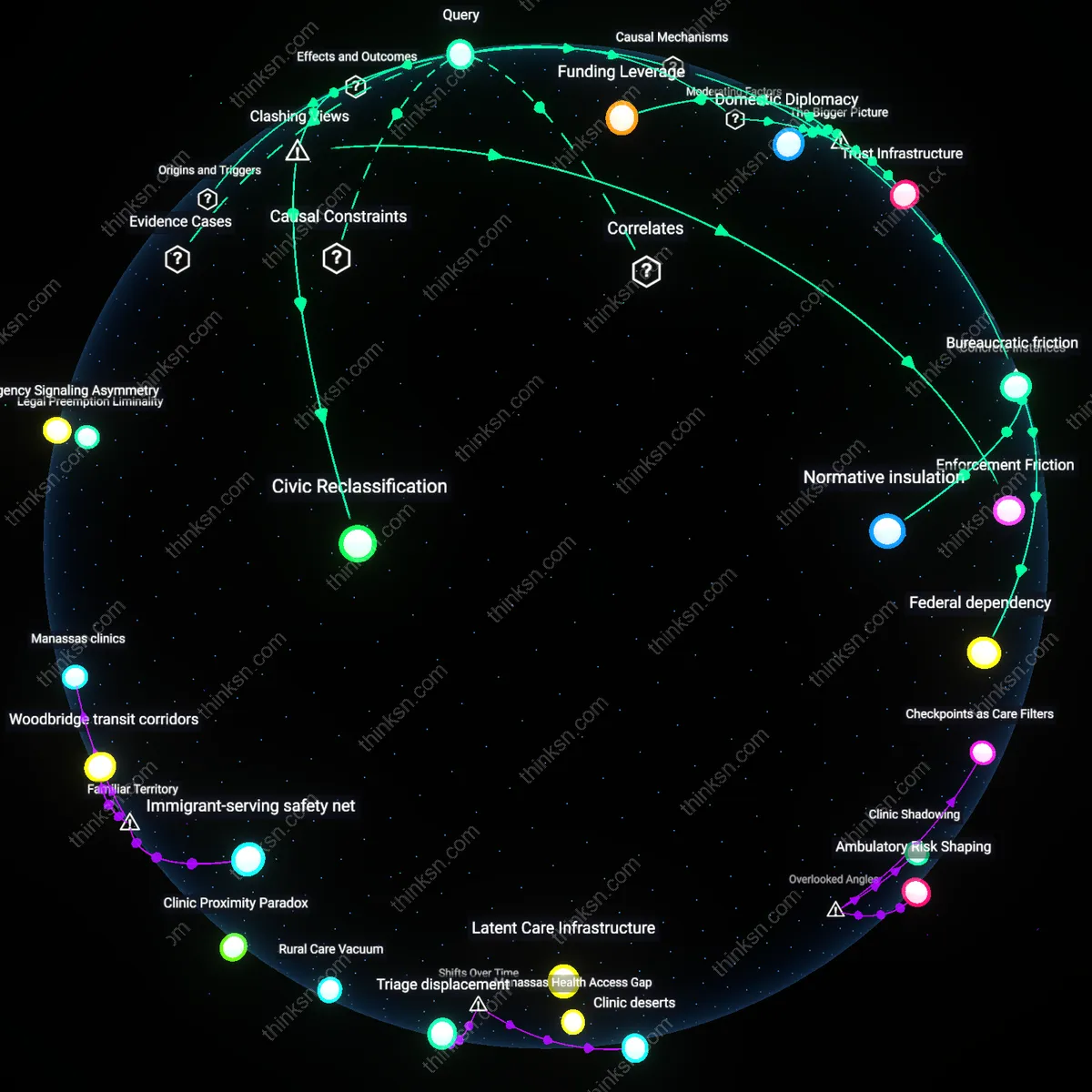
Analysis reveals 11 key thematic connections.
Key Findings
Fiscal deflection pressure
Aging-in-place technology subsidies emerge as municipalities redirect long-term care cost expectations onto households through incremental infrastructural nudges. Local governments exploit the ambiguity of home-based tech as ‘support’ rather than ‘care,’ enabling them to classify expenditures as capital investments rather than ongoing social spending, which are subject to less fiscal scrutiny and unionized labor costs. This mechanism bypasses politically fraught decisions about expanding public care staffing by recasting responsibility as technical optimization—masking systemic underfunding while appearing responsive. What’s overlooked is how budgetary classification systems, not demographic need, steer subsidy design, transforming elder-care deficits into solvable problems of home sensor coverage rather than wage-supported personnel.
Intergenerational rent compression
Subsidies for aging-in-place technologies function as indirect instruments to delay intergenerational housing transfers in high-cost urban markets. By extending older adults’ physical tenure in homes that would otherwise be vacated or downsized, municipalities reduce the immediate pressure on constrained housing supply—effectively using elder-tech as a tool of housing market stabilization. The mechanism operates through tacit coordination between housing departments and aging offices, where home monitoring systems become stand-ins for vacancy regulation. This reveals that elder-care subsidies are often less about care quality than managing latent housing crises, a connection obscured by siloed policy domains.
Infrastructural care laundering
Local governments deploy aging-in-place tech subsidies to absorb federal smart-city grants and private IoT partnerships under the guise of social welfare, converting surveillance-compatible infrastructure into socially legitimized investments. The mechanism works through municipal innovation offices that reframe motion sensors and emergency pendants as 'community health assets,' thereby redirecting data-centric urban development funds toward elder-focused programs that would otherwise lack funding. This camouflages the prioritization of scalable, vendor-managed systems over relational care models, revealing that the subsidy serves not to fix elder-care gaps but to launder infrastructural agendas through vulnerable populations.
Fiscal signaling
The introduction of aging-in-place technology subsidies in Portland, Oregon’s 2021 Senior Services Enhancement Initiative reveals that local governments use targeted funding not primarily to close care gaps but to signal fiscal responsibility while avoiding structural reforms. The city allocated $3.2 million to smart home sensors and remote monitoring devices through a competitive grant process administered by Multnomah County’s Aging and Disability Services, conditioning access on cost-matching from community nonprofits—a mechanism that publicly demonstrates elder investment while shifting long-term care burdens to under-resourced partners. This maneuver reflects a broader pattern where municipal budgets prioritize visible, low-liability expenditures over expanding public caregiving infrastructure, exposing how fiscal optics can substitute for systemic capacity. What is non-obvious is that the subsidy’s design, rather than its amount, functions as a bureaucratic proxy for accountability without altering dependency ratios in care delivery.
Technological deflection
The deployment of municipally subsidized fall-detection wearables in Chicago’s West Englewood neighborhood through the 2019 Age-Friendly Chicago Action Plan correlates with stagnant home-care worker wages and declining senior outreach staffing at the city’s Department of Family and Support Services. Local officials partnered with tech nonprofit SmartSense Chicago to distribute 1,200 motion sensors and panic buttons to elders living alone, branding it a 'preventive care leap,' yet at the same time the city rejected union proposals to raise direct-care worker pay above $15/hour, citing budget constraints. This coexistence of escalating tech investment alongside eroded labor support in elder services indicates that technology adoption can serve as a politically palatable alternative to workforce scaling, one that emphasizes individual risk mitigation over collective care standards. The underappreciated dynamic is that such technologies function less as care solutions and more as policy alibis, enabling officials to claim innovation while sidestepping labor-intensive reforms.
Spatial triage
In King County, Washington, the selective rollout of aging-in-place telehealth subsidies to affluent areas like Bellevue and Mercer Island—while omitting high-elder-density, low-income zones such as South Park—demonstrates that municipal support for elder tech often follows existing spatial inequities rather than ameliorating them. Administered through the Area Agency on Aging’s 2020 Home Independence Program, subsidies were prioritized in neighborhoods with higher property values and greater broadband access, justified by 'readiness for tech integration,' despite greater health vulnerability indices in underserved areas. This geographic pattern reveals that local governments frequently adopt a risk-minimizing logic in elder-care spending, allocating resources where compliance and outcomes are more predictable, thereby reinforcing care deserts under the guise of efficiency. The critical insight is that subsidy distribution operates not as a corrective but as a reinforcement mechanism, privileging administrative manageability over equitable need.
Fiscal Risk Transfer
Local governments deploy aging-in-place technology subsidies to shift long-term care cost liabilities from public health and social services onto households, enabled by the structural mismatch between municipal budget constraints and rising elder-care demand. This mechanism functions only because state and federal financing fails to cover expanding home-based care infrastructure, forcing local actors to innovate within fiscal boundaries while relying on private adoption of tech solutions. The non-obvious implication is that these subsidies act not as care enhancements but as financial circuit breakers, redistributing risk rather than expanding capacity.
Infrastructure Preemption
The introduction of aging-in-place subsidies reflects a preemptive investment in digital and physical infrastructure to forestall more costly systemic failures, such as hospital overcrowding or foster care system saturation, which occur when elderly individuals lose independent living options. This causal path depends on municipal access to data linking isolation and housing instability to emergency service utilization, allowing targeted interventions before crisis points. What is underappreciated is that these programs are not primarily about aging dignity but about blocking cascade failures in overburdened public systems.
Political Legibility Gap
Subsidies for aging-in-place technologies emerge in municipalities where older residents constitute a cohesive voting bloc capable of pressuring officials, revealing that policy responses prioritize politically visible populations over structurally disadvantaged elders who lack organizational power. This dynamic only produces subsidies when electoral incentives align with service delivery, excluding marginalized groups such as low-income seniors of color or non-English speakers from benefit streams. The deeper systemic issue is that elder-care remediation becomes conditioned on political salience, not demographic need.
Fiscal Preemption
The introduction of aging-in-place technology subsidies in cities like Portland, Oregon after 2010 reveals that local governments are shifting elder-care financing downstream to households, compensating for defunded state-supported long-term care services. As Medicaid waivers increasingly offloaded care responsibilities to communities post-1999 Olmstead Decision, municipalities responded not by expanding public facilities but by subsidizing private technological fixes—such as remote monitoring systems—effectively redefining elder care as a home-infrastructure issue rather than a health entitlement. This turn bypasses the political difficulty of raising care staffing wages or building public nursing capacity, instead leveraging technology to maintain older adults in settings where the state bears minimal ongoing operational cost. The non-obvious implication is that local fiscal constraints have preempted structural reform, rendering technology subsidies a fiscal safety valve rather than a holistic care solution.
Spatial Recontainment
The rollout of aging-in-place technology grants in Tokyo’s 23 wards between 2014 and 2020 signals a strategic reversal from postwar urban expansion toward the controlled recontainment of elderly populations within existing housing stock. As Japan’s national 'Compact City' policy redirected municipal investment away from suburban growth and toward the densification of central districts, elders—previously expected to relocate to institutional or peripheral care settings—became subjects of urban stabilization, their homes retrofitted with fall-detection sensors and telehealth kiosks to prevent displacement. This represents a shift from viewing aging as a demographic drain on city vitality to treating elders as anchors of neighborhood continuity amid depopulation. The underappreciated consequence is that technology becomes the mechanism for re-embedding vulnerable bodies into the urban fabric, not to enhance autonomy but to preserve the spatial integrity of the shrinking city.