Why Courts Favor Poorer Parents in Custody Battles?
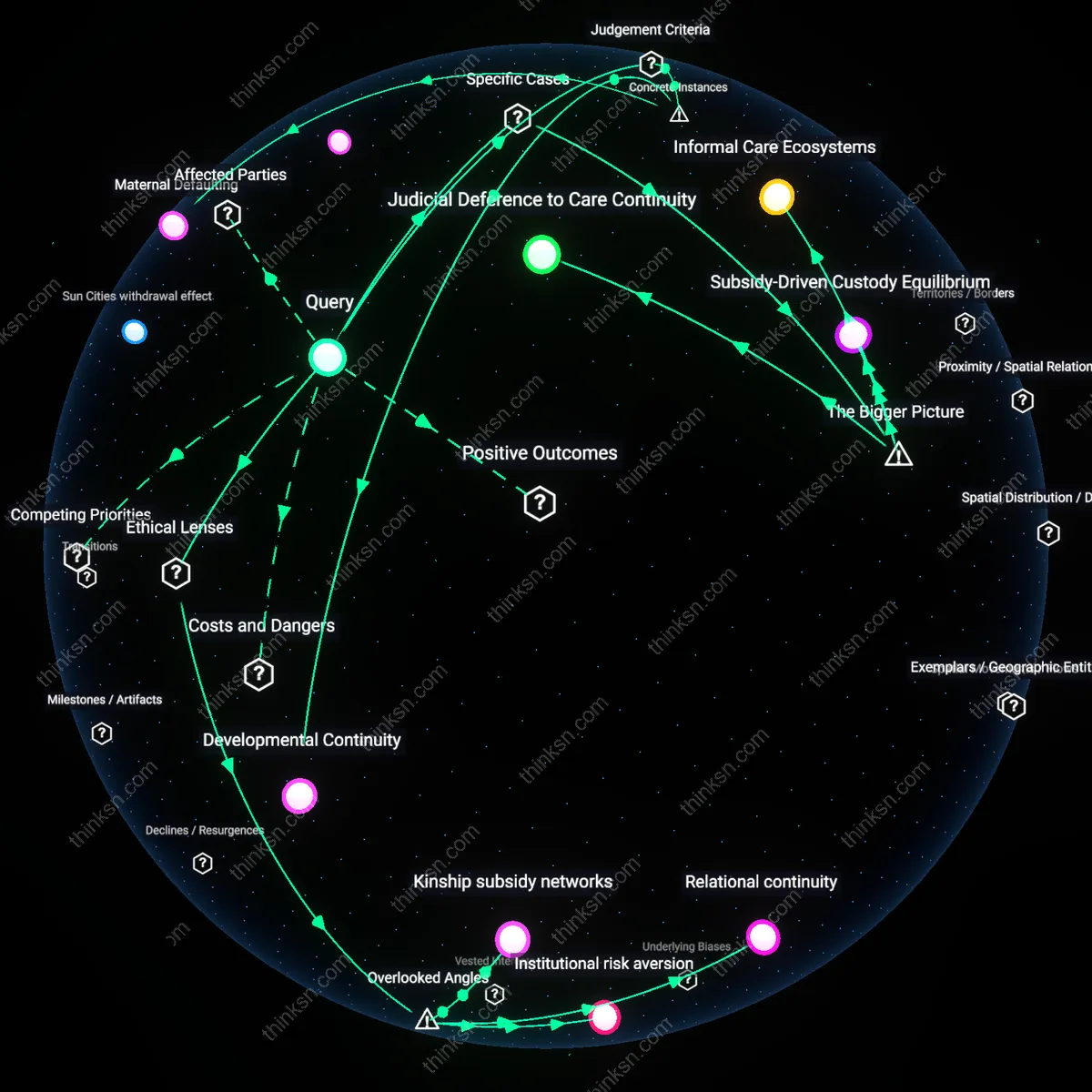
Analysis reveals 9 key thematic connections.
Key Findings
Developmental Continuity
In the 2016 Ontario Court of Appeal decision *L.(J.) v. C.(S.)*, a mother with significantly lower income but stable caregiving history was awarded primary custody over a higher-earning father due to the child’s established routine, school integration, and emotional dependence on her, revealing that judicial benchmarks prioritize psychological stability over economic capacity. The court invoked section 24(2) of the *Children’s Law Reform Act*, which lists the 'best interests of the child' as the sole determining factor, and emphasized continuity in attachments, daily habits, and community networks as legally weighty elements. This approach underscores that the judiciary treats developmental trajectory as a distinct moral yardstick—separable from material provision—especially when disruption risks demonstrable harm to a child’s affective and cognitive growth. What is underappreciated here is that financial disparity is often repositioned not as neglect but as background conditionality, with courts actively resisting equating poverty with parental deficiency when stability is otherwise present.
Institutional Frugality
In Maricopa County, Arizona, between 2010 and 2015, custody determinations in dependency cases increasingly favored kinship caregivers—often low-income relatives—over non-relative foster placements, not solely for relational reasons but because state child welfare agencies faced severe budget constraints and relied on federally reimbursable kinship subsidies that cost less than congregate care. The Arizona Department of Child Safety, under court mandate from the *Stand Up for Arizona* class action, was required to minimize out-of-home placement costs while achieving permanency, leading judges to ratify custody assignments that reduced long-term fiscal exposure even when biological parents lacked material resources. This demonstrates that child welfare systems sometimes apply a hidden economic calculus—efficiency—whereby decisions are shaped less by abstract moral norms and more by the imperative to contain public expenditure. The non-obvious insight is that 'best interests' can be operationally defined downstream of administrative thrift, making poverty a structuring condition rather than a disqualifier when it aligns with cost-minimizing placement logic.
Maternal Defaulting
In post-divorce custody rulings in Japanese family courts between 2000 and 2020, primary custody was awarded to mothers in over 90% of cases regardless of income, employment, or paternity involvement, reflecting an uncodified judicial presumption that maternal care is normatively superior—a bias sustained through informal settlement practices and the absence of joint custody statutes until 2024. This systemic tilt persists even when fathers offer greater financial stability, because judges rely on tacit cultural scripts that equate early childhood welfare with biological mothering, effectively institutionalizing gendered caregiving hierarchies under the guise of child-centered outcomes. The Family Court in Osaka’s 2018 mediation records reveal that economic disparity was routinely discounted when mothers could demonstrate routine child-rearing, such as school drop-offs or meal preparation, treating these acts as proxies for irreplaceable emotional labor. The underrecognized mechanism is that child welfare priorities absorb and naturalize gender norms, allowing them to function as silent judgment criteria that preempt economic comparisons entirely.
Relational continuity
Courts award primary custody to less financially resourced parents when the child’s primary attachment bonds have formed with that parent, particularly in cases where the other parent has been intermittently or minimally present. This decision reflects the ethical priority of relational continuity over material advantage, grounded in attachment theory’s influence on family court psychology and the legal doctrine of the ‘best interests of the child.’ The non-obvious dimension is that courts often treat emotional co-narration—the shared daily routines, emotional attunement, and psychological synchrony between child and caregiver—as a form of invisible infrastructure that, once disrupted, cannot be easily rebuilt, even with superior financial resources. This shifts the standard understanding from an economic or logistical analysis to one centered on affective durability and developmental stability.
Institutional risk aversion
Judges assign custody to less resourced parents when reallocating children would trigger mandatory child welfare oversight due to geographic displacement or income thresholds, thereby exposing the family to surveillance or service withdrawal. This behavior follows from risk-minimization logic within bureaucratic child protection frameworks, where removing a child from an emotionally stable but economically precarious environment risks triggering CPS reevaluation, which could escalate foster involvement. The overlooked dynamic is that courts implicitly prioritize procedural containment over material uplift, seeking to avoid activating parallel state interventions that could destabilize the family more than poverty itself. This reveals that child welfare systems often optimize for administrative manageability rather than holistic well-being.
Kinship subsidy networks
Primary custody is granted to lower-income parents when extended kin networks—such as grandparents, aunts, or community elders—are actively providing off-the-books caregiving labor and housing support, making the parent’s household more viable than formal assessments acknowledge. This reflects an implicit recognition of non-state care economies within communitarian ethics and customary law, which courts pragmatically accommodate even when unrecorded in financial affidavits. The underappreciated factor is that these informal subsidy networks function as stealth social infrastructure, redistributing care in ways that formal custody evaluations rarely measure but judicial experience often detects. This challenges the standard narrative that economic disadvantage is uniformly detrimental by revealing hidden redistributive resilience within marginalized communities.
Judicial Deference to Care Continuity
Courts prioritize stable caregiving relationships over income when a parent has been the primary hands-on caregiver, as seen in Washington State’s dependency court rulings involving low-income mothers retaining custody post-reunification. This reflects a systemic preference embedded in child welfare guidelines—such as the Adoption and Safe Families Act’s ‘reasonable efforts’ clause—for minimizing disruptive transitions, especially when children have formed strong attachments. The non-obvious implication is that financial disparity is often overridden not due to ideology, but because judges treat continuity of care as a legally actionable form of stability, codified through case law interpreting ‘child’s best interest’.
Informal Care Ecosystems
In New York City’s child welfare cases, courts often award primary custody to financially disadvantaged parents embedded in robust kinship networks, such as maternal grandmothers or aunts actively participating in childcare. These arrangements succeed because the court system relies on observable, community-supported care infrastructures rather than balance sheets, allowing non-market forms of capital to offset income deficits. This reveals that child welfare actors use de facto care availability—documented through home visits and caseworker assessments—as a proxy for fitness, privileging relational density over financial metrics when evaluating custody fitness.
Subsidy-Driven Custody Equilibrium
In rural Missouri, courts have granted primary custody to lower-earning parents who qualify for state-funded child care subsidies, Medicaid, and housing assistance, effectively closing resource gaps that would otherwise disqualify them. State eligibility frameworks act as equalizing mechanisms, transforming financial need into access points for institutional support, thereby altering custody cost-benefit calculations. The underappreciated dynamic is that welfare architecture—not judicial altruism—creates the material conditions for custody decisions favoring less-resourced parents, revealing a stealth redistribution logic built into child welfare administration.