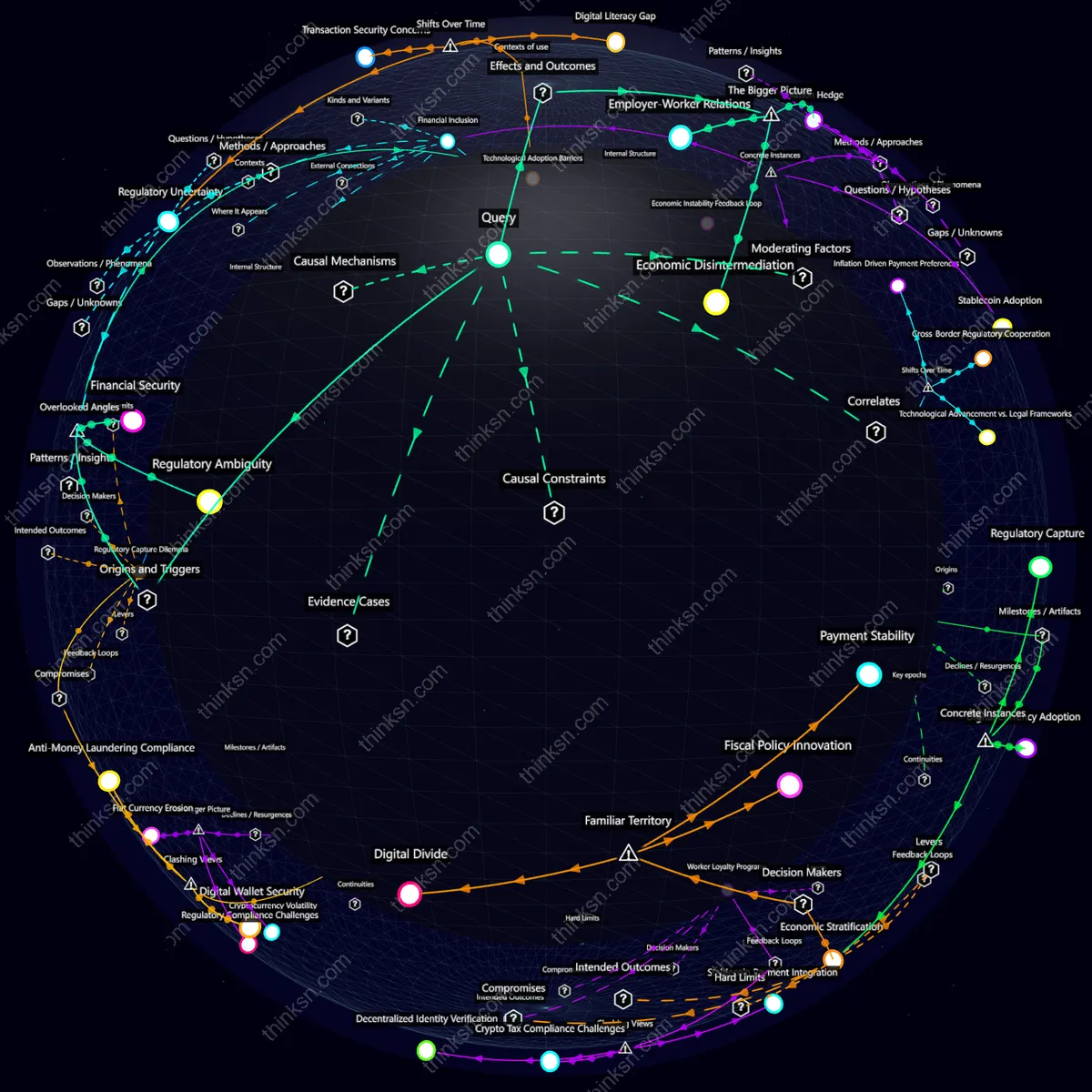
Gig Workers Demand Stablecoins Over Fiat in Inflation Era
Analysis reveals 6 key thematic connections.
Key Findings
Financial Security
The shift towards stablecoin payments from gig workers could heighten the perception of financial security among this workforce. However, it may also exacerbate income inequality if only a portion of gig workers adopt stablecoins, leaving many behind in a fragmented labor market.
Regulatory Ambiguity
The move to stablecoin payments amid inflation could push regulators into uncharted territory. This ambiguity might lead to reactionary policies that either stifle innovation or inadvertently create new risks for gig workers dependent on digital currencies.
Technological Adoption Barriers
Adopting stablecoins requires overcoming technical and educational barriers, which could disproportionately affect older gig workers or those in less tech-savvy regions. This may lead to a bifurcated labor market where access to digital financial tools becomes a new form of socio-economic stratification.
Economic Disintermediation
The shift towards stablecoin payments could disrupt traditional financial intermediaries like banks and payment processors. This disintermediation reduces transaction costs but also diminishes regulatory oversight, potentially leading to increased risks of fraud or money laundering in the gig economy.
Inflation Hedge
Gig workers seeking stablecoin payments may be motivated by an attempt to hedge against inflation. This behavior could signal a broader shift towards cryptocurrencies as a store of value, challenging traditional monetary policies and central bank authority over economic stability.
Employer-Worker Relations
If gig workers demand stablecoin payments, it might alter the power dynamics between employers and workers. Employers may resist such changes due to operational complexities or regulatory concerns, leading to potential conflicts that could reshape labor laws and employment contracts in favor of more flexibility for workers.
Deeper Analysis
What are the technological adoption barriers for gig workers transitioning to stablecoin payments in the labor market amid inflation?
Digital Literacy Gap
The digital literacy gap between gig workers and tech-savvy users poses significant barriers to adopting stablecoin payments. As inflation drives the need for alternative financial tools, those with limited technical skills struggle to navigate complex crypto platforms, risking financial exclusion and widening economic disparities.
Regulatory Uncertainty
Unclear regulations surrounding stablecoins create a chilling effect on gig workers transitioning to this payment method. The lack of clear legal frameworks increases the risk of regulatory backlash, deterring many from experimenting with what could be a more stable form of currency during inflationary periods.
Transaction Security Concerns
Gig workers often face high transaction security concerns when transitioning to stablecoin payments. While stablecoins promise financial stability amid inflation, the fear of hacking and loss of funds is palpable, leading many to prefer traditional banking systems despite their drawbacks.
What emerging insights can be derived from gig workers seeking stablecoin payments as an inflation hedge, and what diverse perspectives exist on this trend's impact on labor markets during inflationary periods?
Stablecoin Adoption
Gig workers adopting stablecoins to mitigate inflation risks expose them to volatile cryptocurrency markets, undermining the stability they seek. This shift can lead to a fragmented labor market where only tech-savvy or financially literate gig workers benefit from stablecoin payments.
Financial Inclusion
As more gig workers demand stablecoin payments, traditional financial institutions may struggle to keep up with digital payment trends, widening the gap between those who can access advanced financial tools and those who cannot. This trend could exacerbate income inequality among gig workers during inflationary periods.
Regulatory Scrutiny
The rise of stablecoin payments as an inflation hedge attracts regulatory attention, posing compliance risks for gig economy platforms. Stricter regulations might curtail the flexibility and autonomy that gig workers value, potentially driving some to informal or unregulated market segments.
What strategies could regulatory bodies implement to address the challenges and opportunities presented by gig workers requesting stablecoin payments in response to inflation?
Inflation-Driven Payment Preferences
Regulatory scrutiny intensifies as gig workers increasingly prefer stablecoin payments to mitigate inflation risks. This shift forces regulators to balance speed and accuracy, potentially leading to regulatory lag that hampers innovation and adoption.
Cross-Border Regulatory Cooperation
As gig workers with stablecoin preferences transcend national boundaries, regulatory scrutiny drives international collaboration to harmonize rules. However, this process is fraught with jurisdictional conflicts and differing priorities, delaying effective oversight and exacerbating systemic risks.
Technological Advancement vs. Legal Frameworks
The rapid evolution of stablecoin technology challenges existing legal frameworks, prompting regulatory scrutiny to evolve dynamically. This constant adjustment requires significant resources and can create fragile dependencies on technological advancements, risking instability if regulations lag behind innovation.
Financial Inclusion
Regulatory scrutiny of stablecoin payments for gig workers raises the bar for financial inclusion. Policymakers must balance innovation with risk, ensuring that regulatory frameworks do not inadvertently exclude a significant portion of the workforce from digital payment systems.
Crypto Regulation Paradoxes
As regulators seek to understand and govern stablecoin transactions among gig workers, they face paradoxes in crypto regulation. Overly stringent rules may stifle innovation and adoption, while too lenient policies could expose users to significant risks, creating a delicate balancing act.
Economic Instability Feedback Loop
Regulatory scrutiny can inadvertently contribute to economic instability if it fails to address the underlying causes of inflation that drive gig workers towards stablecoin payments. This oversight may exacerbate cycles of financial volatility and worker insecurity, highlighting the need for a holistic approach.
Explore further:
- How might financial inclusion initiatives impact gig workers' preference for stablecoin payments over fiat currency during inflationary periods?
- What are the potential systemic strains and trade-offs in labor market regulations when gig workers prefer stablecoin payments over fiat currency during inflation, considering the crypto regulation paradoxes?
What are the potential systemic strains and trade-offs in labor market regulations when gig workers prefer stablecoin payments over fiat currency during inflation, considering the crypto regulation paradoxes?
Regulatory Arbitrage
The crypto regulation paradox encourages regulatory arbitrage where businesses exploit differences in national policies. For example, gig economy platforms might relocate their operations or shift assets to jurisdictions with more favorable regulations, undermining local labor market protections and tax revenues.
Monetary Policy Efficacy
When stablecoins are widely used by gig workers during inflationary periods, traditional monetary policy tools like interest rates may become less effective. Central banks face a complex challenge in maintaining price stability without stifling the growth of digital currencies and related innovations.
Stablecoin Inflation Hedge
During periods of high inflation, gig workers often prefer stablecoins over fiat currency for their stability and ease of use. However, regulatory uncertainty around stablecoins can lead to a paradox where increased demand from gig workers exacerbates market volatility, undermining the very stability that attracts them.
Labor Market Fragmentation
As gig workers increasingly seek stablecoin payments for their labor, traditional employment protections and benefits become less relevant. This shift can lead to a regulatory paradox where efforts to protect gig workers through labor market regulations are rendered ineffective due to the preference for digital assets that operate outside conventional financial systems.
Regulatory Capture Dilemma
Financial institutions and tech firms with vested interests in stablecoin adoption may influence regulators to soften restrictions, leading to a regulatory paradox. This can result in systemic risks as oversight is compromised for the sake of innovation and market stability, leaving gig workers vulnerable to financial instability.
Explore further:
- How might shifts towards gig workers demanding stablecoin payments instead of fiat currency affect the efficacy of monetary policy over time?
- In the context of regulatory capture, what strategies can labor market regulators and gig platforms employ to address workers' preference for stablecoin payments over fiat currency during inflation?
How might shifts towards gig workers demanding stablecoin payments instead of fiat currency affect the efficacy of monetary policy over time?
Digital Currency Adoption
The rapid adoption of stablecoins by gig workers could undermine traditional monetary policy efficacy by creating a parallel financial system. Central banks might struggle to control inflation and liquidity in the fiat economy if significant portions of economic transactions move off their radar into digital currency networks.
Regulatory Capture
Fintech companies that facilitate stablecoin payments may lobby for regulations that favor their business models, potentially leading to a regulatory capture scenario where monetary policy is distorted in ways that benefit the new financial intermediaries rather than the broader economy. This could erode public trust in traditional central banking mechanisms.
Economic Stratification
The increasing reliance on stablecoins among gig workers might exacerbate economic stratification, as those outside this digital payment ecosystem are left behind. This bifurcated economy poses challenges for monetary policy to ensure equitable distribution of financial benefits and risks across all segments of society.
In the context of regulatory capture, what strategies can labor market regulators and gig platforms employ to address workers' preference for stablecoin payments over fiat currency during inflation?
Labor Union Influence
As gig workers increasingly prefer stablecoin payments for their stability during inflation, labor unions face a dilemma in advocating for worker rights. They must balance the need to support digital payment methods that align with workers' preferences against the risk of losing control over traditional wage negotiation strategies, potentially undermining long-term bargaining power.
Digital Wallet Security
The shift towards stablecoin payments complicates regulatory capture dynamics by introducing new security challenges. Gig platforms and regulators must navigate a delicate balance between facilitating user-friendly digital wallets and ensuring robust security measures against fraud, which can be at odds with the ease of access that gig workers seek.
Anti-Money Laundering Compliance
Regulatory capture becomes more intricate when considering anti-money laundering (AML) requirements in the context of stablecoin payments. While gig platforms and regulators aim to protect financial systems, stringent AML policies can inadvertently stifle innovation or create barriers for small-scale operators trying to enter the digital payment ecosystem.
What strategies could be implemented to mitigate economic stratification when gig workers prefer stablecoin payments over fiat currency during periods of inflation?
Payment Stability
As gig workers opt for stablecoin payments to shield against inflation, this shift can stabilize income levels among lower-income earners. However, it may also widen the wealth gap if higher-income individuals continue to prefer traditional investment avenues that outpace inflation.
Fiscal Policy Innovation
Governments and central banks are increasingly pressured to innovate fiscal policies that accommodate stablecoin usage. This could lead to regulatory frameworks that either promote financial inclusivity or inadvertently create new barriers for those less tech-savvy, deepening economic stratification.
Digital Divide
The preference for stablecoins among gig workers highlights the digital divide, where access to stablecoin technology and knowledge varies widely. This disparity can exacerbate existing socioeconomic inequalities, leaving marginalized groups further behind in terms of financial stability and opportunities.
How might labor unions react to gig workers' preference for stablecoin payments over traditional currency in times of inflation, and what emerging trends could this shift reveal about future labor market dynamics?
Digital Wallet Integration
As gig workers increasingly prefer stablecoin payments over traditional currency due to inflation concerns, labor unions face the challenge of integrating digital wallets into their benefits and support systems. This shift could strain union resources and necessitate new technological investments, potentially widening the gap between tech-savvy and less-technically-oriented workers.
Regulatory Compliance
Labor unions must navigate complex regulatory landscapes to advocate for gig workers using stablecoins, which can vary significantly by region. This may lead to fragmented union strategies and increased legal costs, weakening the collective bargaining power of gig workers across different jurisdictions.
Worker Loyalty Programs
Unions could develop loyalty programs linked to stablecoin payments to retain and attract members, but this approach risks alienating those who prefer traditional currency or lack access to digital wallets. Such initiatives may inadvertently deepen the divide between unionized gig workers and independent contractors.
Explore further:
How will digital wallet integration evolve to accommodate gig workers requesting stablecoin payments instead of fiat currency amid inflation?
Cryptocurrency Volatility
The rise of stablecoin payments through digital wallets for gig workers intensifies the scrutiny on cryptocurrency volatility. As inflation pressures push more towards stablecoins, sudden market fluctuations can still undermine trust and adoption among users wary of financial instability.
Regulatory Compliance Challenges
As gig workers increasingly demand stablecoin payments via digital wallets to hedge against inflation, regulatory bodies face growing pressure to establish clearer guidelines for cross-border transactions involving cryptocurrencies. This creates a complex web of compliance challenges that could slow down the integration process and expose users to legal risks.
Fiat Currency Erosion
The shift towards stablecoin payments via digital wallets signals a decline in reliance on fiat currencies for gig workers, potentially accelerating their erosion as primary transaction mediums. This trend could provoke countermeasures from central banks to stabilize national currencies, leading to cycles of policy adaptation and technological response.
What strategies can companies implement through worker loyalty programs to attract gig workers who prefer stablecoin payments during inflationary periods?
Stablecoin Payment Integration
Integrating stablecoin payments into worker loyalty programs can attract gig workers seeking financial stability during inflationary periods. However, this strategy may create dependencies on specific blockchain networks, exposing companies to regulatory risks and technical vulnerabilities.
Crypto Tax Compliance Challenges
Worker loyalty programs that offer crypto incentives must navigate complex tax compliance issues, potentially deterring gig workers who are wary of additional bureaucratic hurdles. This could undermine the program's effectiveness in attracting talent during volatile economic times.
Decentralized Identity Verification
Implementing decentralized identity verification for worker loyalty programs can enhance security and trust but may alienate gig workers uncomfortable with privacy concerns or lacking access to necessary technologies, highlighting a potential trade-off between innovation and inclusivity.