How Curated Content Algorithms Impact Authentic Community Engagement on Social Media
Analysis reveals 4 key thematic connections.
Key Findings
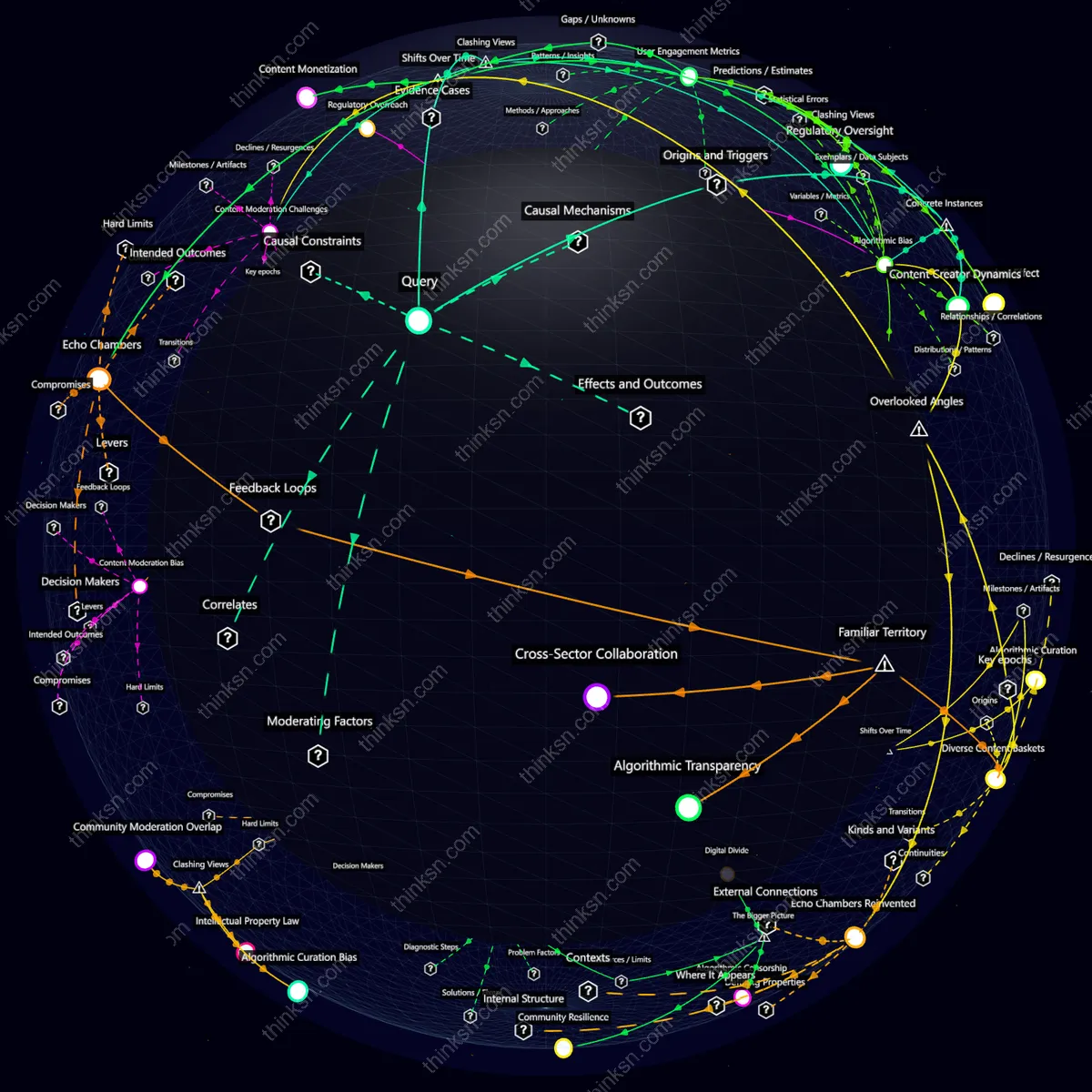
User Engagement Metrics
Prioritizing curated content over raw interactions distorts user engagement metrics by emphasizing quality over quantity. Platforms like Instagram's algorithm shift towards 'meaningful connections' risks alienating users who prefer diverse, less polished content.
Algorithmic Bias
The systemic driver of algorithmic bias surfaces as platforms reinforce echo chambers through curated content prioritization. Facebook's struggles with political polarization exemplify how such biases can marginalize minority viewpoints and foster social division.
Content Creator Dynamics
This shift creates a fragile dependency on content creators who produce high-quality, engaging material. YouTube's reliance on professional vloggers over casual users highlights the risk of platform stagnation if the supply of curated content dries up or becomes homogenous.
Content Moderation Challenges
Over-reliance on curated content can strain content moderation systems as platforms struggle to balance the promotion of quality content with the need for rapid, adaptive responses to emerging issues and trends in user-generated material.
Deeper Analysis
What are the potential quantitative impacts and evaluative consequences of algorithmic bias in prioritizing curated content over raw interactions on community engagement metrics and user trust within social media platforms?
Echo Chamber Effect
Algorithmic bias amplifies the echo chamber effect by prioritizing curated content that reinforces users' existing beliefs. This creates a feedback loop where users are exposed less to diverse viewpoints, reducing their ability to engage critically with differing opinions and potentially polarizing communities further.
User Engagement Metrics
Over-reliance on algorithmic curation for engagement metrics can lead to superficial measures of user satisfaction. Platforms may misinterpret high interaction rates as genuine community engagement, while in reality, users could be disengaging from meaningful interactions and forming shallow connections.
Regulatory Oversight
Algorithmic bias poses significant challenges for regulatory oversight, as it is often difficult to measure or define the extent of bias. This ambiguity can delay necessary policy interventions while platforms continue to exploit user data, eroding public trust and potentially undermining democratic processes.
How has the evolution of content moderation challenges affected community engagement trends on social media platforms as prioritization shifted from raw interactions to curated content?
Algorithmic Bias
As platforms shifted from monitoring raw interactions to curating content through AI, algorithmic bias emerged as a critical challenge. This shift led to skewed engagement trends, often privileging certain types of content or viewpoints over others, thereby amplifying polarizing narratives and silencing underrepresented voices.
User Moderation Fatigue
With the rise in user-generated reports for flagged content, many social media users experienced a growing fatigue from constant moderation duties. This led to a decline in community policing efforts and an increase in passive consumption rather than active engagement, undermining the very fabric of communal self-regulation.
Regulatory Overreach
As governments worldwide introduced stringent regulations targeting online hate speech and misinformation, social media platforms faced unprecedented pressure to enforce strict content moderation policies. This often resulted in overzealous censorship, stifling legitimate discourse and chilling free expression among users.
What are emerging insights and diverse perspectives on how prioritizing curated content over raw interactions influences user engagement metrics in social media communities?
Algorithmic Bias
Prioritizing curated content over raw interactions can exacerbate algorithmic bias by amplifying certain voices and silencing others, leading to a skewed representation of user interests and behaviors. This can alienate diverse communities and reduce overall engagement metrics as users feel their views are not represented.
Echo Chambers
The shift towards curated content in social media increases the risk of creating echo chambers where users only encounter information that reinforces their existing beliefs, limiting exposure to varied perspectives. This can lead to a stagnation or decline in user engagement metrics as interactions become less dynamic and more insular.
Content Monetization
Focusing on curated content over raw interactions often leads platforms to prioritize high-value content that drives ad revenue, potentially at the expense of user-generated content. This trade-off can result in a decline in authentic community engagement and user satisfaction, impacting long-term sustainability.
What strategies can social media platforms implement to mitigate user moderation fatigue when prioritizing curated content over raw interactions for community engagement?
Algorithmic Bias
Increasing reliance on algorithms to moderate content can inadvertently perpetuate algorithmic bias, as these systems often lack nuanced understanding of cultural contexts and subtle forms of expression. This can lead to over-moderation or under-moderation of certain user groups, exacerbating feelings of exclusion and mistrust among community members.
Community Policing Overload
Relying heavily on volunteer community moderators for content moderation can create an unsustainable workload, leading to burnout and a decrease in the number of willing volunteers. This overload not only strains existing moderators but also deters new users from stepping up, creating a vicious cycle where the system becomes increasingly dependent on fewer and fewer individuals.
User Trust Erosion
Prioritizing curated content over raw interactions can erode user trust in social media platforms. Users may perceive that their voices are being silenced or marginalized, leading to a decrease in engagement and an increase in negative sentiment towards the platform. This erosion of trust can be exacerbated if users feel that the moderation is inconsistent or biased.
What strategies can social media platforms implement to mitigate echo chambers when prioritizing curated content over raw interactions to enhance community engagement?
Algorithmic Transparency
Increased transparency in algorithmic curation can empower users to understand how their feed is personalized, potentially reducing reliance on echo chambers. However, this strategy may inadvertently expose the complexity of content moderation and exacerbate user frustration or confusion.
Cross-Sector Collaboration
Social media platforms partnering with fact-checking organizations can introduce diverse perspectives into users' feeds, breaking down echo chambers. Yet, such collaborations might face resistance from communities skeptical of external oversight, creating internal conflicts and operational challenges for the platform.
Diverse Content Baskets
Curating content that includes a wide range of viewpoints can help mitigate echo chambers but risks alienating users who prefer homogeneous information. Platforms may struggle to balance user engagement with diverse content without compromising their core mission or losing audience loyalty.
What are the measurable impacts and trade-offs on community engagement when social media platforms implement stringent community policing to prioritize curated content over raw interactions?
Content Moderation Bias
Stringent content moderation leads to an uneven distribution of curated content, favoring certain viewpoints and voices while suppressing others. This bias can polarize communities by silencing marginalized groups who rely on social media for visibility.
Algorithmic Amplification Effects
The algorithms that prioritize curated content often amplify the reach of established creators, overshadowing raw interactions from less prominent users. This amplification effect can undermine community engagement and creativity by discouraging user-generated content due to perceived futility.
Shadow Moderation Networks
Emerging informal networks of volunteer moderators arise in response to the strain on official moderation teams, often leading to inconsistent enforcement of policies. These shadow moderation networks can introduce new forms of bias and create a fragmented user experience, undermining trust in community policing efforts.
How has the prioritization of diverse content baskets over raw interactions evolved in affecting community engagement on social media platforms over time?
Algorithmic Bias
As social media platforms prioritize diverse content baskets over raw interactions, they risk amplifying algorithmic biases. Curating a wide range of content can inadvertently marginalize niche communities by failing to recognize their unique communication patterns and interaction metrics.
Echo Chambers Reinvented
Efforts to enhance community engagement through diverse content baskets sometimes lead to the creation of echo chambers 2.0, where personalized algorithms curate a sense of diversity but reinforce user biases by selectively amplifying similar viewpoints and excluding contrary opinions.
Content Moderation Challenges
The shift towards prioritizing diverse content baskets complicates content moderation efforts. Platforms struggle to balance the need for broad representation with the imperative to maintain safe and inclusive environments, potentially leading to over-moderation of certain types of content or under-moderation in others.
Algorithmic Curation
As social media platforms shifted towards algorithmic curation of diverse content baskets, they inadvertently prioritized engagement metrics over user privacy and data security. This shift led to increased dependency on opaque algorithms that could manipulate user behavior without their explicit consent, raising ethical concerns about transparency and autonomy.
Cultural Sensitivity
As diverse content baskets aimed to reflect global cultural diversity, social media companies faced increasing pressure to navigate complex issues of cultural sensitivity and representation. This often led to a delicate balance between inclusivity and the potential backlash from communities feeling misrepresented or underrepresented.
Explore further:
- In what ways do echo chambers, reinvented through prioritized curated content over raw interactions, alter the static mapping of community engagement structures on social media platforms?
- In what ways can prioritizing culturally sensitive curated content enhance community engagement and foster a more inclusive environment on social media platforms?
In what ways can prioritizing culturally sensitive curated content enhance community engagement and foster a more inclusive environment on social media platforms?
Digital Divide
Prioritizing culturally sensitive content can exacerbate the digital divide, as communities with limited access to technology might miss out on curated platforms that require advanced devices or internet speeds. This creates an uneven playing field where certain groups are further marginalized due to unequal access.
Cultural Appropriation
Efforts to include diverse cultural content risk crossing into territory of cultural appropriation, particularly in Western contexts where understanding and respect for the nuances of cultures outside dominant traditions may be lacking. This can lead to backlash from communities whose practices are misrepresented or commodified.
Global North vs Global South
Social media platforms based primarily in the Global North often struggle with fostering authentic engagement from users in the Global South, where different norms and values shape content creation. This tension can result in a superficial inclusion that fails to address underlying power imbalances.
Algorithmic Bias
Prioritizing culturally sensitive content can inadvertently amplify algorithmic biases if not carefully managed. Platforms risk reinforcing stereotypes by over-correcting for cultural insensitivity, leading to echo chambers that limit exposure to diverse viewpoints.
Content Censorship
Efforts to promote cultural sensitivity may result in excessive content censorship, stifling free expression and creativity. This can disproportionately affect marginalized communities who rely on social media as a platform for dissent and self-expression.
Digital Colonialism
The push for culturally sensitive content often reflects Western-centric norms, potentially leading to digital colonialism where global internet policies are shaped by narrow cultural perspectives. This can marginalize non-Western cultures and perpetuate power imbalances online.
Explore further:
- What strategies can social media platforms implement to prevent cultural appropriation while prioritizing curated content over raw interactions for enhanced community engagement?
- In social media platforms, how does prioritizing curated content over raw interactions impact community engagement differently in the Global North compared to the Global South under stress conditions such as economic downturns or political instability?
What strategies can social media platforms implement to prevent cultural appropriation while prioritizing curated content over raw interactions for enhanced community engagement?
Intellectual Property Law
Social media platforms risk legal battles if they enforce strict intellectual property laws to prevent cultural appropriation. This could stifle creative expression and inadvertently protect established brands over marginalized communities, highlighting the need for nuanced approaches that balance legal frameworks with ethical considerations.
Algorithmic Curation Bias
Relying on algorithmic curation to detect and mitigate cultural appropriation can lead to biased outcomes. Algorithms may misidentify authentic cultural expressions as inappropriate due to incomplete data, disproportionately affecting content from less represented cultures and reinforcing existing power imbalances.
Community Moderation Overlap
Empowering community members to report and moderate instances of cultural appropriation can create a fragmented moderation landscape. This approach may lead to inconsistent enforcement and potential harassment of users, while also shifting the burden of policing culture onto vulnerable communities who should not have to bear this responsibility.
In social media platforms, how does prioritizing curated content over raw interactions impact community engagement differently in the Global North compared to the Global South under stress conditions such as economic downturns or political instability?
Digital Divide
The digital divide exacerbates disparities between the Global North and South during economic downturns, where access to curated content on social media can be a luxury for those in the Global North with stable internet connections. In contrast, users in the Global South may face significant barriers due to unreliable connectivity or financial constraints, leading them to prioritize basic communication over engaging with complex, curated narratives.
Algorithmic Censorship
Algorithmic censorship on social media platforms disproportionately affects marginalized communities in the Global South during political instability. Curated content algorithms often favor mainstream narratives and can suppress dissenting voices more severely in regions with less robust legal protections for free speech, thereby deepening information asymmetries and undermining community resilience.
Community Resilience
In the Global North, communities may leverage curated content to build resilience through shared narratives that foster solidarity during economic downturns. However, in the Global South, a reliance on raw interactions might be more critical for rapid mobilization and support networks due to weaker formal institutions, highlighting how prioritizing curated content can inadvertently isolate or alienate already vulnerable populations.