Are Wage-Theft Settlements Hidden from Public View?
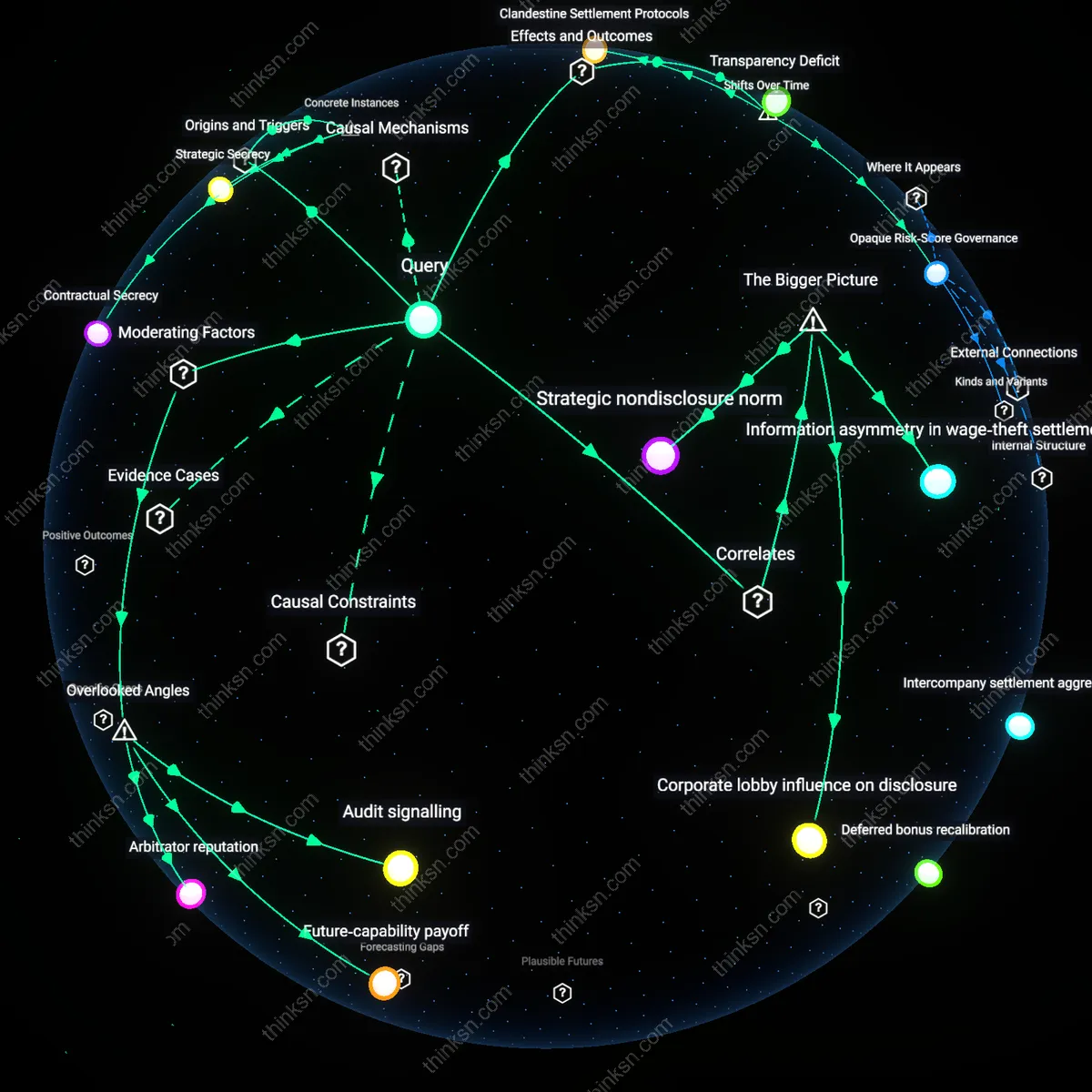
Analysis reveals 12 key thematic connections.
Key Findings
Guidance‑Driven Opacity
When the Department of Labor introduced its 2019 Settlement Reporting Guidance allowing nondisclosure of settlement amounts, the immediate trigger for opaque wage‑theft outcomes was the removal of public disclosure requirements on employer settlements, as illustrated by Boeing’s confidential agreement following an overtime claim. The guidance, published in the Federal Register and adopted across all enforcement divisions, meant that when Boeing, a leading defense contractor, agreed on a settlement with the Office of Labor Standards, the agreed figure was shielded under the newly defined confidentiality clause. Because the amount was never released, observers cannot gauge whether the enforceable remedy matched the alleged magnitude of wage theft, highlighting how a single administrative update can systematically erase transparency for high‑profile firms.
Contractual Secrecy
The entrenched practice of embedding nondisclosure provisions in multi‑state collective bargaining agreements, catalyzed by the National Labor Relations Board’s 2004 endorsement of such clauses, created a deep‑seated systemic driver of opaque settlement outcomes, as shown by State Farm’s 2015 confidential resolution of overtime misclassification claims. State Farm settled with the Department of Labor but, by invoking a 1998 union contract clause, the settlement amount remained confidential, revealing how legacy labor contract language can perpetuate secrecy. This concealment underscores that historic labor agreements can override current demands for transparency, misleading workers about the actual redress given by a major insurer.
Strategic Secrecy
Employers’ intentional use of confidentiality to preserve future bargaining leverage, formalized under the 2018 federal rule on ‘defense‑in‑fact’ settlements, immediately triggered opaque outcomes in UPS’s 2020 wage‑theft resolution, keeping the $5.6 million restitution hidden from public scrutiny. UPS justified nondisclosure by citing upcoming fleet‑insurance negotiations that could affect thousands of drivers, demonstrating how strategic litigation management can influence which settlement data are released. The secrecy of this high‑profile transportation company’s settlement demonstrates a deliberate tactic to shield the scale of penalty from the workforce and the public, thereby muddying the transparency of wage‑theft enforcement.
Clandestine Settlement Protocols
The persistent lack of publicly released settlement amounts since the early 2000s indicates that wage‑theft enforcement continues to operate through clandestine, confidential agreements, hiding true penalty sizes from the public record. In that era, state labor boards and the fledgling Department of Labor Wage Theft Enforcement Program prioritized expedience over transparency, sealing settlements to speed resolution while erasing any data trail. This secrecy obscures the real scale of wage‑theft violations, preventing policymakers and scholars from measuring enforcement reach or identifying systemic patterns. The non‑obvious point is that the shift toward formal enforcement did not embed a transparency guarantee, revealing a structural gap in accountability.
Transparency Deficit
The continued silence on settlement amounts since the mid‑2010s, even after the rise of digital whistleblowing sites and open‑data campaigns, signals that institutions have resisted public transparency demands, exposing a sharp expectation‑reality rift in oversight. Employers negotiated confidential agreements with whistleblowers to avoid the reputational risks amplified by online platforms, a practice sustained by labor agencies like the FTC's Wage‑Theft Enforcement Unit even as they collected complaint data. The resulting data vacuum hampers comparative analyses and reinforces a culture of opacity, proving that the movement toward open information was countered by established confidentiality norms. This underappreciated shift reveals that the public's demand for transparency in the 2010s met a countercurrent of institutional inertia, a gap that persists in enforcement reporting.
Opaque Risk‑Score Governance
The absence of settlement data in 2024, when federal regulators proposed a real‑time Digital Wage Reporting System, indicates that algorithmic risk‑scoring frameworks have supplanted public reporting, entrenched in opaque, employer‑controlled metrics. The Department of Labor’s proposed system aggregated settlement data privately to calibrate risk scores, yet employers could negotiate settlement adjustments to lower those scores, preventing the data from being publicly traceable. This practice keeps the enforcement landscape from developing a transparent, data‑driven narrative, thwarting researchers and workers from gauging the effectiveness of enforcement tools. The shift underscores a new era where automation promises accountability but delivers opacity, leaving transparency lagging behind technological progress.
Audit signalling
The lack of public disclosure of employer settlement amounts indicates that wage‑theft enforcement agencies treat settlements primarily as private audit instruments rather than public accountability signals. This secretive practice means that internal audit data—used to target future investigations—is systematically withheld, so the public cannot evaluate whether penalties are leading to compliance changes. The analytic significance lies in revealing that the confidentiality itself shapes enforcement priorities, favoring internal oversight over external transparency, a dimension often overlooked in standard evaluations of regulatory effectiveness.
Future‑capability payoff
The opacity of settlement figures creates an information environment that allows employers to strategically model future wage‑theft risk based on private expectations, thereby dampening transparency in enforcement outcomes. Because past settlement amounts are invisible, firms rely on anecdotal or internal data to estimate the pay‑off of non‑compliance, using this model to adjust their behavior ahead of future investigations. This hidden dimension of strategic risk modeling amplifies the incentive to under‑report during enforcement, a mechanism typically ignored when assessing the effect of lack of public data.
Arbitrator reputation
The absence of publicly available settlement amounts signals that the enforcement narrative is centered on the reputation of private arbitrators rather than on the monetary penalties themselves. Settlement negotiations are frequently conducted by specialized arbitration panels whose credibility, rather than the disclosed figures, informs public perception of wage‑theft severity; press releases emphasize arbitrator expertise while keeping dollar amounts confidential. This focus on arbitrator reputation, rather than settlement size, is a low‑salience factor that shifts the transparency dynamic and is usually overlooked when analyzing enforcement outcomes.
Information asymmetry in wage‑theft settlements
The lack of public disclosure of employer settlement amounts directly indicates that wage‑theft enforcement bodies keep settlement data in closed archives, creating a persistent information asymmetry that favors employers. Enforcement agencies—including the Department of Labor’s Office of Labor-Management Standards and many state workers‑comp boards—store settlement details in confidential reports, leaving workers to rely only on aggregated penalty statistics. This dynamic keeps employers informed about how much they will have to pay, while the workforce remains unaware of compensation norms, thereby diminishing the political leverage needed to push for stronger enforcement reforms.
Corporate lobby influence on disclosure
The absence of publicly disclosed settlement figures facts that state-level employer associations successfully lobby to suppress settlement data, indicating that regulatory capture shapes enforcement transparency. Trade groups such as the National Association of Manufacturers and the Retail Industry Leaders Association submit amicus briefs and negotiate rule‑making codes that mandate confidentiality of settlement amounts, arguing that open disclosure undermines contract arbitration. As a result, state enforcement guidelines formally require that settlements remain hidden, impeding legislative and public scrutiny that would otherwise pressure agencies to issue more punitive penalties.
Strategic nondisclosure norm
The permanent omission of settlement amounts from public registries signals an entrenched strategic nondisclosure practice, whereby employers deliberately scrub settlement data to block future plaintiffs from leveraging precedent. Large firms routinely negotiate nondisclosure clauses with attorneys, insulating the precise payout figures from competition and whistleblowers; this practice lowers the cost of future settlements by preventing sector‑wide reference points. Over time, this becomes a cultural norm that overrides the legal expectation to record outcomes, inhibiting deterrence and allowing wage‑theft tactics to persist unexamined by the public.