Can Viral Instagram Campaigns Drive Faster Legislative Changes Than Traditional Lobbying?
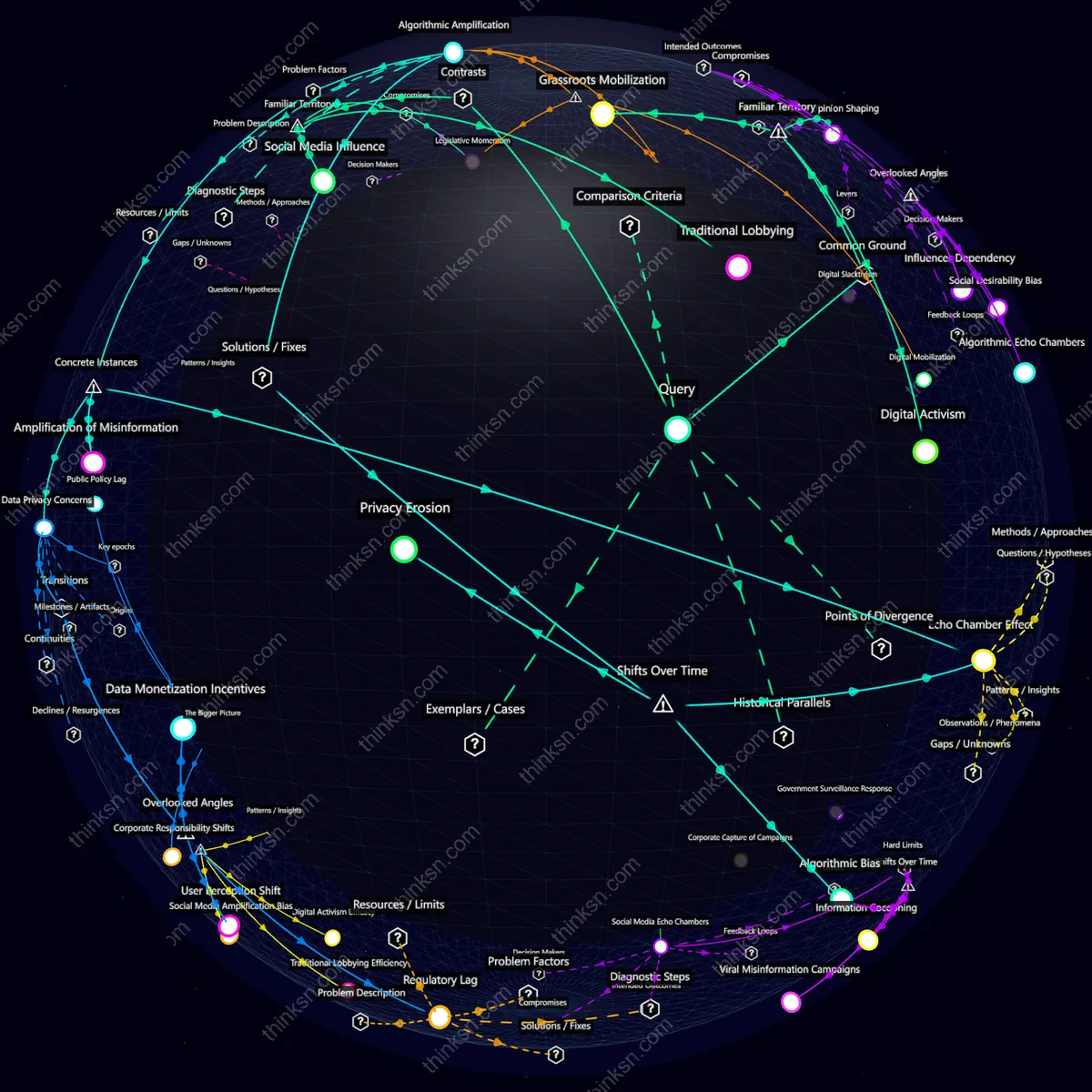
Analysis reveals 6 key thematic connections.
Key Findings
Social Media Influence
Viral Instagram campaigns can rapidly mobilize public opinion, often bypassing traditional media. However, this influence is fleeting and susceptible to viral fatigue or backfire effects when content loses novelty, potentially undermining sustained legislative momentum.
Legislative Momentum
Instagram-driven advocacy might accelerate initial engagement but faces systemic challenges like bureaucratic inertia and entrenched interests. This can lead to a disconnect between digital enthusiasm and the slow pace of actual policy change, risking disillusionment among activists.
Traditional Lobbying
While viral campaigns attract broad public attention, traditional lobbying by professional advocates often yields more consistent results due to deep relationships with policymakers. However, this method lacks the grassroots engagement and media impact of social media-driven movements.
Digital Activism
Viral Instagram campaigns can amplify digital activism, potentially bypassing traditional lobbying. However, this rapid mobilization may lead to superficial engagement without sustained advocacy efforts, undermining legislative impact and fostering a culture of quick fixes rather than long-term solutions.
Public Opinion Shaping
Instagram's capacity to shape public opinion quickly can influence legislators' perceptions of constituent concerns. Yet, this reliance on social media trends might skew policy priorities towards more visible issues, neglecting less sensational but critical areas that require legislative attention.
Grassroots Mobilization
Viral campaigns often galvanize grassroots mobilization by leveraging emotional connections and relatable content. However, the ephemeral nature of social media fame means these movements might struggle to maintain momentum without robust offline organizing, threatening sustained legislative change.
Deeper Analysis
What are potential strategies for leveraging viral Instagram campaigns to accelerate legislative momentum compared to traditional lobbying methods?
Social Media Advocacy
Activists using viral Instagram campaigns to shift public attention from traditional lobbying efforts can amplify legislative momentum by engaging younger demographics. However, this strategy risks alienating older constituents and may undermine relationships with established political stakeholders.
Hashtag Activism
The rise of hashtag activism on Instagram has enabled rapid mobilization around legislative issues but often leads to a 'clicktivist' mentality where engagement is superficial, diluting genuine legislative impact over time. Real-world examples include #MeToo and #BlackLivesMatter.
Influencer Influence
Collaborating with social media influencers to leverage their large followings can quickly build support for legislation but may backfire if the influencer's credibility is questioned or if followers become disillusioned by perceived inauthenticity. A notable example involves K-pop stars advocating for climate change policies.
Explore further:
- What emerging insights and hidden assumptions are there regarding how social media advocacy, such as viral Instagram campaigns, can influence legislative change more effectively than traditional lobbying methods?
- What strategies can be formulated to leverage hashtag activism for more effective viral Instagram campaigns aimed at driving legislative change compared to traditional lobbying methods?
What strategies can be formulated to leverage viral Instagram campaigns for shaping public opinion and driving legislative change more efficiently than traditional lobbying methods?
Social Desirability Bias
Viral Instagram campaigns can amplify social desirability bias by highlighting behaviors or opinions that seem universally accepted. This may lead to conformity pressures, making it difficult for minority viewpoints or dissenting voices to be heard, thus silencing potential opposition and skewing public opinion.
Algorithmic Echo Chambers
Instagram's algorithms can create echo chambers where users are primarily exposed to content that reinforces their existing beliefs. This can polarize opinions and reduce the impact of campaigns aiming for broad-based legislative change, as they may struggle to reach diverse audiences effectively.
Influencer Dependency
Relying heavily on social media influencers to shape public opinion through viral campaigns introduces a dependency that can be fragile. Influencers' influence fluctuates and is often short-lived, leading to unpredictable outcomes and making sustained legislative change challenging.
What strategies can be formulated to leverage hashtag activism for more effective viral Instagram campaigns aimed at driving legislative change compared to traditional lobbying methods?
Digital Mobilization
Hashtag activism can transform digital mobilization by rapidly aggregating diverse voices to demand legislative change. However, this strategy also risks becoming a performative act detached from sustained grassroots organizing, undermining its effectiveness and legitimacy.
Algorithmic Amplification
The reliance on algorithmic amplification in hashtag activism can lead to echo chambers where only certain narratives thrive, marginalizing alternative viewpoints. This dependency limits the diversity of engagement and may provoke backlash from those feeling excluded or misrepresented.
Legislative Momentum
Hashtag activism can create legislative momentum by bringing public pressure to bear on policymakers but often fails to translate online enthusiasm into tangible policy outcomes due to its ephemeral nature, leading to disappointment and disillusionment among activists.
Digital Slacktivism
Hashtag activism often blurs the line between meaningful engagement and digital slacktivism. While it can raise awareness quickly, the ease of participation may lead individuals to feel falsely satisfied after merely sharing a hashtag, thus reducing their likelihood of engaging in deeper, more impactful actions such as volunteering or donating.
Historical Shifts
Over time, hashtag activism has evolved from a novel tactic to a mainstream strategy, shifting public discourse around social issues. Yet this shift has also led to fatigue and skepticism among some audiences who feel overwhelmed by constant demands for attention and engagement, highlighting the need for campaigns to innovate continuously to maintain relevance.
Explore further:
- What are the potential trade-offs and measurable systemic strains when algorithmic amplification is used in viral Instagram campaigns to accelerate legislative change compared to traditional lobbying methods?
- What are the historical shifts in legislative change strategies, and how do they compare to modern viral Instagram campaigns in terms of efficacy and speed?
What are the potential trade-offs and measurable systemic strains when algorithmic amplification is used in viral Instagram campaigns to accelerate legislative change compared to traditional lobbying methods?
Echo Chamber Effect
Algorithmic amplification in viral Instagram campaigns can intensify the echo chamber effect, where users increasingly engage with like-minded content and become less exposed to opposing views. This limits nuanced discussions on legislative change, polarizing communities and potentially hindering collaborative problem-solving.
Data Privacy Concerns
The use of algorithmic amplification often relies on granular user data, raising significant privacy concerns as users may not fully understand how their information is being utilized to drive political campaigns. This can erode public trust in both social media platforms and legislative processes.
Amplification of Misinformation
Algorithmic amplification can rapidly spread misinformation or misleading narratives, as seen during the 2016 U.S. presidential election when false claims gained traction through automated accounts on Instagram. This undermines efforts to achieve evidence-based legislative change and can distort public opinion.
Privacy Erosion
The use of algorithmic amplification for political campaigns often involves the collection and analysis of vast amounts of personal data, leading to significant privacy erosion among users. This can undermine trust in social media platforms and the broader digital ecosystem, complicating efforts to mobilize public support for legislative change through ethical means.
Algorithmic Bias
When algorithms are designed to amplify certain types of content based on engagement metrics, they may inadvertently propagate algorithmic bias by favoring sensational or controversial narratives over nuanced and balanced discussions. This can skew public perceptions and hinder the development of informed opinions necessary for effective legislative advocacy.
Explore further:
- To what extent might the echo chamber effect on Instagram amplify viral campaigns' impact and potentially bypass traditional lobbying methods in driving legislative change more quickly?
- How do data privacy concerns evolve in viral Instagram campaigns compared to traditional lobbying methods, and what mechanisms drive legislative change over time?
How do data privacy concerns evolve in viral Instagram campaigns compared to traditional lobbying methods, and what mechanisms drive legislative change over time?
User Awareness Campaigns
Instagram's viral campaigns raise user awareness about data privacy in a way that traditional lobbying fails to achieve. However, the ephemeral nature of social media content means this heightened awareness can quickly fade without sustained engagement.
Public Policy Lag
The rapid evolution of digital platforms outpaces legislative adaptation, creating a significant lag where public policy struggles to keep up with changing data privacy concerns. This gap exposes users to increased risk until new regulations are enacted.
Corporate Responsibility Shifts
Companies shift their focus towards more proactive corporate responsibility initiatives in response to viral campaigns, but this can be superficial and driven by public relations rather than genuine commitment to privacy protection.
User Perception Shift
As viral Instagram campaigns leverage personal data for targeted engagement, users' perception of privacy shifts from a private concern to a public issue. This shift amplifies the collective impact of individual choices and triggers greater scrutiny and pressure on platforms to protect user data.
Regulatory Lag
The rapid evolution of digital media outpaces traditional regulatory frameworks, creating significant lag in legislative responses. As viral campaigns exploit gaps in existing laws, this lag not only exposes users to privacy risks but also underscores the need for adaptive and dynamic regulatory mechanisms that can keep pace with technological advancements.
Data Monetization Incentives
The economic incentives driving data monetization through viral campaigns create a delicate balance between innovation and user protection. Companies are increasingly motivated to extract maximum value from user data, often at the expense of privacy safeguards. This dynamic raises ethical concerns about consent and exploitation, highlighting the need for robust oversight mechanisms.
Explore further:
- What are the measurable impacts and potential failures of user awareness campaigns on driving legislative change compared to traditional lobbying methods under high pressure scenarios?
- How does regulatory lag impact the effectiveness of viral Instagram campaigns in driving legislative change compared to traditional lobbying methods?
What are the measurable impacts and potential failures of user awareness campaigns on driving legislative change compared to traditional lobbying methods under high pressure scenarios?
Social Media Echo Chambers
Social media echo chambers amplify user awareness campaigns by focusing engagement within homogeneous groups, creating a perception of broader support than actually exists. This can lead to legislative pressure from misaligned public sentiment and undermine the credibility of genuine grassroots movements.
Government Surveillance Response
Increased government surveillance in response to large-scale user awareness campaigns aimed at privacy rights may backfire, hardening public opposition through a chilling effect on free speech. This paradoxical outcome can stall legislative progress and reinforce existing barriers against change.
Corporate Capture of Campaigns
Large corporations co-opting user awareness campaigns to divert attention from their own practices or interests can dilute the message, leading to watered-down legislation that fails to address core issues. This undermines public trust and weakens genuine reform efforts.
Public Fatigue
User awareness campaigns can lead to public fatigue if the same messages are repeated without innovation. Overexposure diminishes urgency and engagement, undermining legislative support despite increased awareness.
Resource Allocation Disparity
Campaigns often lack the financial resources of traditional lobbying groups. This disparity leads to a skewed playing field where well-funded opposition can outmaneuver user-driven initiatives with greater ease.
Backlash from Traditional Stakeholders
User awareness campaigns may face backlash from entrenched stakeholders who prefer existing systems. Such pushback can fragment support and mobilize counter-campaigns, complicating legislative progress.
Explore further:
- What strategies can be formulated to leverage viral Instagram campaigns while mitigating the risks associated with social media echo chambers to drive legislative change more effectively than traditional lobbying methods?
- What are the emerging insights and hidden assumptions about how resource allocation disparity affects the effectiveness of viral Instagram campaigns in driving legislative change compared to traditional lobbying methods?
What strategies can be formulated to leverage viral Instagram campaigns while mitigating the risks associated with social media echo chambers to drive legislative change more effectively than traditional lobbying methods?
Algorithmic Bias
Social media algorithms reinforce echo chambers by prioritizing content that aligns with users' existing beliefs. This can exacerbate algorithmic bias, where platforms inadvertently promote misleading information over factual reporting, undermining public trust and discourse integrity.
Information Cocooning
Users who reside in social media echo chambers tend to cocoon themselves from opposing viewpoints, leading to a fragmented societal understanding of issues. This can hinder the formation of broad-based coalitions for legislative change, making it harder to achieve consensus and action.
Viral Misinformation Campaigns
Echo chambers amplify viral misinformation campaigns, where false narratives can spread rapidly and widely without scrutiny, diluting the impact of genuine advocacy efforts. This undermines the credibility of social media as a tool for driving legislative change, requiring robust fact-checking mechanisms.
What are the emerging insights and hidden assumptions about how resource allocation disparity affects the effectiveness of viral Instagram campaigns in driving legislative change compared to traditional lobbying methods?
Digital Activism Efficacy
Resource Allocation Disparity significantly alters the perceived efficacy of digital activism on platforms like Instagram. As marginalized groups receive fewer resources for mobilization, their campaigns may appear less impactful compared to those with abundant funding and support, despite potential grassroots effectiveness. This disparity can create a skewed perception among policymakers regarding the true reach and influence of online advocacy.
Traditional Lobbying Efficiency
The efficiency of traditional lobbying methods is challenged when resource allocation disparities favor established actors over emerging digital advocates. Wealthy organizations with deep pockets can often secure more legislative changes through conventional channels, leading to a perception that such methods are superior or more reliable, despite potential ethical and democratic concerns about representativeness.
Social Media Amplification Bias
Resource Allocation Disparity exacerbates social media amplification bias, where content from well-funded campaigns tends to receive greater visibility due to strategic use of resources for influencer collaborations and targeted ads. This creates a feedback loop that silences less privileged voices, reinforcing the dominance of certain narratives over others in driving legislative change.