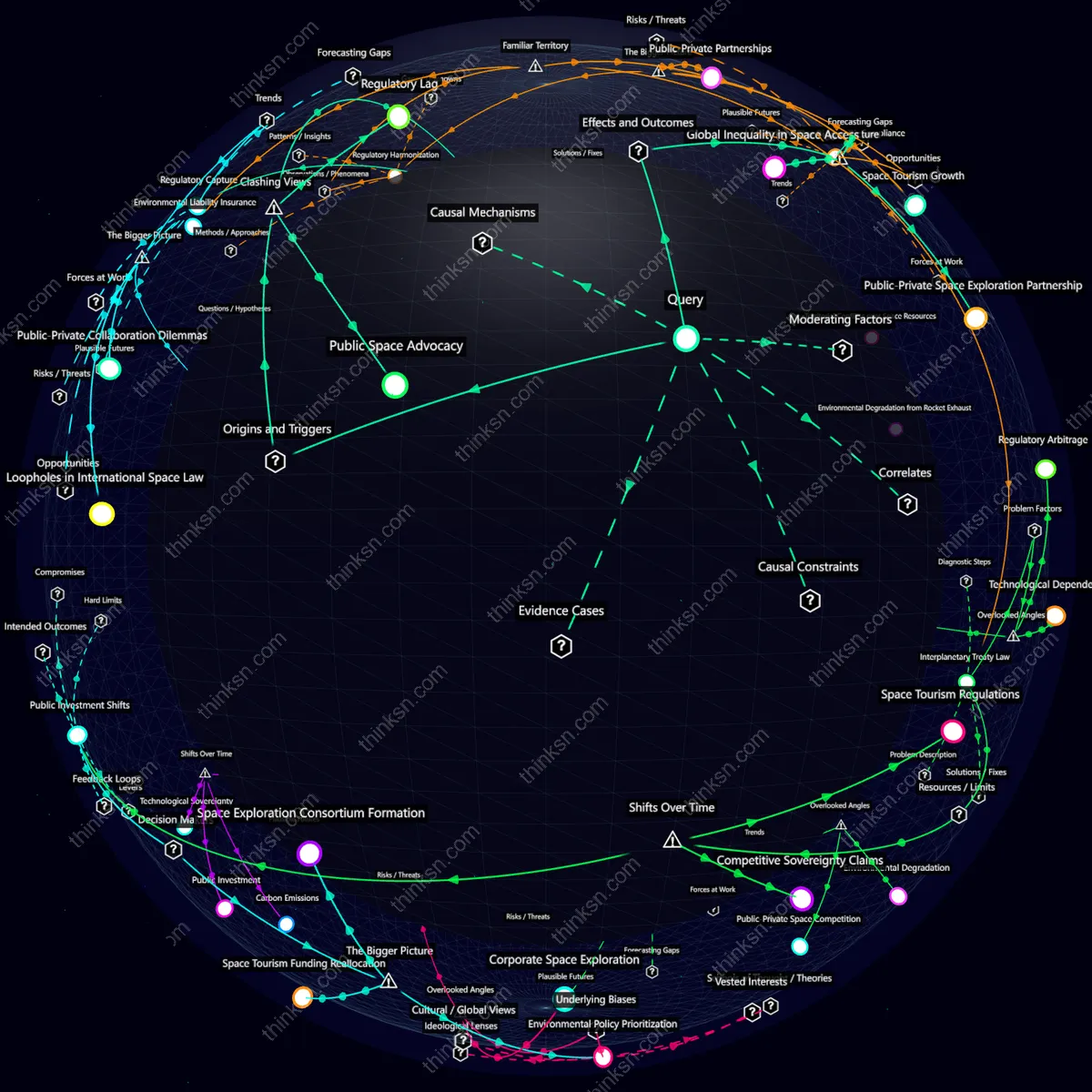
How Space Tourism Affects Earths Environmental Policies by 2045
Key Findings
Space Launches And Climate Rules
Space launches will likely be exempt from carbon accounting by 2045 because policy prioritizes private-sector space development over environmental regulation.
When government space agencies rely on private money to meet goals, they become vulnerable to budget shifts. NASA's Space Launch System, for example, developed under tight public funding, shows how such dependence can weaken long-term planning. As billionaires build their own launch systems, public programs do not get canceled. Instead, they lose priority as lawmakers favor funding new private ventures seen as strategically valuable. This shift mirrors the Commercial Orbital Transportation Services program after 2010, which redirected NASA's focus toward working with private companies. The result is a growing partnership model that values cost sharing over independent public capability. In this model, environmental concerns like pollution from rocket launches take a back seat to technological leadership and economic gains. Because launches are seen as space activities, not Earth-based ones, emissions are often ignored. By 2045, climate policies will likely continue to exclude rocket launches from carbon rules. This exception persists even as total emissions from space activities rise.
Space Tourism's Influence
Space tourism for billionaires will redirect public policy and funding toward private ventures by strengthening political support for market-based solutions over environmental governance.
By 2045, space tourism will be available only to billionaires. This exclusive access will shift political focus away from shared environmental efforts. Instead, it will favor private technological advances. Private success in space builds support for market-driven policies. This pattern emerged when satellite launches were commercialized in the 1990s. At that time, environmental reviews were weakened for private missions. A similar trend will now reduce attention to Earth’s environment. Lawmakers will prioritize private space projects over public science. Regulatory habits from past decades will reinforce this path. Public funds will increasingly support private space companies. This shift mirrors the Obama-era 2010 National Space Policy. Earth science will lose out as a result.
Space Tourism Impact
Space tourism does not change climate policy because voter concern about energy costs keeps political focus on Earth, not space.
By 2045, space tourism may grow, but it will not change environmental policies on Earth. Public spending on space and climate actions still depends on energy use and elections. Agencies like the EPA and NASA have separate goals and budgets. Climate rules and carbon prices are tied to national economies and energy systems. Countries act on climate based on local costs, not space travel. Private trips to orbit do not affect these choices. Voters care more about energy bills than space adventures. Since politicians respond to voters, they focus on Earth-based issues. Orbital tourism does not alter this political reality. So funding and rules stay focused on Earth.
Space Tourism Effect
Elite space tourism delays environmental progress by redirecting public funding and attention through a cycle of spectacle and perceived national achievement.
National space programs often focus on high-profile achievements. They draw funding away from environmental efforts. These programs follow defense-style spending habits. They gain support during moments of perceived strategic urgency. Public money flows to visible tech projects. Early environmental monitoring lost out to NASA after Sputnik. The same pattern could repeat with space tourism. By 2045, a symbolic success in private spaceflight could draw large public funds. Governments may favor commercial space deals. Climate infrastructure would get less support. This shift happens because showy advances attract political and public attention. Private wins are mistaken for national progress. The cycle continues until a severe climate crisis forces change. Until then, space spectacle delays serious environmental action. It captures both budgets and public focus. The delay comes from bureaucracy and attention, not policy failure.
Space And Environment Spending
Space and environmental policy shifts are driven by economic crises, not elite influence, because downturns force governments to reprioritize spending for stabilization.
Public spending on space and environmental policy changes mostly because of major economic shocks and energy crises. These events shift government priorities by affecting growth, jobs, and inflation. The 1973 oil crisis led to new energy agencies and research funding. The 2008 financial crisis pushed support for renewable energy and shale gas to create jobs. Each crisis reshaped both environmental and space policy. Such shifts respond to economic stress, not changes in leadership. Even if private space travel grows by 2045, policy will still react to energy or financial crises. Government budgets for agencies like NASA and the Department of Energy adjust based on economic cycles. This countercyclical funding logic means economic stability drives decisions. The rise of billionaire spaceflight does not shape policy agendas in any meaningful way.
Deeper Analysis
If public concern over climate inequality grows stronger than the perceived strategic value of space dominance, could space launch activities lose their exemption from carbon accounting before 2045?
Space Launch Rules
Regulatory priorities for space launches favor military needs over environmental concerns because national security institutions treat space access as essential to strategic power.
National security goals are the main reason space policies favor military needs over environmental concerns. This shapes regulations so that launch capacity and access to orbit come first. Environmental rules take a back seat, as seen in U.S. policy and similar approaches by other spacefaring nations. Even when environmental issues gain public attention, military priorities remain dominant. Regulatory exemptions for space launches persist because the military sees space access as essential to strength. This view grew from Cold War history, where limits on spy satellites were resisted. Agencies like the U.S. Space Force help maintain this system. They combine military and civil roles, giving defense goals more weight. Metrics like readiness and control of space matter more than carbon emissions or space debris. Because of this, major changes to space launch regulations before 2045 are unlikely. A shift would require a change in national security thinking, not just public opinion.
Private Rocket Launches
Private rocket launches avoid carbon tracking because national reliance on confidential commercial operations prioritizes economic and mission goals over environmental transparency.
National space goals now depend on private companies for rocket launches. This reliance reduces public oversight of rocket emissions. The reason is not a lack of rules. Instead, companies keep launch details secret for business reasons. This shift became clear when NASA moved from its own shuttles to private resupply flights. These missions focused on low cost and success, not environmental data. Today, governments depend on a few wealthy firms for routine access to space. As a result, emissions are not counted in carbon totals. Officials prioritize national economic strength over climate transparency. Firms that reuse rockets quickly are seen as vital to technological leadership. This makes emissions reporting even less of a priority. The pattern matches past actions under arms export rules, where security concerns overrode environmental ones. Without strong global climate policies, this situation will continue. Rocket launches will remain outside carbon accounting systems until at least 2045.
What if public outrage over visible orbital pollution from billionaire spaceflights triggers a backlash that forces environmental concerns back onto the legislative agenda?
Space Trash Backlash
Visible space debris from private launches sparks public and media pressure that forces governments to strengthen environmental rules and shift funding to cleanup efforts.
When debris from billionaire spaceflights fills low Earth orbit, it becomes visible proof of environmental harm in space. This sight triggers public anger, amplified by media coverage. The public outcry forces lawmakers to rethink weak regulations. Like the 1969 oil spill, visible damage disrupts tolerance for unchecked exploitation. Political pressure grows when people see harm caused by elite privilege. The backlash makes environmental oversight a priority again. Major space nations then require environmental reviews for private launches. Public funds shift to cleaning up orbital debris instead of supporting commercial projects.
What if a major climate disaster were directly attributed to emissions from spaceports—would public pressure then force environmental agencies to integrate aerospace activity into terrestrial climate regulations?
Space Tourism Pollution
Space tourism will not face real climate regulation unless agencies are already aligned to assign emission responsibility, because fragmented oversight prevents accountability even after disasters.
A serious climate disaster caused by spaceport emissions would not automatically lead to strict environmental rules for space tourism. Regulatory agencies would only act if they were already ready to expand their authority during a crisis. This kind of readiness happened when the European Union included aviation in its carbon trading system after the 2008 financial crisis exposed risks in exempting industries. The key factor is whether environmental and transportation agencies already work together closely. Right now, they do not for space operations, as oversight is split among transport, defense, and aviation authorities. Without clear lines of responsibility, public outrage cannot force space emissions into climate policies. Past efforts to regulate offshore oil platforms show that visibility alone changes little. So structural reform for space tourism requires advance coordination among agencies. Without it, even a major disaster leads only to weak symbolic actions, not real oversight.
Climate Disaster Triggers
Environmental agencies will regulate spaceport emissions only if a climate disaster provides legally valid proof that those emissions directly and significantly harm atmospheric stability, because past precedents tie regulatory action to clear evidence of large-scale harm.
When government oversight is split between areas like air quality and space operations, gaps in accountability arise. These gaps do not result from weak monitoring. They occur because no laws connect different sectors under shared liability rules. The U.S. Clean Air Act showed this pattern. It allowed federal action only after emissions from fixed sources were clearly tied to cross-border harm. The same logic applies to spaceports. If a climate disaster is clearly linked to emissions from rocket launches, environmental agencies could act. This would not happen just because of public demand. It would happen because past laws and events set a precedent. Major environmental laws and past crises like acid rain proved that clear, widespread harm expands legal responsibility. Agencies would bring space operations into climate rules only if the disaster provides solid legal evidence. That evidence must show launch activities significantly disrupt atmospheric stability. Only then would current environmental authority allow federal intervention. The threshold is not political pressure. It is proof of direct and major impact.
Space Tourism And Climate Rules
Aerospace projects evade strict climate regulation because national competitiveness goals outweigh environmental concerns in shaping policy decisions.
National innovation systems focus on long-term goals that measure technological leadership. These goals shape funding decisions. Agencies favor projects that show clear, visible progress in engineering. Aerospace projects, like space tourism, often win support. They serve as symbols of national strength. Public-private partnerships help sustain political stories about progress. Such projects gain favor not for their economic value but for their visibility in global rankings. Climate impact matters less than this perception of leadership. Regulatory action on aerospace emissions depends more on competition than on environmental risk. History shows this pattern. After Sputnik, science funding rose not for ecological reasons but to signal strength. Even after a climate disaster linked to space launches, agencies hesitate. New rules need broad interagency backing. Such coordination only forms when environmental action supports national prestige. Climate concerns take a back seat to global status. Regulations follow technological competition, not ecological urgency. Public pressure alone cannot shift this focus. Institutional priorities filter environmental demands. The result is clear: ecological rules for aerospace depend on national competitiveness first. Environmental accountability comes second. This shapes how seriously climate impacts are taken. The system responds to prestige, not pollution.
What would happen to public climate funding if a billionaire's space tourism venture triggered a catastrophic orbital incident that directly harmed Earth's atmosphere?
Space Tourism Backlash
Public support for space tourism funding collapses when environmental harm from private launches triggers climate concerns, shifting federal R&D priorities toward restoration.
Federal science funding in the U.S. has often reacted to crises rather than long-term plans. Events like Sputnik, the oil crisis, and the 2008 collapse shifted research priorities. Big funding boosts came during times of national threat, not calm. When energy is stable, public and political support for costly programs fades. Space exploration survives only if tied to survival, economy, or risk. It depends on public willingness to accept debt and high-tech spectacle. Without a major shock, support for space spending drops fast. A single accident could change everything. If a billionaire's space trip damages the atmosphere, reaction intensifies. Ozone loss or pollution like after a major volcano would raise alarm. Space can no longer be seen as separate from Earth's environment. Climate policy then outweighs symbolic technology. The idea that space drives progress loses ground. Funding shifts to climate repair. The claim that stable energy allows steady space funding fails. Atmospheric harm creates a new crisis. Public investment in space tourism loses justification unless strict rules come first.
Space Disaster Diverts Funds
A disaster in space causes more public funding to shift toward space projects and less toward climate programs because governments prioritize restoring technological prestige over environmental recovery.
When a major space accident happens, it often damages the government's image. This damage triggers a stronger and faster public spending response than environmental crises do. After such an event, money shifts toward fixing the immediate reputation problem. The focus becomes high-profile space projects, not long-term climate needs. This pattern is not driven by urgent ecological risks. It is driven by the need to restore national pride in technology. A well-known failure in space, especially one linked to billionaire tourism, would likely cause more funding to go toward space-based solutions. It would not lead to more support for climate programs. Instead, funding for climate action would shrink. The state would prioritize showing off advanced space technology over protecting the Earth. Public resources would flow into repairing the image of technological progress, not into fixing the atmosphere.
Explore further:
- Would public tolerance for space tourism depend more on the source of atmospheric harm being clearly tied to private launches rather than state-led missions, even if the environmental impact were identical?
- Would public funding still shift toward space-based damage control over climate resilience if a major disaster occurred during a period of extreme climate-related disasters on Earth?
What if a major energy security crisis does not occur between now and 2045—how would that affect the relationship between space tourism and environmental policy shifts?
Space Tourism Impact
Space tourism has little effect on environmental policy because stable energy conditions preserve existing bureaucratic and legal processes that are not swayed by non-disruptive technologies.
Long-term energy security keeps environmental regulation on a stable path. This path began in the 1970s with laws like the Clean Air Act. Agencies such as the EPA change slowly through routine rulemaking. Major overhauls only happen during crises. When there is no crisis, policy shifts come from court rulings, lobbying, and coordination between agencies. New technologies like space tourism do not drive these changes. They do not affect budget decisions or legislative schedules. Without a major energy crisis by 2045, space tourism will not shape environmental policy. This is not because of neglect. It is because regulatory systems follow fixed timelines. They also uphold international climate agreements. These systems resist changes from symbolic tech advances. As a result, space tourism influences public debate. It does not alter policy.
Space Billionaires Effect
Stable energy and economic conditions reduce pressure for major policy shifts, allowing public skepticism about billionaire spaceflights to shape demands for fairer investment in environmental and space programs.
When energy is secure and the global economy is stable, governments face less pressure to act boldly on energy or spend heavily to stimulate the economy. Without a crisis, there is less reason to reorganize environmental or space policies. Past shifts, like those after 1973 or 2008, came from major shocks. Today, such crises are absent. Policy changes now rely more on slow, technical reviews than urgent reform. At the same time, high-profile private spaceflights highlight unequal access to technology. These events draw public attention. People begin to question why public funds support space exploration while social needs go unmet. NASA and agencies like it are less likely to get emergency funding. Environmental agencies also face tighter limits on change. The spectacle of wealthy individuals flying to space does not control policy directly. But it strengthens public debate over fairness in spending. If no major energy crisis occurs by 2045, this sense of unfairness will grow. Public pressure may then shift focus toward policies that spread benefits more widely. Elite space travel thus becomes a visible symbol that fuels demands for fairer use of public money.
Rocket Launch Emissions
Rocket launch emissions remain uncounted in global carbon accounting because current climate models do not capture their stratospheric effects, so no policy mechanism can include them.
International carbon accounting rules do not include emissions from rocket launches. These rules treat space launch emissions as too small to matter. The 2019 IPCC report repeated this view. But launch rates are rising fast. Rocket exhaust releases black carbon and alumina into the stratosphere. These pollutants spread high in the atmosphere. Current climate models do not track these effects. Without model input, emissions stay out of national carbon totals. Reusable rockets still don’t trigger reporting. Climate policies rely on model data to assign impacts. Today’s models miss the effects of repeated launches. So, even if private companies run most launches, emissions aren’t counted. Governments may avoid oversight, but that’s not the key issue. The real problem is missing scientific evidence in climate models. Without proof of impact, accounting rules cannot include these emissions. Better models are needed to change policy.
Energy Stability And Policy
Environmental and space policy will follow existing budget and legislative plans if energy stability continues, because funding systems resist public pressure and prioritize technical feasibility over equity concerns.
Stable global energy supplies through 2045 keep national innovation systems on fixed paths. Long-standing budget rules and government hierarchies shape funding more than public sentiment or flashy tech displays. Historical data from groups like the IEA and OECD show that without sudden crises, big shifts in public investment follow existing legislative patterns. Agencies plan in cycles, and funding changes slowly, as seen in the U.S. Department of Energy and NASA programs. High-profile events like billionaire spaceflights do not alter policy because spending decisions are insulated from public pressure. Oversight bodies require cost-benefit analysis, emphasizing technical and security goals over fairness debates. Appropriations rely on routine processes, not political spectacle. Without a major energy crisis, public debate on inequality will have little effect on environmental or space policy. Instead, established budget cycles and legislative plans will set the course.
Space Tourism Influence
Stable energy supply reduces pressure for green reform, allowing symbolic projects like space tourism to shape the justification and direction of public R&D funding.
When energy supplies remain stable, environmental regulations often stop being shaped by urgent crises. Instead, they align with long-standing industrial interests and existing infrastructure. This pattern is clear in policies like the U.S. Energy Policy Act of 1992 and the EU's carbon market design. Both favored market stability over deep change. Without a major energy crisis by 2045, funding will likely continue flowing to established energy systems. This reduces pressure to adopt strong decarbonization policies. More political attention then becomes available for symbolic technology projects. One example is state-supported space tourism ventures. These high-profile efforts can help justify ongoing NASA funding. They are often promoted as sources of new technology or national pride. In this way, space tourism does not control policy but helps shape how space spending is justified. It becomes a tool to legitimize federal research spending within broader environmental and industrial plans. The lack of economic stress makes this possible. Institutional habits grow stronger. Over time, space tourism gains outsized influence on federal innovation budgets.
Explore further:
- What happens to environmental policy if space tourism triggers a powerful new lobbying coalition that aligns with national security interests in orbital infrastructure?
- What if public backlash against billionaire spaceflights triggers emergency-level environmental funding as a symbolic countermeasure, despite stable energy security?
- If climate models were updated to include stratospheric particulate effects from rocket launches, would space tourism emissions automatically trigger accountability under current international carbon frameworks?
- What happens to public funding of space exploration if a sudden energy crisis disrupts long-standing budgetary frameworks before 2045?
What if public backlash over climate inequality forces international bodies to treat orbital access as a global common, overriding national competitiveness concerns?
Rocket Launch Pollution
Orbital access will become a shared global resource only after repeated failures in climate governance force nations to adopt binding rules, not by choice but by necessity.
When only a few private companies control access to space, their launch frequency shapes national power. International agencies cannot enforce rules because authority is spread across different bodies. For example, the International Maritime Organization could not make countries reduce ship emissions. Similarly, there is no global system to track pollution from rocket launches. This pollution is not counted in carbon totals, not because we cannot measure it, but because no single body is in charge. Reusable rockets lower costs and increase flight numbers, but do not require environmental reviews. This gap in oversight is like how the Montreal Protocol missed ozone damage from rocket fuel. As climate concerns grow, rich tourists flying to space draw public criticism. The European Union may tax launch emissions, acting alone. Such moves pressure global agencies to respond or become irrelevant. Orbital access will only be seen as a shared resource if repeated misuse erodes trust in voluntary rules. Only after repeated failures will nations accept binding oversight with monitoring and limits. This shift will happen only after global climate efforts lose credibility, not before. It will be a reaction to crisis, not a preventive step. The result will be a new push for international rules on space emissions. A binding registry will emerge only when current systems fail visibly and repeatedly. The lasting change comes from pressure, not planning. In the end, norms shift only after trust breaks down.
What happens if public outrage over a space-related environmental disaster overwhelms fragmented regulatory authorities before institutional alignment occurs?
Rocket Emissions Gap
Rocket emissions are left out of climate accounting because the UN climate system avoids regulating powerful nations' strategic technologies, not because the emissions are hard to measure.
Current climate rules do not include rocket emissions from high altitudes. This is not because scientists cannot measure them. It is because the UN climate system focuses on emissions within national borders. The Paris Agreement holds countries accountable for land-based sources like factories and farms. It does not cover emissions in upper layers of the atmosphere. These layers are used by rockets and affect climate too. But no global rule requires tracking them there. The system avoids regulating areas linked to national pride and military or economic power. This was true for airlines and ships for years. The same delay is now happening with space. Even if models can show their climate effect, rules depend on political agreement. Major space nations resist new rules. They do not want limits on their activities. So emissions remain uncounted not for scientific reasons but because of political choices.
Space Launch Pollution
Public outrage after space launch pollution will not lead to swift policy change because regulatory authority is split and procedures delay action.
Environmental damage from space launches is often seen as part of wider industrial growth, not just elite misconduct. This view affects how regulators respond. Federal agencies like the EPA, FAA, and NOAA have separate roles under old laws. These roles were not designed for new risks like rocket emissions. During the Deepwater Horizon spill, slow coordination between agencies delayed action. The same problem exists for space launches. Environmental reviews are often pushed to state level or skipped. This allows private companies to operate ahead of rules. The delay is not due to ideology but to how agencies are structured. They follow set procedures that favor inaction. Public anger after a space-related disaster may demand change. But without a unified regulatory body focused on long-term climate harm, those demands lose force. Bureaucratic routines absorb pressure instead of driving reform. Even with clear evidence of harm, policy does not shift quickly. The system is slow by design.
Space Tourism Emissions
Space tourism emissions are excluded from global carbon accounting because no international legal system holds any nation responsible for pollution released in near-space.
Commercial space launches release emissions high in the atmosphere. These emissions occur above national airspace. No international law currently assigns responsibility for pollution in this zone. The area is considered global commons under a 1967 treaty. This means no single country controls it. Existing climate agreements focus on pollution within national borders. They do not cover emissions in near-space. As a result, rocket emissions are left out of global carbon accounting. This gap exists not because scientists cannot measure the effects. It exists because no legal system can assign blame or enforce rules across countries. Even repeated pollution from launches cannot be tracked to any nation's carbon total. Past global environmental deals have created shared rules. But no such agreement exists for space emissions. Without new international laws, this gap will persist. The problem is not scientific uncertainty. The problem is the lack of a legal framework.
Would public tolerance for space tourism depend more on the source of atmospheric harm being clearly tied to private launches rather than state-led missions, even if the environmental impact were identical?
Space Tourism Backlash
Public tolerance for space tourism falls faster when private launches harm the environment because they are seen as violating shared responsibility, triggering demands for regulation.
Public support for space tourism depends more on values than on who causes environmental harm. It matters less if a government or a private company damages the atmosphere. What matters more is whether people see the activity as serving the common good or just helping the rich. When environmental harm comes from private companies, it is seen as unfair. People view such actions as ignoring civic duty. This view grows stronger when the planet is under crisis. Evidence from past events shows this shift. During the ozone crisis, science data changed government priorities. Agencies like NASA and NOAA showed the risks. That led to global action. Health concerns overcame industry resistance. A similar shift happens today when private rocket launches harm the environment. People demand regulation. They look to groups like the EPA or the IPCC for rules. When launches seem like luxury stunts, public tolerance drops fast. The same damage done by governments might be accepted more. But private harm feels like a moral breach. This triggers stronger demands for limits. Regulatory action becomes more likely. Without accountability, public support and public funding cannot last.
Would public funding still shift toward space-based damage control over climate resilience if a major disaster occurred during a period of extreme climate-related disasters on Earth?
Space Launch Pollution
Space launch pollution stays ignored because the UN climate system only tracks emissions tied to countries, not activities beyond national borders.
Emissions from space launches are left out of global climate records. This happens because the UN climate system only tracks pollution reported by countries. The system was built to count emissions within national borders. It does not cover activities that cross or rise above those borders. Climate models used by the UN are designed to track pollution from land-based sources. They do not account for gases released high in the atmosphere by rockets. No global body is responsible for assigning blame for pollution from space flights. Without responsibility, there is no pressure to act. Even if a disaster followed heavy rocket activity, it would not lead to funding for space-related damage control. The event would not fit reporting rules built for countries, not space. Past attempts to include airplane and ship emissions failed for similar reasons. Policy decisions depend more on who is held accountable than on climate data.
What happens to environmental policy if space tourism triggers a powerful new lobbying coalition that aligns with national security interests in orbital infrastructure?
Space Tourism Lobbying Gap
Space tourism cannot shape policy because fragmented oversight prevents the unified lobbying needed for political influence.
Regulatory control over space activities is split among civil, military, and commercial agencies. This separation blocks the formation of a unified lobbying group. Without such a group, space tourism cannot align with national security or industrial policies. In the U.S., the FAA's space office operates separately from defense and NASA programs. In Europe, the Space Agency works apart from defense and energy councils. Political influence in research funding requires coordinated advocacy across agencies. It also needs shared funding and common goals. No major spacefaring nation has created this kind of integrated system by 2023. As a result, private space companies lack the unified voice needed to shape policy. Even if space tourism grows by 2045, it will not gain strong influence over environmental or innovation policy. This is because no integrated governance structure exists to support coordinated lobbying.
What if public backlash against billionaire spaceflights triggers emergency-level environmental funding as a symbolic countermeasure, despite stable energy security?
Space Spending Backlash
Public backlash against elite space travel drives Congress to increase environmental funding as a symbolic act to reaffirm fair distribution of science benefits.
When Congress demands proof that science spending benefits ordinary people, agencies like NASA must justify missions by their practical returns, not national pride. This change became clear after 1990, when the National Science Foundation began requiring research to show social impact, not just scientific value. Public criticism grows when only the wealthy can access headline-grabbing technologies like space travel. People question fairness in spending, even if the power grid stays reliable and climate efforts continue. The pressure comes not from economic crisis, but from expectations that public innovation should serve everyone. Standards from international groups like the OECD reinforce this view. During budget debates, lawmakers respond not by funding new energy solutions, but by boosting environmental programs symbolically. They do this to counter the image of science serving the rich. Therefore, if outrage over billionaire spaceflights grows by 2045, large funding increases for environmental projects will follow. This will not be due to worsening climate risks. It will be a legislative move to restore trust in public science by showing it serves public needs.
If climate models were updated to include stratospheric particulate effects from rocket launches, would space tourism emissions automatically trigger accountability under current international carbon frameworks?
Rocket Emissions Gap
Rocket emissions stay unregulated because current climate models cannot track their stratospheric effects well enough to meet reporting rules.
Unregulated rocket emissions persist because climate rules only track pollution tied to specific countries and economic sectors. Emissions above the tropopause, like black carbon and alumina from rockets, are not included in national reports. These particles affect the climate in ways current climate models do not capture well. The models do not track stratospheric particles often or accurately enough to adjust carbon budgets. Without clear model output showing how these emissions warm the planet, they do not count under climate rules. Even frequent rocket launches cannot change this unless models show measurable warming. The rules require proof of detectable impact on global temperatures, not just the risk of harm. So rocket emissions remain uncounted, no matter how high their volume.
Space Tourism Emissions
Space tourism emissions escape regulation because financial timelines favor investment over environmental safeguards, and monitoring systems have not yet included flight-related pollutants.
The time it takes to see returns on large financial investments does not match the urgent timeline for climate action. This mismatch delays environmental protections in global policy. Funds that rely on long-term profits drive investment in new industries like space technology. Governments shape policies to protect these investments instead of enforcing strict environmental rules. Special economic zones are created to showcase new technologies. These zones often ignore environmental reviews because they promise economic growth. Climate agreements depend on countries reporting emissions every two years. But rocket emissions are not included in those reports, even though agencies monitor the upper atmosphere. As a result, pollution from space tourism flights is not tracked under current rules. Liability rules will not take effect until such emissions are formally measured and included in global monitoring systems.
What happens to public funding of space exploration if a sudden energy crisis disrupts long-standing budgetary frameworks before 2045?
NASA Budget Stability
Public funding for space exploration will stay aligned with current goals through 2045 because long-term budget cycles and interagency coordination limit abrupt shifts during crises.
NASA's funding process is slow and multi-year. This protects space exploration spending from sudden changes. Energy crises have disrupted economies before. Yet NASA kept its core missions funded. The same was true during the 2008 financial crisis. Budgets shift only slightly from year to year. Long-term contracts limit quick changes. Congress reviews funding on a fixed cycle. Agencies coordinate well in advance. The Office of Management and Budget stays focused on long-term plans. So even a major energy crisis before 2045 will not cut space funding much. Changes happen slowly through reprogramming. Major shifts are unlikely. Funding will stay focused on current goals. This will remain true through 2045.