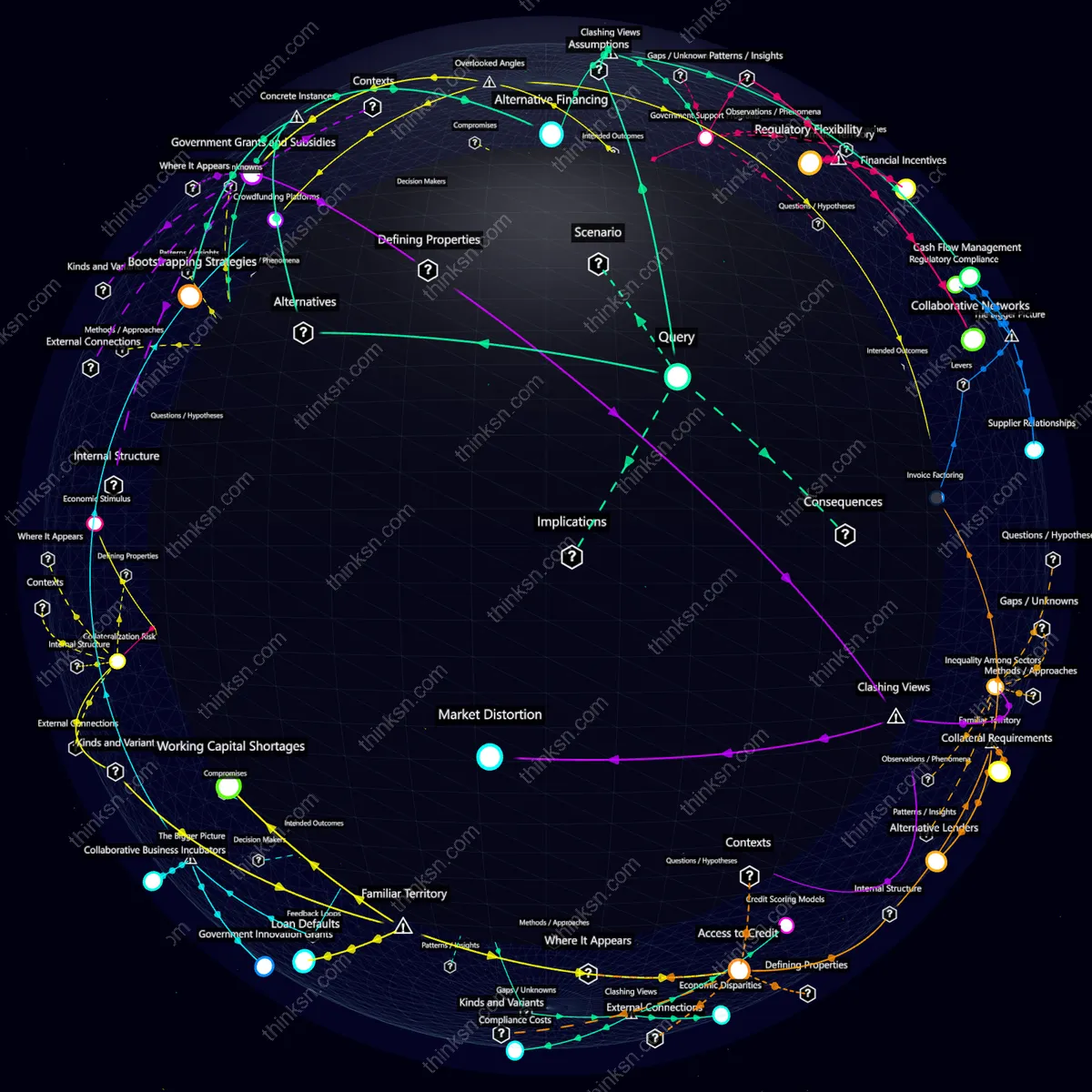
Small Business Financial Adaptation to Stricter Bank Lending During Recovery
Analysis reveals 6 key thematic connections.
Key Findings
Alternative Financing Options
Small businesses might pivot towards alternative financing options like crowdfunding or peer-to-peer lending platforms. This shift can reduce dependency on traditional banks but introduces new risks such as higher interest rates and less regulatory oversight, potentially leading to financial instability if not managed carefully.
Cash Flow Management
Businesses may intensify cash flow management strategies by tightening credit policies with customers or accelerating invoice payments. While this can improve liquidity in the short term, overly aggressive tactics could strain relationships and harm long-term customer loyalty and revenue streams.
Government Support Programs
Small enterprises might seek assistance through government support programs designed to aid businesses during economic transitions. Relying on these programs can provide much-needed relief but also ties the business's financial health closely with political cycles, creating uncertainty and dependency.
Alternative Financing
Small businesses increasingly turn to alternative financing sources like crowdfunding, peer-to-peer lending platforms, and venture capital. However, these options often come with higher interest rates and less favorable terms compared to traditional bank loans, potentially squeezing profit margins.
Bootstrapping Strategies
Business owners adopt bootstrapping strategies such as cutting costs by delaying equipment purchases or reducing staff hours to preserve cash flow. This can lead to a decline in service quality and customer satisfaction, ultimately harming long-term growth prospects.
Government Grants
Small businesses may seek out government grants designed to support economic recovery efforts but these funds often come with stringent requirements and limited availability, forcing businesses to compete fiercely for scarce resources.
Deeper Analysis
What strategies can small businesses employ to explore alternative financing options in response to stricter bank lending criteria during an economic recovery?
Crowdfunding Platforms
Small businesses increasingly turn to crowdfunding platforms like Kickstarter and GoFundMe as banks tighten lending criteria. However, this strategy often requires significant time and effort to build a compelling campaign, engage with potential backers, and manage expectations. Additionally, the success rate can be unpredictable and depends heavily on market trends and public interest.
Invoice Factoring
Invoice factoring allows businesses to sell their outstanding invoices at a discount for immediate cash flow. While this can alleviate short-term financial pressure, it introduces significant costs in the form of fees and reduced revenue from selling invoices below face value. Moreover, over-reliance on invoice factoring can strain business relationships with customers who may feel pressured by late payment collection attempts.
Government Grants and Subsidies
Exploring government grants and subsidies presents a viable but complex path for securing funds without traditional loans. However, navigating the bureaucratic process is often lengthy and requires extensive documentation, which can be resource-intensive for small businesses already stretched thin. Furthermore, eligibility criteria might be stringent, limiting access to only specific industries or projects.
Explore further:
- What strategies can small businesses employ to integrate invoice factoring as a financial adaptation in response to stricter bank lending criteria during an economic recovery?
- What is the impact of government grants and subsidies on small businesses adapting to stricter bank lending criteria during an economic recovery?
What are the emerging insights and diverse viewpoints on how small businesses can leverage government support programs to adapt financially when faced with stricter bank lending criteria during an economic recovery?
Financial Incentives
Government support programs often leverage financial incentives to encourage small businesses to adapt their operations. However, these incentives can create a dependency on short-term subsidies rather than fostering sustainable business models, potentially leaving companies vulnerable if the programs are discontinued.
Collaborative Networks
Support programs that foster collaborative networks among small businesses and government agencies can accelerate knowledge sharing and resource allocation. Yet, such networks may also reinforce existing power dynamics, disproportionately benefiting well-established firms over newer or smaller enterprises.
Regulatory Flexibility
Government initiatives aimed at providing regulatory flexibility to small businesses during economic recovery periods can reduce compliance burdens but may also lead to reduced oversight and quality control standards, posing risks to consumer protection and market integrity.
What strategies can small businesses employ to integrate invoice factoring as a financial adaptation in response to stricter bank lending criteria during an economic recovery?
Cash Flow Management
Effective cash flow management becomes paramount for small businesses integrating invoice factoring as a strategy to navigate stricter bank lending criteria. By closely monitoring and optimizing cash inflows and outflows, companies can mitigate the risks associated with higher borrowing costs and shorter credit terms. However, this often requires significant upfront investment in financial technology solutions or hiring specialized staff.
Supplier Relationships
Invoice factoring can strain supplier relationships if not managed transparently, as suppliers may perceive it as a signal of the company's financial instability. This can lead to reduced trust and potentially higher costs from suppliers seeking assurance through increased prices or stricter payment terms. Businesses must communicate openly with their suppliers about the benefits and stability that invoice factoring provides.
Regulatory Compliance
Small businesses must navigate a complex regulatory landscape when implementing invoice factoring, ensuring compliance with various financial regulations to avoid legal repercussions. The ease of access to funds through invoice factoring might tempt businesses to overlook regulatory requirements, leading to potential fines and damage to the company's reputation if non-compliance is discovered.
What is the impact of government grants and subsidies on small businesses adapting to stricter bank lending criteria during an economic recovery?
Market Distortion
Government grants and subsidies often lead to market distortions by favoring certain businesses over others, potentially stifling innovation and competition. For instance, small businesses that rely heavily on these subsidies may become less competitive in the long run when subsidies are reduced or withdrawn.
Dependency Trap
The reliance on government grants and subsidies can create a dependency trap for small businesses, making them vulnerable to economic shocks. When banks tighten lending criteria during an economic recovery, businesses that have become accustomed to state support may find it challenging to secure private financing.
Inequality Among Sectors
Subsidies and grants often benefit specific sectors more than others, leading to inequality in the distribution of resources. For example, tech startups might receive generous funding through innovation grants, while traditional industries may be left behind, exacerbating existing economic disparities.
Explore further:
- What strategies can small businesses employ to avoid falling into a dependency trap when adapting their financial practices in response to stricter bank lending criteria during an economic recovery?
- How might stricter bank lending criteria during an economic recovery exacerbate inequality among different sectors in small businesses, and what financial adaptations could these sectors consider?
What strategies can small businesses employ to avoid falling into a dependency trap when adapting their financial practices in response to stricter bank lending criteria during an economic recovery?
Financial Flexibility
As small businesses strive for financial flexibility to adapt to stricter lending criteria, they often neglect long-term planning in favor of short-term survival. This can lead to a dependency trap where constant reliance on quick loans or high-interest financing perpetuates debt cycles and stifles innovation.
Digital Financial Tools
The adoption of digital financial tools by small businesses, while intended to improve efficiency and transparency, can create new vulnerabilities. Over-reliance on proprietary software may lock firms into restrictive contracts with tech providers who control critical data and functions, leading to a dependency trap where switching costs are prohibitive.
Government Support Programs
While government support programs aim to aid small businesses during economic recovery, they can inadvertently foster dependency. Businesses may become overly reliant on subsidies or grants, undermining their ability to develop sustainable financial practices and adapt independently in the long term.
Collateralization Risk
Small businesses increasingly rely on personal assets as collateral to secure loans during economic recovery. This practice creates a dependency trap where business owners face severe financial risks if the business fails, forcing them into unsustainable debt cycles.
Funding Diversification Gap
The shift towards stricter bank lending criteria often pushes small businesses towards alternative funding sources like crowdfunding or venture capital. However, these alternatives require significant upfront costs and complex legal structures, making it harder for less experienced entrepreneurs to navigate.
Regulatory Overreliance
Businesses may become overly dependent on government stimulus programs during economic recovery. While initially helpful, this reliance can weaken the business’s long-term resilience when such support is eventually reduced or withdrawn.
What is the impact of collateralization risk on small businesses when bank lending criteria become stricter during an economic recovery?
Access to Credit
Stricter bank lending criteria heighten collateralization risk, making it harder for small businesses with limited assets to secure loans. This restricts access to credit, potentially stifling growth and innovation when economic recovery is underway.
Loan Defaults
As collateralization risk increases due to stricter lending standards, small businesses may resort to risky financial strategies to maintain operations. These tactics can lead to higher loan default rates as the economic recovery fails to meet initial expectations, creating a vicious cycle of debt and instability.
Working Capital Shortages
Small businesses heavily reliant on loans face working capital shortages when collateralization risk escalates due to stringent bank criteria. This forces them to cut costs aggressively, impacting operational efficiency and employee morale, which can undermine long-term recovery prospects.
How does the funding diversification gap evolve as small businesses adapt to stricter bank lending criteria during an economic recovery?
Alternative Lending Platforms
The rise of alternative lending platforms like Kabbage and OnDeck challenges traditional banking dominance by offering quick, data-driven loans to small businesses. This shift can exacerbate the funding diversification gap as smaller firms struggle with platform fees and stringent algorithmic criteria.
Government Grants
Government grants aimed at fostering economic recovery often favor larger enterprises due to complex application processes and scale requirements, leaving micro and small businesses behind. This perpetuates the funding diversification gap by concentrating resources in fewer hands.
Crowdfunding Campaigns
Crowdfunding campaigns have democratized access to capital for creative and technology startups but often exclude traditional brick-and-mortar businesses due to marketing challenges and platform limitations. This reinforces a bifurcated funding landscape where only certain types of ventures benefit from diversification.
How do changes in access to credit affect the financial strategies of small businesses during an economic recovery with stricter bank lending criteria?
Collateral Requirements
As banks tighten lending criteria during economic recovery, stricter collateral requirements force small businesses to tie up valuable assets. This reduces operational flexibility and deters investment in growth opportunities.
Alternative Lenders
The rise of alternative lenders offering more flexible credit terms fills the gap for small businesses struggling with traditional bank restrictions. However, these often come with higher interest rates and less favorable repayment structures.
Invoice Factoring
Small businesses increasingly turn to invoice factoring as a way to access immediate cash flow despite stringent credit conditions. This can lead to financial over-leverage and hidden fees that erode profit margins.
In what ways might government grants serve as an alternative to bank lending for small businesses during economic recovery periods, and what emerging insights can be gleaned from this approach?
Economic Stimulus
Government grants as a form of economic stimulus can redirect small business owners' focus from traditional bank lending towards alternative funding sources, potentially creating a dependency on public sector support during recessions. However, over-reliance may undermine private credit markets and lead to inefficiencies when the economy recovers.
Entrepreneurship Ecosystem
Government grants can significantly alter the entrepreneurship ecosystem by shifting incentives from profit-driven ventures towards socially oriented or innovation-led projects. While this may boost certain sectors, it could also limit the growth of more conventional business models that rely on traditional financing methods.
Regulatory Framework
The evolving regulatory framework for government grants can create fragile dependencies within small businesses as they adapt to changing eligibility criteria and application processes. This flexibility may lead to sudden funding cuts or shifts in priorities, leaving some firms struggling to navigate the complex landscape of public finance.
Explore further:
- What strategies and workflows can be formulated to strengthen the entrepreneurship ecosystem in response to stricter bank lending criteria during an economic recovery?
- How might changes in the regulatory framework influence the financial strategies and compliance challenges faced by small businesses during an economic recovery with stricter bank lending criteria?
What strategies and workflows can be formulated to strengthen the entrepreneurship ecosystem in response to stricter bank lending criteria during an economic recovery?
Crowdfunding Platforms
As banks tighten lending criteria during economic recovery, crowdfunding platforms become critical for entrepreneurs seeking alternative funding. This shift can strengthen community engagement and innovation but also introduces risks such as regulatory scrutiny and the potential for fraud or misuse of funds.
Government Innovation Grants
To bolster the entrepreneurship ecosystem amidst stricter bank lending criteria, governments may introduce innovation grants to support startups. While this intervention can accelerate growth in niche sectors and enhance research, it could also create dependency on public funding and skew market dynamics if not carefully managed.
Collaborative Business Incubators
Incubators play a pivotal role by offering mentorship, resources, and networking opportunities to startups navigating the new lending landscape. However, success hinges on maintaining quality partnerships and avoiding burnout among mentors and over-reliance on incubator services.
How might changes in the regulatory framework influence the financial strategies and compliance challenges faced by small businesses during an economic recovery with stricter bank lending criteria?
Credit Scoring Models
Stricter regulatory frameworks compelling banks to tighten lending criteria can lead small businesses to rely on alternative credit scoring models that incorporate non-traditional data. While this may enhance access for some, it also introduces risks such as increased costs and potential discrimination against certain demographics.
Economic Disparities
Changes in regulatory frameworks can exacerbate economic disparities between small businesses located in urban versus rural areas, where the latter often face greater challenges accessing capital due to fewer financial institutions and less developed credit markets. This uneven distribution of resources may slow overall economic recovery.
Compliance Costs
Increased compliance costs imposed by regulatory reforms can disproportionately burden small businesses, potentially squeezing their profit margins and limiting reinvestment opportunities. Meanwhile, larger corporations with more robust legal teams often adapt more easily to new regulations, widening the competitive gap between big and small enterprises.