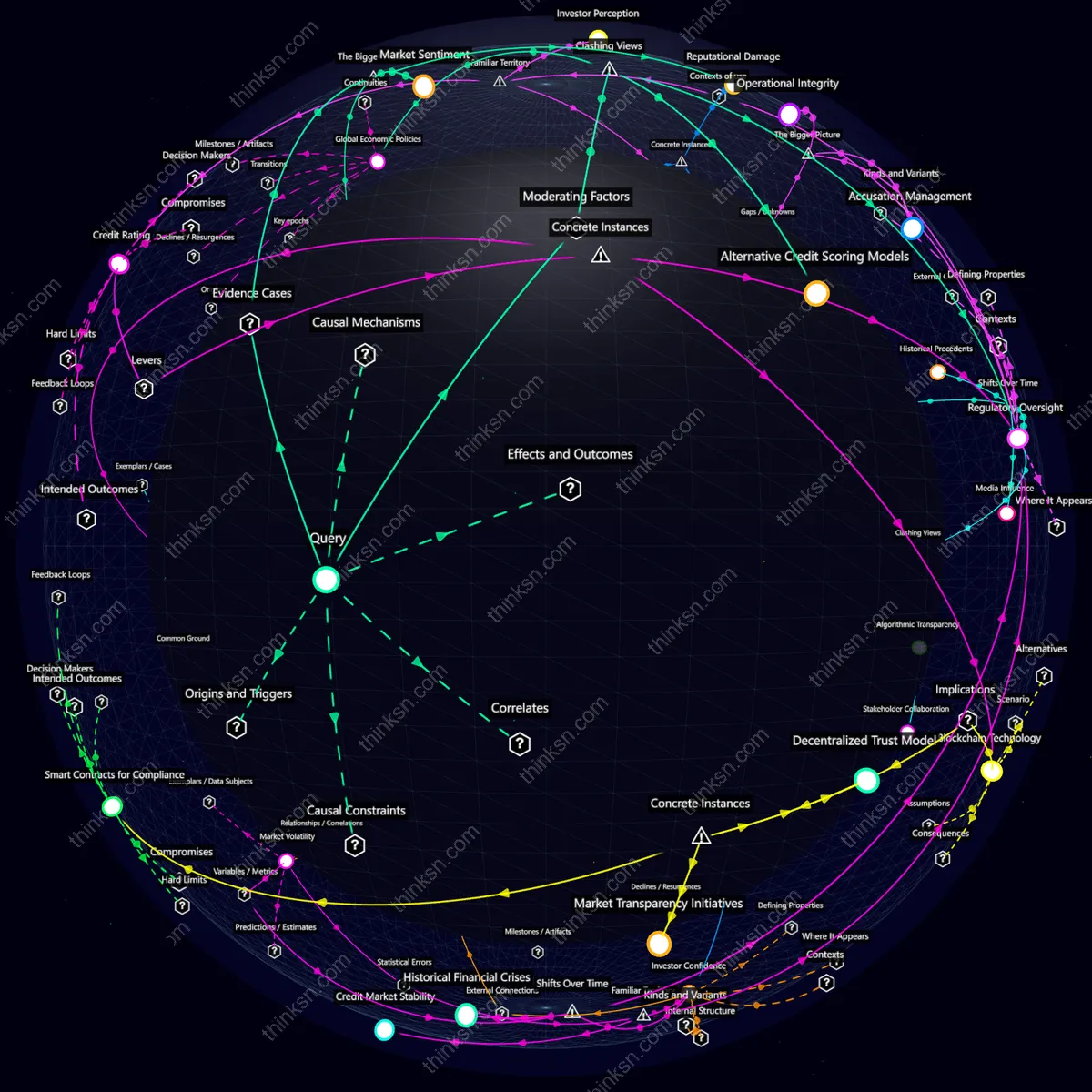
Title: When Credit Ratings Crumble: Investor Trust in Peril
Analysis reveals 6 key thematic connections.
Key Findings
Regulatory Oversight
Increased regulatory scrutiny can paradoxically erode investor confidence if perceived as a reaction to inadequate initial oversight. This highlights the fragile balance between trust in regulatory bodies and market stability, where overreaction might signal systemic risks rather than addressing them.
Alternative Credit Scoring Models
The rise of alternative credit scoring models like those based on big data analytics can undermine traditional agencies' influence. However, this shift may also reveal new vulnerabilities, such as the opacity and bias inherent in algorithmic decision-making processes.
Global Economic Policies
Divergent global economic policies can amplify or mitigate the impact of a corruption scandal by shaping international investor behavior and market responses. For instance, nations with robust anti-corruption measures might attract more capital, shifting power dynamics away from traditional credit rating agencies.
Market Sentiment
The accusation of corruption against a major credit rating agency can dramatically shift market sentiment, leading investors to question the reliability and integrity of financial assessments. This could trigger widespread re-evaluation of investment strategies, potentially causing significant volatility in markets as confidence in established ratings diminishes.
Regulatory Scrutiny
Increased regulatory scrutiny on credit rating agencies following corruption allegations can lead to stricter regulations and oversight, impacting the business models of these entities. This shift could inadvertently stifle innovation or reduce transparency if overly restrictive measures are implemented, creating a delicate balance between protection and efficiency.
Reputational Damage
The reputational damage inflicted on a credit rating agency by corruption accusations can have long-lasting effects, undermining trust among investors and financial institutions. This erosion of credibility may extend to other related entities or industries, illustrating the interconnected nature of market perceptions and systemic risk.
Deeper Analysis
What is the role of regulatory oversight in mitigating the impact of corruption accusations on investor trust and market outcomes for major credit rating agencies?
Market Confidence
Regulatory oversight plays a critical role in maintaining market confidence by ensuring transparency and accountability. However, overly stringent regulations can stifle innovation and investment, creating a delicate balance where minor policy shifts can significantly impact investor trust.
Accusation Management
Effective regulatory oversight involves swift and transparent handling of corruption accusations to minimize market disruption. Failure to act promptly or lack of credibility in investigations can exacerbate investor skepticism, leading to adverse market outcomes for major credit rating agencies.
Operational Integrity
Regulatory bodies must maintain their operational integrity to avoid conflicts of interest and ensure unbiased oversight. If regulatory frameworks become compromised by corruption or political influence, it undermines the entire system's credibility and investor trust.
Investor Perception
Regulatory oversight plays a crucial role in shaping investor perception by ensuring transparency and accountability. Yet, inconsistent enforcement can lead to skepticism among investors, who may doubt the fairness of regulatory actions, thereby affecting their willingness to invest in affected companies or sectors.
Credit Rating
Regulatory oversight is vital for maintaining credibility in credit rating agencies by ensuring that ratings reflect true financial health and risk profiles. However, if perceived as biased towards large institutions or influenced by political considerations, it can severely damage the reputation of these agencies and erode market trust.
Explore further:
- What are the emerging insights and hidden assumptions about how accusations of corruption against a major credit rating agency impact market confidence from diverse perspectives?
- What strategies can be implemented to mitigate the impact on investor trust and market outcomes if a major credit rating agency is accused of corruption?
What are the emerging insights and hidden assumptions about how accusations of corruption against a major credit rating agency impact market confidence from diverse perspectives?
Regulatory Oversight
Increased regulatory scrutiny following corruption accusations can paradoxically erode market confidence by amplifying perceptions of systemic instability and governance failures. While intended to restore trust, stringent oversight may stifle innovation and investment, creating a fragile balance between transparency and operational efficiency.
Media Influence
The rapid spread of negative media narratives around corruption allegations can swiftly undermine market confidence, with financial markets often overreacting before facts are fully established. This dynamic highlights the power of narrative in shaping investor perceptions and behaviors, underscoring the importance of timely, credible information to counteract misinformation.
Historical Precedents
Examining past events such as the Enron scandal reveals that market confidence can take years to recover from significant corporate malfeasance. Historical precedents suggest a cautious approach is needed to manage expectations and restore faith, as public trust once shattered can be exceedingly difficult to rebuild.
What strategies can be implemented to mitigate the impact on investor trust and market outcomes if a major credit rating agency is accused of corruption?
Regulatory Oversight
Strengthened regulatory oversight can mitigate investor mistrust following a corruption scandal by enforcing stricter standards and transparency measures. However, overly intrusive regulation may stifle innovation in the financial sector.
Alternative Rating Agencies
The rise of alternative rating agencies like Egan-Jones or DBRS Limited offers investors an additional perspective but can create fragmentation and uncertainty if these new entrants lack credibility or consistency.
Blockchain Technology
Implementing blockchain for secure, transparent credit scoring could rebuild trust by reducing fraud potential. However, the high cost of adoption and technical barriers may slow widespread implementation.
Explore further:
- What is the role of alternative rating agencies in mitigating investor distrust following accusations of corruption against major credit rating agencies, and how do they compare structurally?
- What alternative scenarios could be formulated if a major credit rating agency were to adopt blockchain technology to mitigate corruption accusations, and how would these strategies impact investor trust and market outcomes?
What is the role of alternative rating agencies in mitigating investor distrust following accusations of corruption against major credit rating agencies, and how do they compare structurally?
Transparency Initiatives
Alternative rating agencies leverage transparency initiatives to build trust among investors by disclosing methodologies and data sources, challenging the opacity of major credit rating agencies. However, this approach can also expose them to legal risks if proprietary information is not adequately protected.
Regulatory Scrutiny
Alternative rating agencies face increased regulatory scrutiny as they challenge the dominance of established players, leading to potential conflicts with financial regulators who must balance innovation and risk management. This can stifle growth or lead to stricter compliance requirements that hinder their agility.
Market Fragmentation
The rise of alternative rating agencies contributes to market fragmentation by offering diverse ratings based on differing criteria, confusing investors and complicating the evaluation process. This diversity can also dilute the influence of major credit rating agencies but may not resolve systemic issues like corruption or bias.
What alternative scenarios could be formulated if a major credit rating agency were to adopt blockchain technology to mitigate corruption accusations, and how would these strategies impact investor trust and market outcomes?
Decentralized Trust Model
Adopting a decentralized trust model could shift credit rating authority away from centralized entities like major agencies towards community-driven validation, reducing dependency on single sources but also introducing challenges in consensus-building and interoperability across diverse stakeholders.
Smart Contracts for Compliance
Implementing smart contracts could automate compliance monitoring and reporting, potentially lowering corruption risk through transparent enforcement. However, this might create new vulnerabilities if the initial contract code contains flaws or if there's a lack of user understanding about their rights and obligations.
Market Transparency Initiatives
Increased transparency could lead to more informed investor decisions by making financial data tamper-proof and readily accessible. This shift might democratize access to information but also strain existing regulatory frameworks, necessitating rapid adaptation to prevent market instability or abuse.
What is the impact of regulatory scrutiny on investor trust and market outcomes when a major credit rating agency faces corruption accusations?
Market Confidence
Regulatory scrutiny of a major credit rating agency facing corruption accusations can severely undermine market confidence as investors question the integrity and reliability of financial ratings, leading to increased volatility and potential liquidity crises in affected markets.
Legal Compliance Costs
Heightened regulatory scrutiny often translates into substantial legal compliance costs for companies and institutions, creating a delicate balance between investment in robust governance structures and the risk of diminished returns due to overregulation or operational inefficiencies.
Reputational Damage
The reputational damage inflicted by regulatory scrutiny can have long-lasting impacts on an organization's market position, as stakeholders may lose trust even after compliance issues are addressed, affecting future business relationships and investor perceptions.
Market Transparency
Regulatory scrutiny increases market transparency by forcing companies to disclose more information about their operations and governance. However, overly stringent oversight can paradoxically lead to reduced trust if perceived as a cover for regulatory capture or biased enforcement.
Investor Confidence
Enhanced regulatory scrutiny may initially bolster investor confidence by signaling stricter control over market practices. Yet prolonged or arbitrary regulation risks eroding this confidence, especially when it disproportionately affects smaller firms or introduces bureaucratic delays that hinder innovation and investment.
Corporate Governance Reform
In response to regulatory scrutiny following corruption accusations against a major credit rating agency, companies may initiate rigorous governance reforms. These measures can range from implementing stricter internal controls to hiring independent watchdogs, but they also introduce operational overhead and potential conflicts with management interests.
Explore further:
- What strategies can be formulated to enhance market transparency in response to corruption accusations against a major credit rating agency, and how might these interventions impact investor trust and market outcomes?
- What is the relationship between investor confidence and market outcomes when a major credit rating agency faces corruption allegations?
What strategies can be formulated to enhance market transparency in response to corruption accusations against a major credit rating agency, and how might these interventions impact investor trust and market outcomes?
Regulatory Oversight
Increased regulatory oversight aims to curb market manipulation by credit rating agencies. However, this could lead to a chilling effect on smaller firms that lack the resources to comply with stringent regulations, potentially stifling innovation and competition.
Algorithmic Transparency
Promoting algorithmic transparency in credit ratings can enhance trust but may also expose proprietary methods to competitors. This could undermine the competitive edge of rating agencies while fostering a more collaborative approach to risk assessment.
Stakeholder Collaboration
Encouraging collaboration between regulators, investors, and other stakeholders can lead to more comprehensive oversight mechanisms. However, such collaborations might also create bureaucratic delays and conflicts over governance, hindering swift action against corrupt practices.
What is the relationship between investor confidence and market outcomes when a major credit rating agency faces corruption allegations?
Market Volatility
When a major credit rating agency faces corruption allegations, market volatility intensifies as investor confidence wanes. This uncertainty can trigger abrupt asset revaluations and liquidity crunches, disproportionately affecting smaller firms reliant on short-term financing.
Regulatory Scrutiny
Increased regulatory scrutiny on financial institutions following corruption scandals at a credit rating agency amplifies systemic risks by tightening compliance requirements. This can hinder market efficiency but may also foster more transparent and resilient practices in the long run, creating trade-offs between short-term disruption and long-term stability.
Cross-Border Investments
Corruption allegations against a major credit rating agency can cause cross-border investments to plummet as investor confidence evaporates. This shift disproportionately impacts emerging markets, exacerbating capital outflows and economic instability in regions least equipped to handle such shocks.
Explore further:
- To what extent can the accusation of corruption against a major credit rating agency induce market volatility, and how might this volatility affect investor trust and broader market stability?
- How do cross-border investments evolve in response to corruption accusations against major credit rating agencies, and what are the long-term impacts on investor trust and market outcomes?
To what extent can the accusation of corruption against a major credit rating agency induce market volatility, and how might this volatility affect investor trust and broader market stability?
Investor Confidence
The erosion of trust in major credit rating agencies due to corruption allegations can significantly undermine investor confidence, leading to rapid withdrawal of capital and increased market volatility. This chain reaction exposes the fragility of financial systems that rely heavily on third-party validation.
Regulatory Oversight
Heightened scrutiny over regulatory oversight emerges as a direct response to corruption accusations against credit rating agencies, reflecting a systemic shift towards stricter controls and transparency measures. This shift may initially stabilize markets but could also stifle innovation and flexibility in financial services.
Historical Financial Crises
The recurrence of themes from historical financial crises, such as the 2008 crisis, underscores how accusations against rating agencies can trigger similar market volatility. This cyclical pattern highlights the enduring impact of institutional failures on investor behavior and broader economic stability.
Credit Market Stability
Uncertainty over the reliability of credit ratings due to corruption can lead to a tightening in lending standards across banks and other financial intermediaries. This results in reduced availability of credit for businesses and consumers, potentially slowing economic growth and increasing default risks.