Backlogged Bench
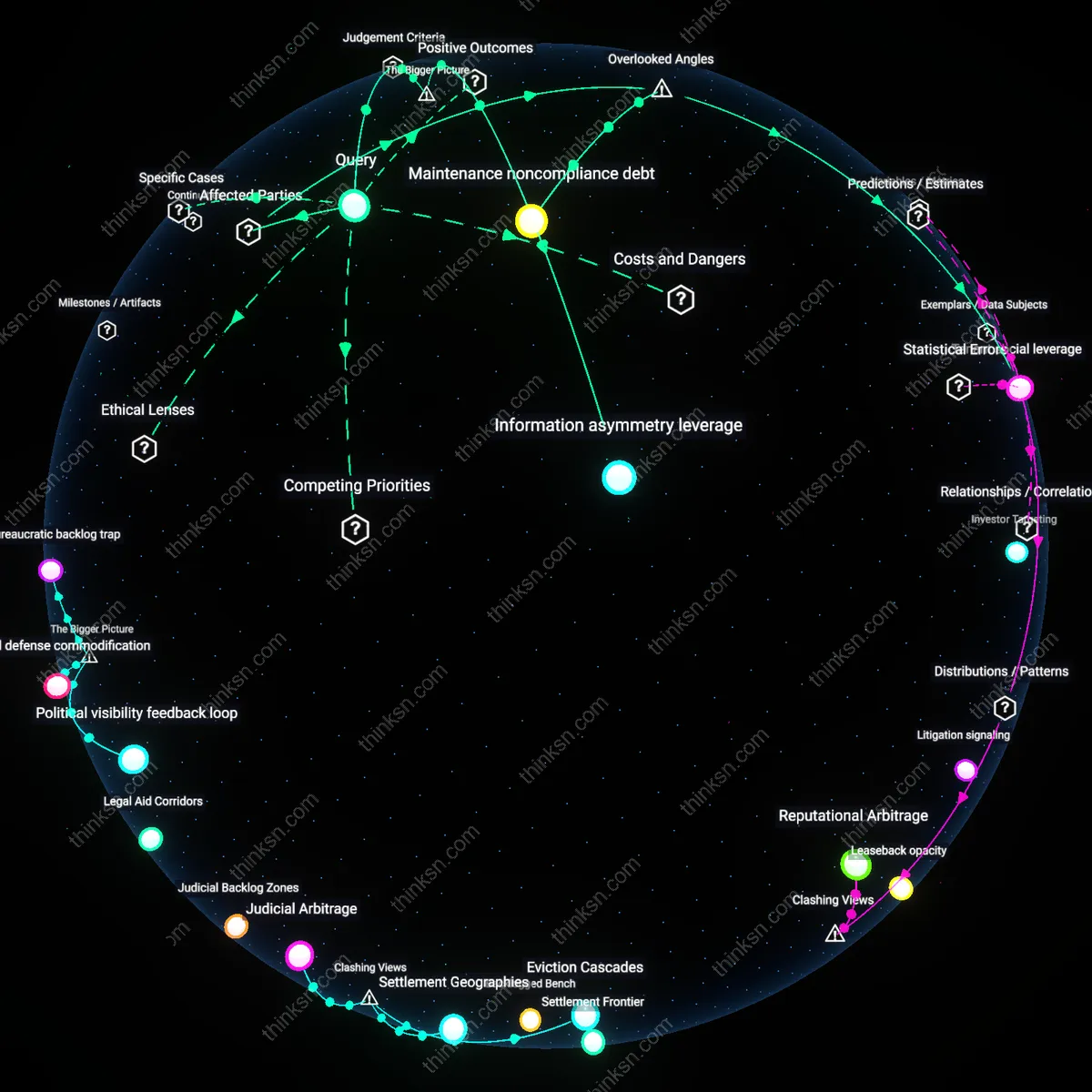
The housing courts in New York City and Newark, NJ, experienced the longest delays in eviction proceedings after 2017 due to a deliberate expansion of tenant legal services combined with pandemic-era moratoria that stalled dockets, creating clusters of backlog density far exceeding national medians. As public defender-style representation became mandated and funded under Right to Counsel laws starting in 2014, more tenants challenged evictions from the outset, transforming courtrooms into prolonged negotiation sites rather than venues of swift enforcement; this produced a structural congestion where case resolution now depends less on judicial decisions than on settlement capacity. The non-obvious outcome of this shift—anchored in the post-2012 expansion of tenant rights infrastructure—is not faster justice, but a judicial landscape where delay functions as de facto defense, revealing how access to counsel has unpredictably reshaped the spatial distribution of eviction risk.
Enforcement Rebound
Beginning in 2021, housing courts in Dallas and Memphis saw the strictest enforcement of eviction rules not because of preexisting harsh policies, but due to the abrupt withdrawal of emergency federal funding and local rental assistance programs that had briefly suppressed filings during 2020–2021, creating a sharp rebound effect in judicial activity. As emergency buffers dissolved, courts rapidly cleared backlogs by fast-tracking cases, concentrating enforcement in low-income ZIP codes with historically weak tenant organizing; this post-moratorium phase shifted the geography of eviction from widespread uncertainty to targeted, high-density dispossessions in specific tracts. The shift—distinct from long-standing patterns—reveals how temporary crisis interventions, once removed, can amplify enforcement severity in ways that reshape spatial risk clusters, making the current map of delay and punishment a legacy of transitory relief rather than permanent policy.
Settlement Frontier
Between 2018 and 2023, King County (Seattle) housing courts developed a disproportionate rate of tenant-favorable settlements due to the rise of tenant unions directly intervening in dockets, not through formal legal standing but as co-strategists alongside public interest lawyers, leveraging time-bound continuances into collective bargaining leverage. Unlike traditional models where settlement correlates with legal representation, here delays became tactical assets negotiated not by courts but among tenants’ assemblies using occupancy strikes as external pressure—transforming crowded courts into terrain of political exchange rather than legal technicality. This shift, emerging after the 2017 rent-control referendum, reveals that where organized tenants gain temporal leverage in backlogged systems, settlement density maps increasingly reflect movement geography, not just legal access, exposing a new frontier where settlements emerge from extra-legal power rather than judicial parity.
Judicial Backlog Zones
Housing courts in New York City experience the longest delays due to a combination of high-volume tenant filings and under-resourced court systems, where strict enforcement of eviction rules persists even as cases stall for months under lease violation dockets in Housing Preservation and Development-monitored buildings. This contradiction—of slow adjudication coexisting with punitive enforcement norms—reflects a system where nonpayment cases are systematically prioritized yet bogged down by procedural complexity, meaning tenants gain temporary shelter but not legal security. The non-obvious outcome is that delay itself becomes a de facto defense, despite formal rules favoring landlords, because overwhelmed docket management inadvertently creates a survival tactic that most tenants do not recognize as strategic.
Legal Aid Corridors
In cities like San Francisco and Seattle, tenant defenses are more likely to result in settlements not because rules are looser, but because publicly funded legal aid organizations are concentrated in municipal zones adjacent to high-rent districts, enabling rapid defense deployment in eviction cases. These corridors form informal but critical pathways through which tenant resilience is channeled, relying on local ordinances that mandate 'right to counsel' programs—unlike in faster-disposing Southern courts where such services are sparse. The underappreciated truth here is that the geography of legal defense infrastructure, not just judicial pace or rule severity, determines settlement outcomes, yet public perception still fixates on 'court delay' rather than 'counsel proximity' as the determining factor.
Compliance Enforcement Frontiers
In Memphis and certain suburban Atlanta jurisdictions, housing courts combine rapid eviction processing with strict enforcement of lease terms under non-metropolitan county constable systems, where landlord-friendly sheriffs expedite lockouts even after minimal procedural checks, creating a high-displacement environment. Here, tenant defenses rarely lead to settlements because local norms deprioritize mediation and legal representation is structurally inaccessible, making negotiation impractical despite federal voucher holders being present. The overlooked mechanism is that eviction strictness and court speed are jointly enabled by fragmented municipal authority and weak tenant coalitions, rendering defenses symbolic rather than tactical—unlike in consolidated urban courts where delay and settlement are mutually reinforcing.
Eviction Cascades
The longest delays in housing courts occur not in cities with the strictest eviction enforcement, but in high-pressure rental markets where landlord legal capacity overwhelms judicial infrastructure, as seen in Philadelphia and Detroit, where corporate landlords use automated filing systems to initiate mass evictions while public defenders stall cases indefinitely, creating a backlog that functions as an informal moratorium—this challenges the intuition that strict enforcement implies speed and efficiency, revealing instead how procedural overload becomes a tactical resource exploited unevenly across tenant populations, with precarious renters in neglected neighborhoods enduring ghost evictions that linger for months without resolution.
Settlement Geographies
Strictest enforcement of eviction rules does not correlate with low settlement rates but instead with highly concentrated patterns of negotiated dismissals in courts where tenant unions have established physical presence near courthouse entrances, such as in Minneapolis and Jackson, Mississippi, where informal defense networks intercept tenants before hearings and broker pre-trial agreements—this disrupts the assumption that legal strictness deters contestation, exposing how spatial proximity of advocacy infrastructure converts procedural rigidity into leverage, making the courthouse itself a friction zone where movement between legal and extralegal support systems determines outcomes.
Judicial Arbitrage
Tenants in rural New Mexico and eastern Kentucky are increasingly bused across state lines to appear in housing courts in Colorado and Illinois where delays are longer and tenant defenses are more institutionalized, orchestrated by cross-state legal aid NGOs who exploit jurisdictional inconsistencies in eviction timelines—this inverts the typical narrative that geographic immobility traps tenants, showing instead how mobility is weaponized by defense coalitions to route vulnerable households into favorable legal geographies, revealing a shadow logistics of tenant survival that treats court calendars as transportable assets rather than fixed local conditions.
Bureaucratic backlog trap
New York City Housing Court delays are longest in boroughs like the Bronx, where strict enforcement of eviction mandates combines with under-resourced court staffing, causing case backlogs that paradoxically increase settlement pressure on tenants despite strong legal defenses. Landlords exploit procedural momentum, while legal aid providers are overwhelmed—this systemic inertia makes even meritorious defenses less likely to reach trial, revealing how institutional inefficiency becomes a tool of eviction acceleration. The non-obvious consequence is that delays do not empower tenants but instead compress their response time within overloaded systems, turning backlog into pressure.
Legal defense commodification
In Harris County, Texas, rapid-docket eviction courts impose strict compliance timelines and limit tenant adjournments, yet produce high settlement rates when tenants are represented by structured defense nonprofits like Houston Volunteer Lawyers. The availability of last-minute legal triage—rather than strength of case—determines settlement outcomes, exposing a system where procedural rigidity is neutralized not by judicial leniency but by concentrated service provision. The underappreciated dynamic is that strict enforcement environments incentivize private legal supply chains to emerge as crisis buffers, turning access to counsel into a stopgap for systemic inflexibility.
Political visibility feedback loop
Philadelphia’s eviction courts exhibit moderate delays but unusually high settlement rates after the Right to Counsel ordinance introduced city-funded representation for low-income tenants, where organized tenant unions publicly track landlord patterns and escalate media pressure on recurring filers. This convergence of legal entitlement and civic monitoring transforms individual defenses into collective leverage, revealing that strict enforcement is most effectively countered not by court-level leniency but by external political visibility that reshapes negotiation dynamics. The overlooked mechanism is that court outcomes reflect off-site mobilization, where tenant power accrues through public naming and political accountability rather than legal technicalities alone.