Delayed Inspections: When Housing Authorities Fail Tenants Systematically?
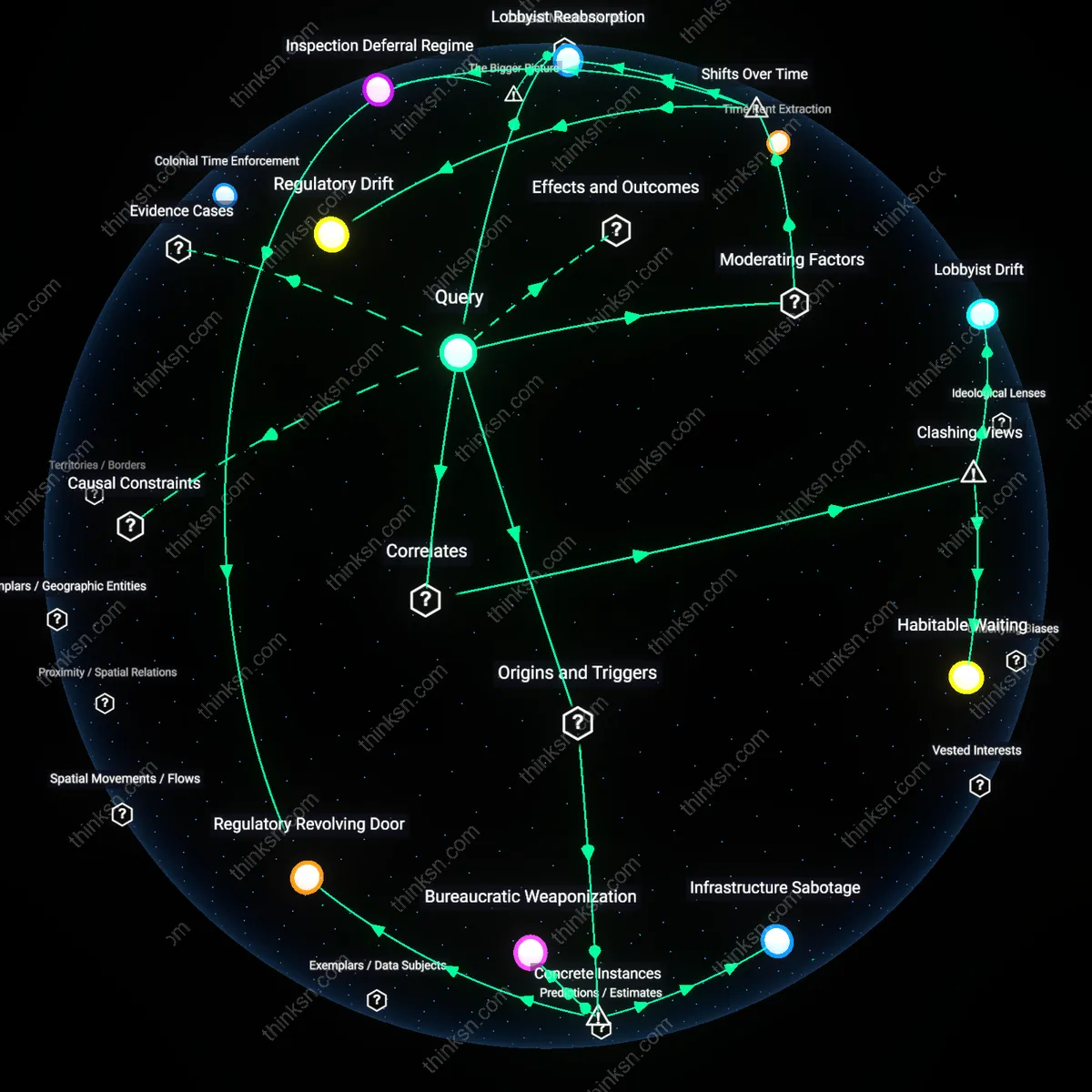
Analysis reveals 9 key thematic connections.
Key Findings
Regulatory Revolving Door
The delay of habitability inspections by a housing authority staffed with former landlord lobbyists in New York City during the 2010s reveals that regulatory capture is sustained not through bribery but through career mobility. Former lobbyists leverage insider knowledge to slow enforcement mechanisms from within, exploiting bureaucratic inertia and procedural discretion to benefit prior employers, which transforms regulatory agencies into passive overseers rather than active enforcers. This mechanism is underappreciated because it operates legally, masking power asymmetry as administrative delay rather than overt corruption. The case of NYC's Division of Housing Preservation and Development (HPD) inspections backlog peaking in 2015—while former real estate advocates occupied key compliance roles—demonstrates how personnel pipelines institutionalize bias, making systemic neglect appear procedural rather than political.
Infrastructure Sabotage
Philadelphia’s 2018 failure to conduct timely habitability inspections in public housing, despite repeated federal warnings, exposes how underfunding functions as a structural lever to disable tenant protections. City officials redirected budget allocations from inspection units to tax abatement programs favoring developers, effectively using fiscal policy to deprioritize enforcement while maintaining formal compliance obligations. This deliberate erosion of capacity reflects not mere neglect but active realignment of state functions to serve capital accumulation. The Frankford Avenue public housing case, where mold and heating failures persisted for over a year before inspection due to staff shortages, reveals that material deprivation is administratively produced—making austerity a weaponized governance tool rather than a fiscal accident.
Bureaucratic Weaponization
The prolonged postponement of habitability inspections in post-Katrina New Orleans public housing was used to justify redevelopment plans that displaced predominantly Black, low-income residents under the guise of safety concerns. Staff within the Housing Authority of New Orleans (HANO), many with prior ties to real estate interests through consulting firms like Urban Management Associates, systematically delayed assessments while declaring buildings 'uninhabitable,' bypassing legal requirements for tenant consultation or rehabilitation. This misuse of bureaucratic authority turned safety protocols into instruments of displacement, illustrating how procedural functions can be inverted to serve elite agendas. Unlike overt corruption, this case shows that power operates through the legitimacy of administrative delay, where inaction becomes a form of policy enactment.
Compliance Deferral
Inspection delays function as a form of informal policy concession to landlords by postponing the enforcement of habitability standards, effectively allowing violations to persist without penalty. This administrative inaction becomes a de facto extension of landlord control over residential conditions, mediated through bureaucratic scheduling decisions that appear neutral but carry material consequences. The non-obvious aspect is that deferral operates as a governance tactic—time itself becomes a mechanism of power, where incremental delays aggregate into sustained exemption from compliance. This reveals how systemic power leverages temporality, not just legal or financial instruments, to maintain control.
Regulatory Drift
The delay of habitability inspections reflects how public oversight institutions gradually adopt the priorities of the industries they regulate, as underfunded housing authorities increasingly rely on personnel with landlord-sector loyalties. This shift intensified after the 1980s, when federal disinvestment in urban housing programs eroded agency capacity, making them dependent on revolving-door staffing—where former industry advocates fill public enforcement roles. The mechanism is institutional attrition under austerity, which allows private-sector norms to infiltrate public functions; what was once a conflict-of-interest safeguard has become a routine staffing pipeline. The non-obvious insight is that degradation of enforcement is not always a sudden capture but a slow migration of regulatory culture toward regulated interests.
Inspection Deferral Regime
Habitability inspection delays reveal the emergence of an informal system where deferred enforcement becomes a structural tool for managing housing crises rather than correcting violations, a transformation accelerated by post-2008 fiscal constraints on municipal budgets. As cities faced rising rental complaints but shrinking funds, agencies shifted from proactive enforcement to triage-based postponement, normalizing lateness as a functional feature. This regime operates through budgetary scarcity leveraged as political cover to deprioritize tenant protections, particularly in gentrifying neighborhoods. The analytical significance lies in recognizing that delays are not mere dysfunctions but adaptive recalibrations of state power that redistribute risk onto vulnerable tenants over time.
Lobbyist Reabsorption
The presence of former landlord lobbyists on housing authority staff illustrates how state regulatory capacity has been restructured since the 1990s to institutionalize industry influence directly within public administration, rather than allowing it to operate externally through donations or lobbying. When underfunded agencies hire personnel with landlord-aligned policy backgrounds, they effectively reabsorb regulatory opposition into operational roles, converting potential oversight into self-regulation. This pivot from adversarial accountability to embedded alignment transforms the state from a neutral arbiter into a managed coordination body. The underappreciated temporal shift is that regulatory failure now stems less from corruption than from the formal integration of opposing interests into governance structures.
Lobbyist Drift
The presence of former landlord lobbyists in housing authority roles reveals not corruption but a normalized career pipeline that treats regulatory capture as human resource efficiency. These officials delay inspections not out of malice but because their professional habitus aligns with property management logics—timelines, liability avoidance, tenant burden-sharing—making delays appear neutral rather than strategic. The system operates through institutionalized perspective alignment, where staffing patterns reproduce landlord priorities without requiring active collusion, and this is significant because it reframes delays as epistemic outcomes, not economic ones. The dissonance lies in recognizing that impartiality can be undermined not by bribery but by shared occupational socialization.
Habitable Waiting
The inspection delay functions not as neglect but as a calculated distribution of precarity, assigning some tenants to prolonged waiting as a form of informal rent extraction. By suspending habitability judgments, authorities enable landlords to retain rent payments while withholding repairs, with the state’s inaction acting as implicit subsidy. This operates through temporal extraction—a system where time becomes a medium of dispossession, and its significance lies in revealing how power can be exercised not through refusal but through deferral. The non-obvious insight is that delay is not a symptom of underfunding but a mechanism of value transfer masked as administrative incapacity.