Initiation Debt
Employee initiative gets absorbed into startup growth during the pre-Series A phase through unpaid strategic labor, where early hires act as de facto co-founders by identifying market gaps and building minimum viable processes without formal authority; this occurs because resource scarcity forces lateral innovation, and the absence of rigid hierarchies allows initiative to bypass approval chains. The shift from bootstrap scarcity to post-funding institutionalization reveals Initiation Debt—the accrued value of informal contributions that later becomes invisible when roles formalize and decision rights centralize, erasing the provenance of key growth drivers.
Process Reabsorption
Employee initiative gets shut down during the Series B-to-C transition when startups adopt scaled operations via CRM, OKR, and ticketing systems designed to standardize execution, replacing emergent workflow improvisation with tracked, permissioned activity; this occurs as CFOs and COOs import enterprise logic to satisfy investor demands for predictability, transforming initiative into compliance risk. The historical shift from growth-at-all-costs to efficiency optimization reveals Process Reabsorption—where the very systems meant to amplify output instead filter out unauthorized innovation, converting employee agency into traceable task completion.
Ownership Deflection
Employee initiative gets absorbed into product evolution in pre-PMF startups through uncredited feature ideation, where engineers and support staff redirect roadmap priorities by informally prototyping solutions to user complaints, exploiting architectural modularity to insert changes without approval; this occurs because survival depends on speed, and founders tolerate shadow engineering. The pivot from exploration to scaling marks a shift where legal and IP frameworks formalize, and deflected ownership emerges—initiative is no longer rewarded as contribution but managed as a threat to unified vision, suppressing bottom-up design as the org consolidates creative rights.
Resource adjacency
Employee initiative gets absorbed into startup growth primarily through unstructured access to operational tools and data, not formal channels. Engineers or junior product staff often repurpose CRM exports, staging environments, or experimental budgets meant for other teams to prototype solutions, creating value when leadership is unaware such autonomy was exercised. This mechanism is invisible in org charts but decisive in early scaling, as initiatives succeed or fail based on whether actors are physically or digitally proximate to deployable systems—what we might call 'resource adjacency'—rather than approval hierarchies or innovation programs. Most analyses overlook this spatial logic of internal resources, assuming permission precedes action, when in volatile startups, use often precedes authorization.
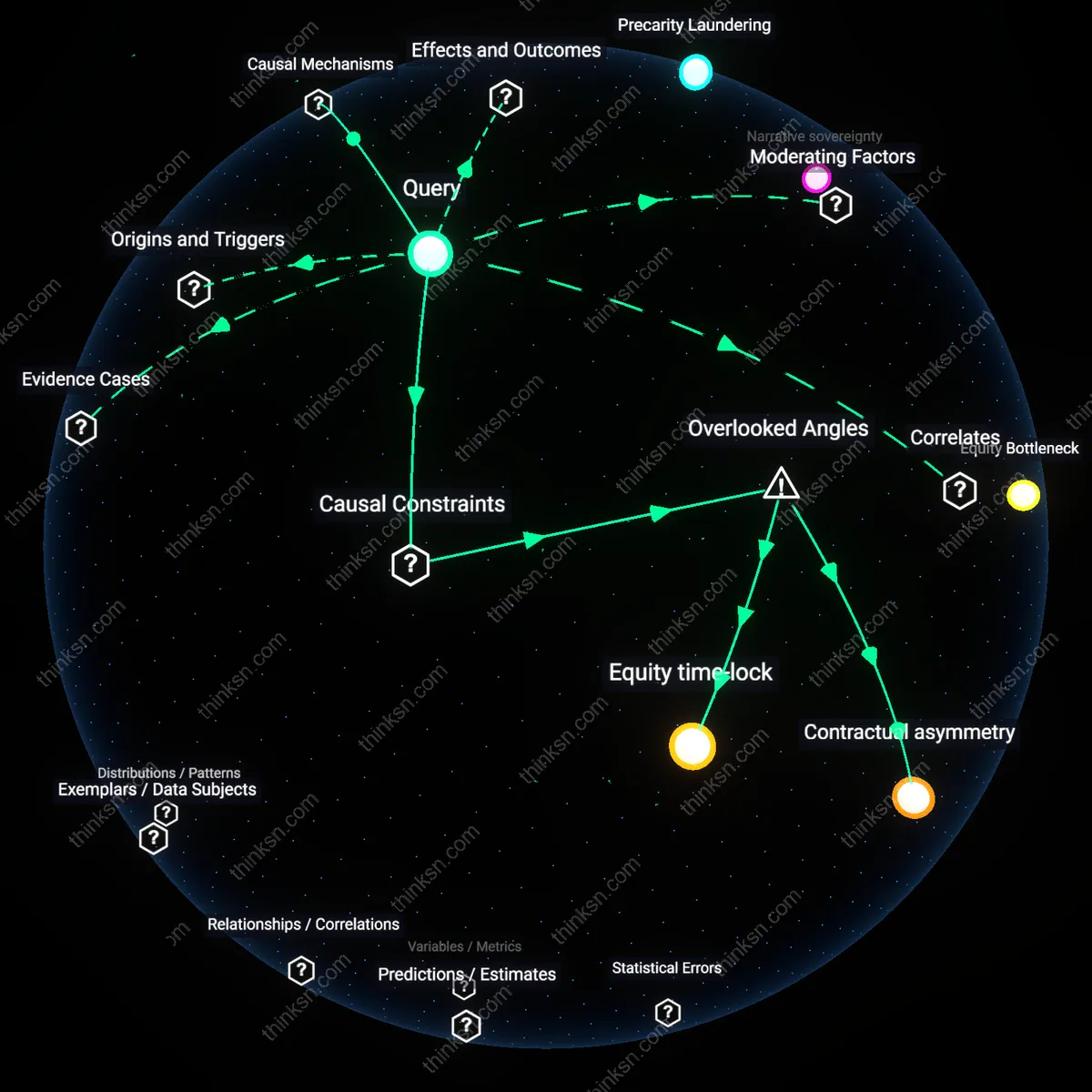
Narrative sovereignty
Employee initiative is absorbed when individuals can attach their efforts to the startup’s dominant growth story—such as 'land-and-expand' or 'viral loop optimization'—allowing their work to be recognized and resourced. Conversely, technically sound ideas get suppressed when they challenge or complicate the official trajectory, even if viable, because maintaining narrative cohesion for investors and hires becomes a higher priority than option value. A sales engineer developing a B2C spin-off within a B2B SaaS firm may be sidelined not for poor fit, but because dual narratives risk confusing external stakeholders. The residual concept, 'narrative sovereignty,' reveals how control over storytelling functions as a covert gatekeeper of initiative, privileging alignment over innovation when external signaling dominates internal development.
Strategic ambiguity
Employee initiative gets absorbed into startup growth when early-stage founders deliberately leave strategic roles and priorities undefined, allowing self-organizing teams to fill gaps through experimentation; this works because distributed agency is incentivized under resource scarcity and rapid feedback loops from customers, which reward visible, adaptive contributions. The mechanism depends on low procedural bureaucracy and high outcome visibility, where initiative maps directly to survival, making it a self-reinforcing system of informal control. What’s non-obvious is that the lack of structure isn’t a flaw but a calculated enabler — absorption happens not despite chaos but because of its capacity to surface high-signal behaviors.
Equity bottleneck
Employee initiative gets shut down when rapid headcount growth triggers centralized decision rights around equity allocation and promotion pathways, placing power to recognize and reward initiative in the hands of a narrow executive layer. This shift occurs as startups transition from product-market fit to scale, activating investor-driven demands for predictable execution and role formalization, which favor consistency over emergent behavior. The non-obvious consequence is that initiative doesn’t disappear — it becomes risk-averse and politically mediated, as employees learn that visibility to leadership matters more than customer impact.
Infrastructure mirage
Employee initiative gets absorbed into startup growth when technical or operational infrastructure projects—like API development or onboarding systems—are framed as mission-critical but remain under-resourced, turning them into sinks for autonomous effort that appears productive but reinforces dependency on core teams. These projects attract proactive employees seeking leverage, yet their outputs are often gated by central architecture or security reviews, delaying real impact and signaling that alignment trumps innovation. The underappreciated dynamic is that such initiatives are not rejected but ritualistically consumed, maintaining morale while preserving control in the hands of platform owners.
Equity Bottleneck
Founders allocate equity to early employees as a reward for initiative, but once vesting schedules and liquidation preferences are structured around founder control, those same employees lose decision-making power despite their contributions to growth; at WhatsApp, early engineers who built core functionality were sidelined in strategic discussions after acquisition by Facebook, exposing how financial incentives can absorb initiative without transferring authority.
Culture Debt
Rapid hiring at startups like Uber during its 2013–2017 expansion phase amplified aggressive, initiative-driven behaviors that initially boosted growth but later clashed with governance needs, revealing how culturally celebrated traits become liabilities when the same norms resist formal processes; the louder the endorsement of 'move fast' as a virtue, the more silently it undermines accountability structures.
Signal Hierarchy
At SpaceX, engineers are encouraged to escalate technical problems directly to leadership, bypassing chain-of-command—a practice that rewards initiative—yet only when framed in aerospace-specific metrics like launch reliability or propellant efficiency, illustrating how initiative is absorbed only when it aligns with dominant performance signals; effort outside these dimensions, such as workplace inclusivity or work-life balance reforms, rarely gains traction despite grassroots momentum.