Do Force Majeure Clauses Fail Tenants in Pandemics?
Analysis reveals 8 key thematic connections.
Key Findings
Structural Asymmetry
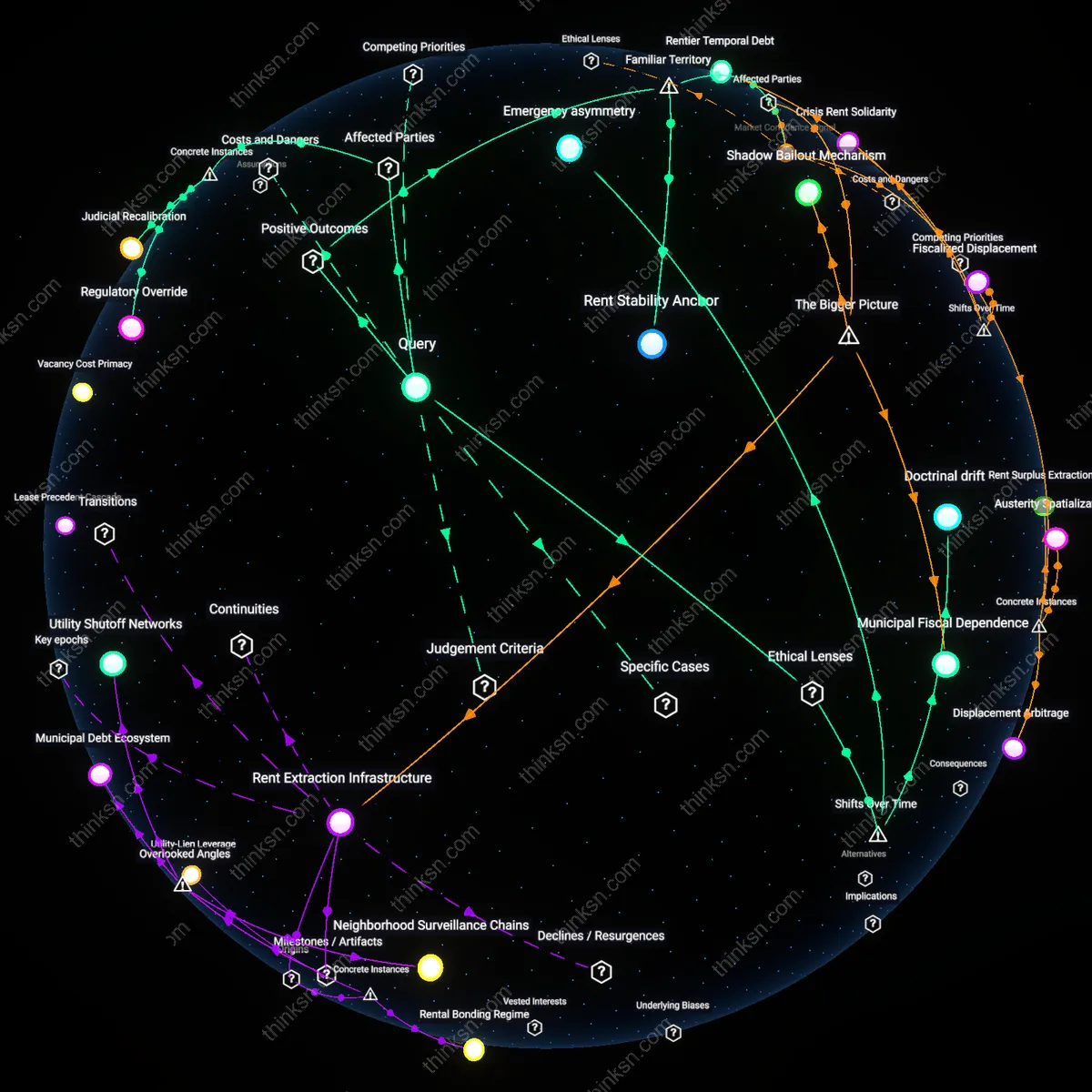
A tenant's lack of bargaining power directly undermines contractual equity in force-majeure enforcement, as seen in the 2020 Brooklyn Rent Relief Coalition's challenge to landlords invoking pandemic clauses to justify evictions despite tenants' rent arrears being tied to COVID-19 job losses; the mechanism operates through unequal lease negotiation conditions where landlords controlled clause inclusion and interpretation, rendering mutual risk-sharing illusory—revealing that contractual formality masks entrenched power differentials in housing markets.
Regulatory Override
In California’s statewide renter protections during the 2020–2021 pandemic, the absence of tenant leverage was neutralized not by contract but by AB 3088, which voided landlord-initiated force-majeure claims to circumvent eviction bans, illustrating how institutional intervention disrupts private contractual advantage when imbalanced parties cannot negotiate in good faith—highlighting that legality, not agreement, becomes the operational domain of protection in crisis conditions.
Judicial Recalibration
New York’s Housing Part courts, in processing commercial lease disputes like those involving small Harlem-based retailers versus Trinity Church Wall Street’s real estate arm in 2021, began applying common law doctrines of impracticability to rebalance force-majeure outcomes, recognizing that tenants’ inability to reject unfavorable terms necessitated judicial correction of contractual outcomes—demonstrating that courtroom equity functions as a corrective lens when market-based consent is compromised.
Rent Stability Anchor
A tenant's lack of bargaining power strengthens the functional reliability of a force-majeure clause for landlords during a pandemic because it prevents widespread renegotiation of lease terms under duress, preserving landlord cash flow and building-level rent stability. When tenants cannot demand mutual concessions, the unilateral activation of force-majeure provisions maintains operational continuity in rental markets, particularly in dense urban housing stocks where leasing turnover is low and replacement tenants are hard to secure. This creates a de facto anchor in otherwise volatile housing economies, as landlords retain predictable, if temporarily adjusted, revenue streams without cascading demand for lease exemptions. The underappreciated insight is that contractual rigidity—often seen as unfair to tenants—serves as infrastructure-level ballast during systemic crises.
Market Confidence Signal
Landlords' ability to enforce force-majeure clauses unilaterally reinforces investor and lender confidence in real estate portfolios during disruptions like pandemics, because the contractual predictability—bolstered by tenants’ weak bargaining position—signals operational resilience. Financial institutions monitoring multifamily or commercial holdings in cities like New York or Chicago treat unchallenged clause activation as evidence of downside protection, which stabilizes asset valuation and secures downstream creditworthiness. This signaling effect sustains capital flows into housing infrastructure precisely when maintenance and service delivery are most strained. While public discourse frames tenant vulnerability as a failure of fairness, it simultaneously functions as a tacit stabilizer in financial perceptions of real estate markets.
Contractual formalism
The ethical erosion of bargaining power during pandemics reveals that force-majeure clauses function not as mutual safeguards but as instruments of landlord dominance, a transformation accelerated by the neoliberal shift in housing policy after the 1980s. As public housing investment declined and rental markets were deregulated in cities like New York and London, tenants—especially low-income renters—became structurally dependent on private landlords, rendering contractual consent a fiction; this imbalance allows landlords to invoke force-majeure unilaterally during crises like the COVID-19 pandemic, effectively suspending tenant protections without reciprocal obligation. This shift from social tenancy models to market-based housing regimes makes the clause’s invocation a tool of exclusion rather than equity, exposing how legal formalism now shields capital under the guise of neutrality.
Emergency asymmetry
The invocation of force-majeure clauses by landlords during pandemics exemplifies a temporally emergent contractual injustice rooted in the post-2008 financialization of housing, where real estate investment trusts and institutional landlords gained outsized market control. Unlike pre-2008 local landlord-tenant relationships, which operated within community norms and uneven but personable dynamics, today’s corporate landlords negotiate from a position of systemic liquidity and legal redundancy, while tenants face increasing precarity due to wage stagnation and housing scarcity. This rupture in ownership structure transformed emergency clauses from equitable risk-distribution mechanisms into instruments of financial resilience for capital only, revealing an asymmetry where the ethics of mutual contingency are preserved in form but inverted in function during crises.
Doctrinal drift
Force-majeure clauses, once rooted in commercial law doctrines requiring mutual impossibility and good faith, now protect landlords disproportionately because their legal interpretation has drifted since the 1970s away from relational equity toward textual absolutism, particularly in jurisdictions like California and Texas influenced by law and economics jurisprudence. As courts began prioritizing contract predictability over fairness during the rise of conservative legal thought, they detached force-majeure from its common-law roots in shared hardship and applied it uniformly—even when invoked unilaterally by resource-rich parties. This doctrinal shift, crystallized in post-2020 rulings during pandemic-related lease disputes, has effectively severed the clause’s ethical linkage to proportionality, transforming it into a legally sanctioned mechanism for redistributing crisis risk onto the weakest contractual party.