When Flood Risk Means Switching Insurance Costs More
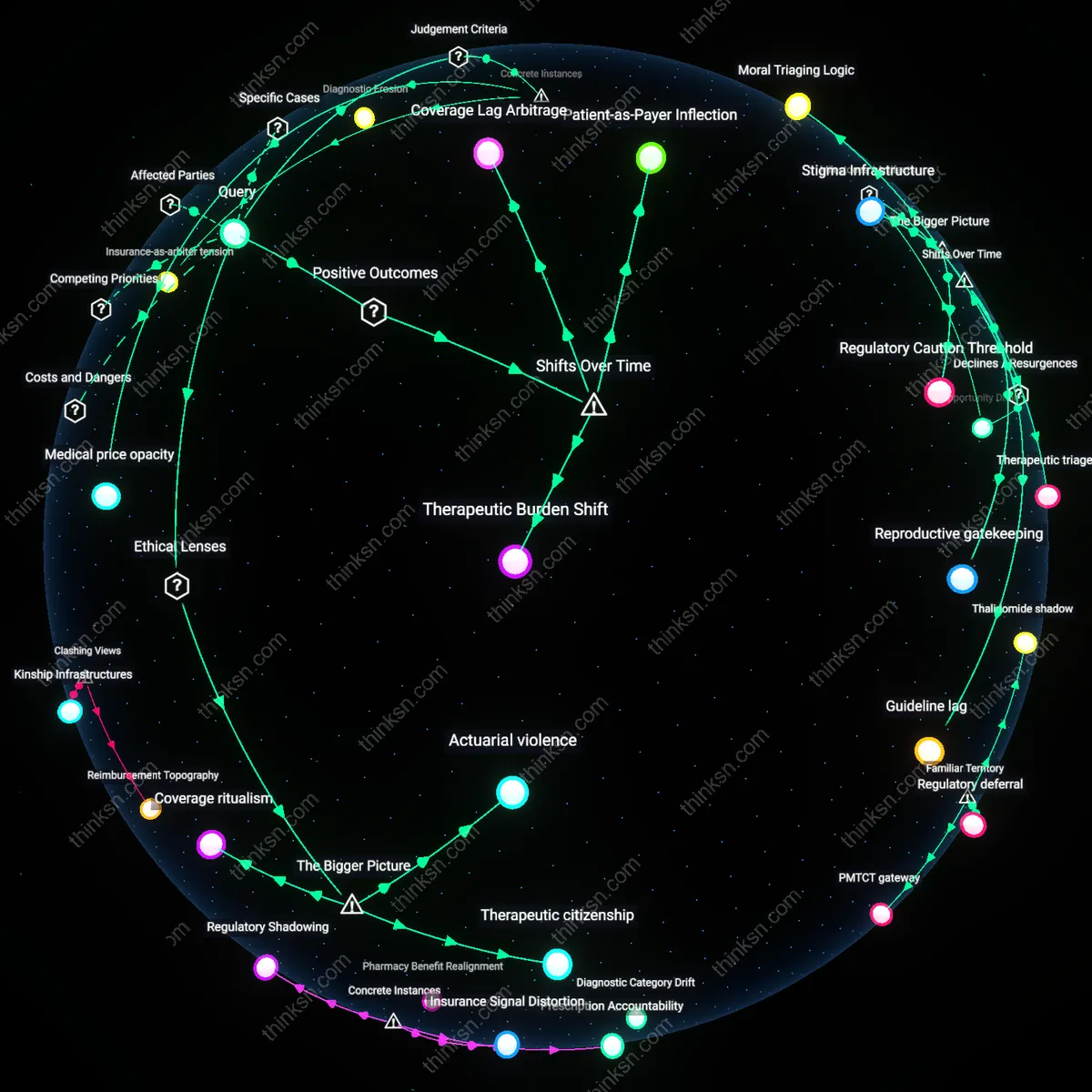
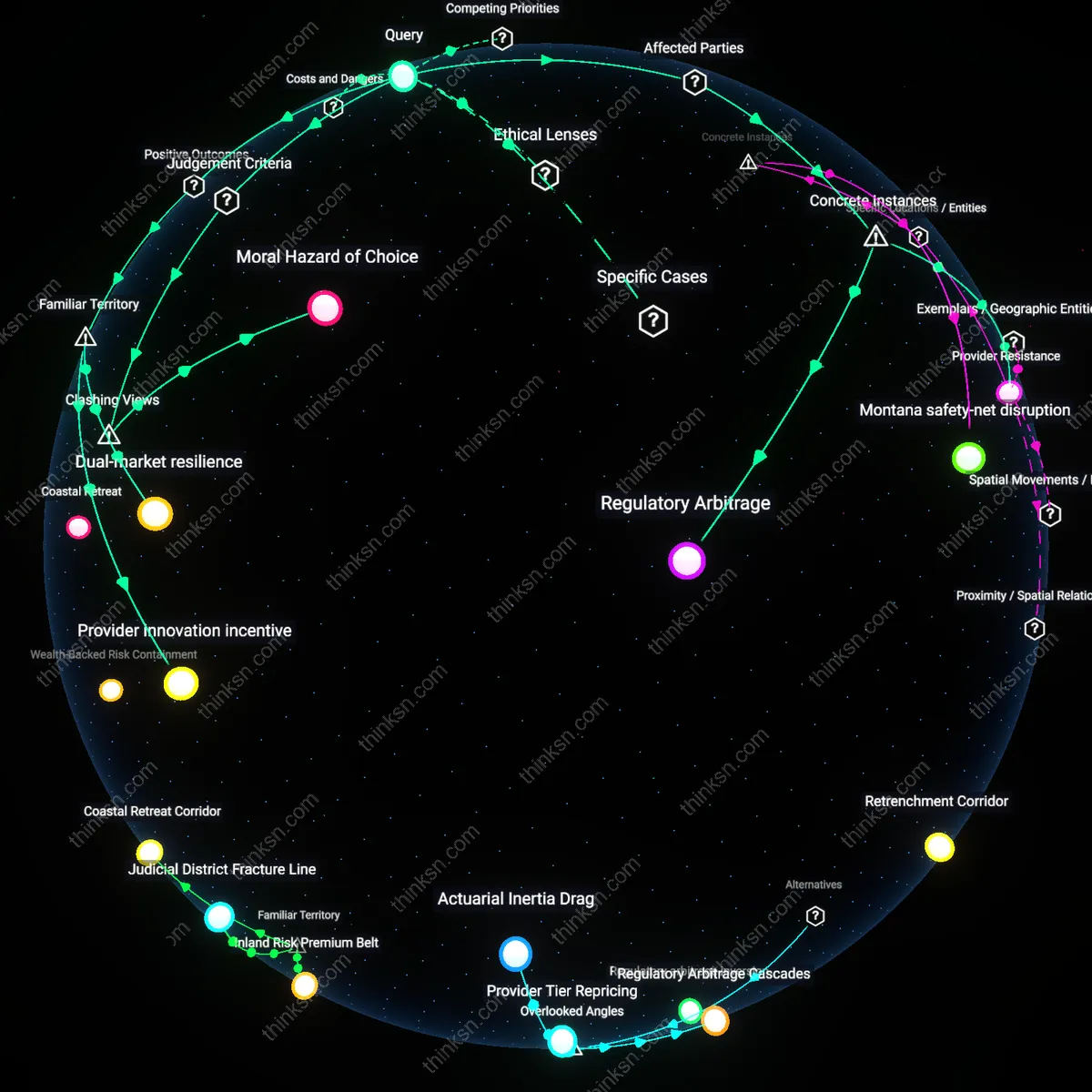
Analysis reveals 8 key thematic connections.
Key Findings
Moral Hazard Displacement
A homeowner should switch insurance providers only when the act of switching reduces their exposure to risk inflation caused by fragmented accountability between primary and flood insurers. When two insurers are involved—one covering standard perils and another covering floods—residents may underestimate response coordination failures during disasters, particularly in FEMA-designated Special Flood Hazard Areas where claims processing is already delayed by bureaucratic silos; this creates a moral hazard not in behavior, but in institutional design, as households assume seamless coverage despite contractual seams. The non-obvious consequence is that switching to a single bundled provider isn't about cost alone, but about reducing the household’s vulnerability to systemic gaps in post-disaster financial recovery, exposing how risk is displaced onto individuals when insurers avoid integrated responsibility.
Capitalization of Exclusion
A homeowner should switch insurers when flood exclusions in existing policies have already been factored into local property values, making continued loyalty to the current provider a hidden subsidy to the insurer rather than a market choice. In coastal counties like those in South Carolina’s Lowcountry, long-standing exclusions have depressed resale values by 7–12% relative to comparable inland markets, meaning homeowners effectively absorb the risk cost without compensation while insurers retain premium income without liability expansion. The counterintuitive insight is that staying with the same insurer perpetuates an invisible transfer of wealth from homeowner to underwriter, masked as policy continuity; this reveals how exclusion terms become embedded in real estate economics, turning insurance inaction into an extraction mechanism.
Regulatory Arbitrage Incentive
A homeowner should switch providers when the current insurer leverages state-level rate regulation to avoid offering flood coverage while still marketing 'comprehensive' protection, effectively relying on consumer inertia to maintain profitability without product evolution. In states like Florida, where property insurance rates require public commission approval but flood offerings do not fall under the same scrutiny, carriers such as Citizens Property Insurance maintain dominant market share by excluding flood risk while benefiting from regulatory legitimacy. The overlooked dynamic is that switching isn't a market response but a corrective to regulatory misalignment—where insurers exploit gaps between mandated oversight and unregulated product gaps—uncovering an incentive structure that rewards partial transparency under the guise of compliance.
Insurance arbitrage trap
A homeowner should switch providers rather than buy standalone flood insurance when their current insurer leverages exclusionary clauses to offload catastrophic risk while still marketing comprehensive coverage, creating a false sense of protection that deepens systemic underinsurance. This dynamic thrives on information asymmetry, where insurers profit from ambiguity in policy language while local governments bear post-disaster recovery costs, shifting long-term risk onto public coffers. The non-obvious consequence is that apparent savings on premiums incentivize widespread exposure to unpriced flood risk, eroding actuarial integrity at the metropolitan level.
Moral hazard cascade
Switching insurers becomes financially rational only when the existing provider’s lack of flood inclusion reflects broader risk externalization strategies that encourage complacency in high-hazard zones, particularly where FEMA flood maps are outdated and lenders accept inadequate coverage. Private insurers, facing pressure to maintain market share, often omit explicit warnings, relying on homeowner self-assessment—this abdication of responsibility enables continued development in floodplains while concentrating future liability in state-backed residual risk pools. What is underappreciated is how individual purchase decisions ripple into regional credit downgrades when aggregate exposure exceeds reinsurance capacity thresholds.
Regulatory capture feedback
Homeowners should change insurance providers when state insurance departments fail to mandate standardized flood disclosure because the resulting regulatory gray zone allows incumbents to minimize risk retention without competitive penalty, distorting market efficiency. This condition enables dominant carriers to treat flood as an à la carte add-on rather than a core peril, preserving profit margins while delaying adaptation to worsening hydroclimatic threats. The overlooked mechanism is that weak oversight fuels reinvestment in vulnerable properties, amplifying both fiscal strain on state disaster funds and long-term uninsurability in actuarially unsound jurisdictions.
Actuarial Inheritance
A homeowner should switch providers only after local floodplain maps are updated to reflect post-2010s climate-driven hydrological patterns, because the transition from static, FEMA-1980s-era flood zones to dynamic, data-driven models has altered actuarial accountability. As insurers now draw on real-time precipitation and sea-level rise metrics since the Paris Agreement era, remaining with a legacy provider means paying for an outdated risk assessment framework, whereas switching aligns one with emerging standards of predictive responsibility. This shift exposes how older policies encode climatic ignorance as financial inertia, transforming what appears to be cost-saving retention into intergenerational risk dumping.
Subsidy Displacement
A homeowner should switch providers when federal disaster relief practices post-1993 Midwest floods institutionalized implicit bailout expectations, making separate flood insurance ethically redundant if the state de facto socializes flood losses. The shift from strictly private compensation to FEMA’s ad hoc disaster declarations created a de facto public backstop that distorts market discipline, especially in politically visible counties where Reconstruction-era aid norms resurface during crises. This reveals that the decision to switch is less about individual risk and more about navigating which communities are historically primed for post-disaster subsidy absorption, rebranding personal insurance decisions as spatially stratified claims on state solidarity.