No-Homework Policies and the Equity Debate for Low-Income Kids?
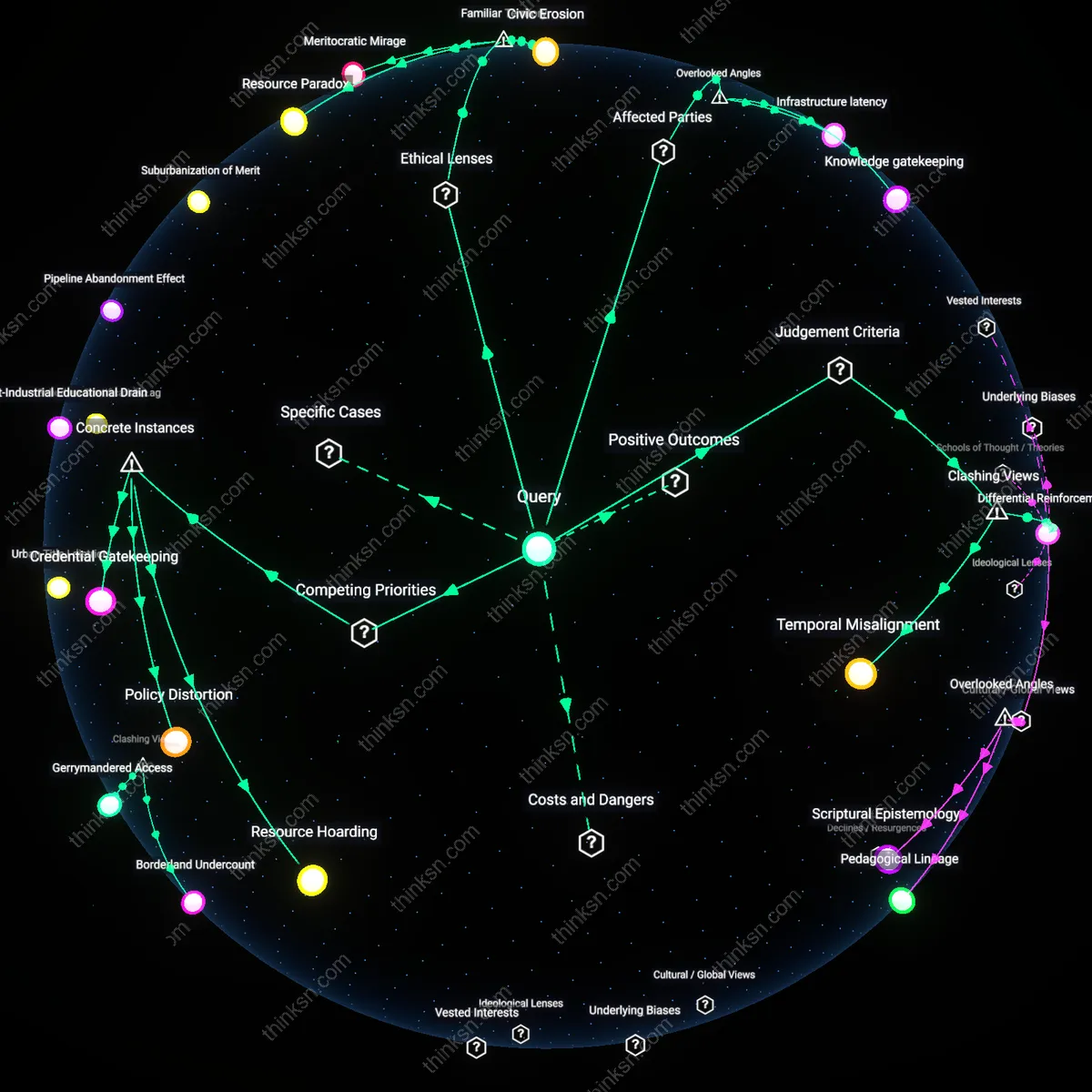
Analysis reveals 11 key thematic connections.
Key Findings
Homework Gap
Eliminating homework in elementary schools disadvantages low-income students because they are less likely to access supplementary academic resources outside school, relying instead on structured assignments to reinforce learning. In underfunded districts, where afterschool programs and tutoring are scarce, the absence of homework removes a key mechanism for skill consolidation, widening achievement disparities along socioeconomic lines. The non-obvious insight is that homework, despite its controversies, functions as a rare equity lever for disciplined academic engagement in homes where educational scaffolding is economically constrained.
Parental Scaffolding Divide
No-homework policies amplify inequities because affluent families often replace assigned work with curated enrichment activities—like math apps, reading programs, or private instruction—while low-income parents may lack time, resources, or literacy to provide equivalent cognitive support. This dynamic shifts academic responsibility from the school to the household, privileging students whose families can simulate school-based practice. What’s underappreciated is that the policy’s fairness depends not on the workload itself, but on the uneven distribution of informed, time-rich caregiving across class lines.
Hidden Curriculum Access
Homework serves as an informal transmitter of study habits, time management, and academic discipline—skills that are more systematically modeled in middle- and upper-class homes. When schools remove homework, they withdraw a shared space where low-income students can acquire these meta-competencies under teacher guidance. The overlooked consequence is that equitable long-term achievement depends not just on content mastery but on equal exposure to the behavioral norms that enable academic persistence, which homework implicitly standardizes across unequal environments.
Practice Access Paradox
In Albany, California, elementary schools eliminated homework in 2017 to reduce stress and promote equity, but low-income students at Pacific Terrace Elementary experienced reduced access to structured academic reinforcement, revealing that equitable intent does not guarantee equitable outcome—since wealthier families could still afford tutors or learning camps while disadvantaged families relied on school-based practice, thus unintentionally widening skill gaps through removed mandated support.
Home Environment Substitution
When the Coppin Academy Elementary School in Baltimore County replaced homework with optional learning packets, students from households with limited English proficiency or parental availability struggled to initiate practice without direct facilitation—demonstrating that removing required academic tasks assumes home environments can self-organize learning, a mechanism that benefits resourced families while disadvantaging those who depend on institutional scaffolding to compensate for constrained domestic conditions.
Curricular Floor Effect
After the Plano Independent School District in Texas adopted a no-homework policy for grades K–2 in 2018, literacy gains among economically disadvantaged students plateaued relative to peers in neighboring districts with balanced homework models, indicating that uniformly low academic dosage—without differentiated reinforcement—creates a floor where students needing more exposure receive no compensatory boost, undermining equity by capping growth potential at the earliest stages.
Temporal Redistribution Burden
No-homework policies implicitly transfer the responsibility for academic reinforcement from schools to households, disproportionately affecting low-income students whose caregivers often lack flexible time due to shift work or multiple jobs; this creates a temporal redistribution burden where learning time once guaranteed during school hours must now be negotiated in homes with fewer temporal reserves. The ethical issue arises under a Rawlsian difference principle, which demands that social institutions compensate for unchosen disadvantages—like unpredictable work schedules—yet current policy assumes temporal equity among families, a fiction in economically stratified communities. Most discussions focus on material resources like internet access, overlooking how time itself becomes a privatized educational resource when practice is delocalized from classrooms, thereby converting pedagogical design into a covert form of temporal taxation on working-class families.
Pedagogical Surveillance Gap
Eliminating homework reduces institutional visibility into how foundational skills like reading fluency or arithmetic retention develop outside formal instruction, creating a pedagogical surveillance gap that particularly disadvantages low-income students who may lack corrective feedback loops at home; under an ethic of care theory, schools have a relational duty to monitor developmental trajectories continuously, not just during school hours. This gap masks early deficits that affluent families can detect and remediate via tutors or learning apps, while under-resourced households depend on school-based diagnostics. Standard equity analyses assume equity in feedback quality, but the unacknowledged dependency is ongoing skill auditing—homework functions as a low-intensity diagnostic tool that, when removed, erodes early intervention capacity in systems meant to correct rather than replicate disadvantage.
Institutional Trust Asymmetry
No-homework policies can deepen institutional trust asymmetry, where low-income families perceive schools as disengaging from their child’s development, undermining collaborative engagement rooted in critical pedagogy’s emphasis on co-agency between educators and marginalized communities; unlike affluent parents who often supplement education independently, working-class families may interpret homework elimination as reduced commitment, not pedagogical reform. This perception, shaped by historical exclusion from educational decision-making, transforms a well-intentioned policy into a signal of lowered expectations. Most equity debates treat resources as tangible, but the non-obvious variable is affective legitimacy—the degree to which policies reinforce or weaken a family’s belief that the school is actively invested in their child—altering the very foundation of educational partnership.
Practice Paradox
No-homework policies in elementary schools exacerbate educational inequity by removing structured academic reinforcement for low-income students whose home environments lack literacy-rich routines, as seen in Denver Public Schools’ 2018 policy shift, where third-grade reading scores declined most sharply in Title I schools—a mechanism made visible through the contrast between middle-class households that substitute informal academic engagement (e.g., parent-led reading, enrichment apps) and working-class households that rely on school-mandated tasks to anchor learning. This contradicts the dominant narrative that homework abolition inherently advances equity, revealing that uniform removal of academic demands without compensatory supports redistributes educational labor in ways that privilege cultural capital over access, making visible the Practice Paradox—the idea that eliminating mandatory practice can widen gaps when practice is unevenly replaced.
Curricular Compression
In the Wake County Public School System, the elimination of homework in early grades led teachers to condense skill reinforcement into already packed instructional blocks, disproportionately affecting low-income students who required repeated exposure to master foundational math and literacy skills, as classroom time could not absorb the full cognitive load previously distributed across home practice. This contradicts the framing of homework as an optional extension of learning, showing instead that its removal forces curricular compression—where skill mastery is squeezed into narrower timeframes, privileging students who achieve fluency faster and marginalizing those who depend on distributed practice—thereby turning classroom pacing into a covert equity barrier.