Subsidized Mixed-Age Preschools vs Higher-Priced Stability: The Trade-Off?
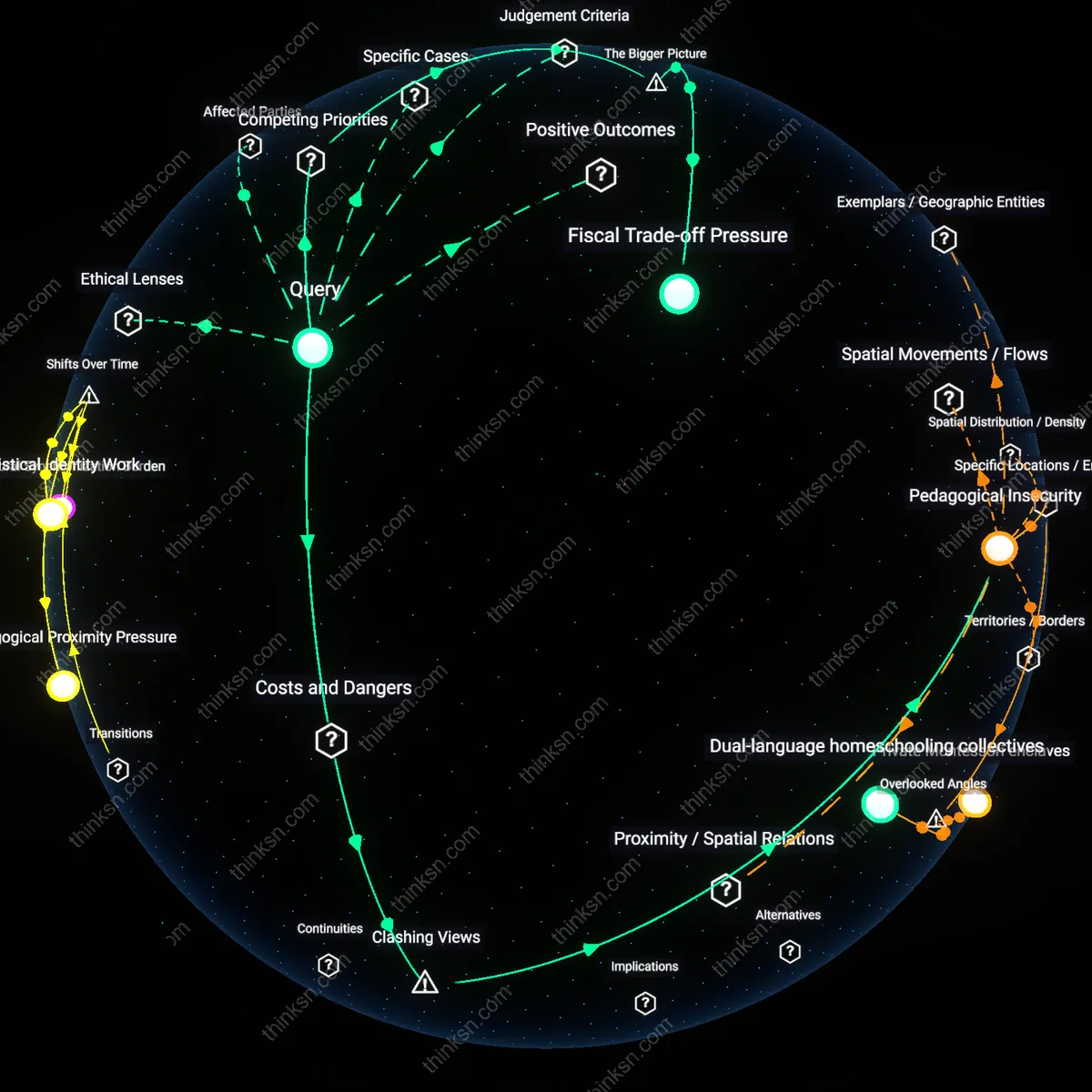
Analysis reveals 4 key thematic connections.
Key Findings
Pedagogical Insecurity
Choosing the more expensive center with lower staff turnover is driven by parents' fear of inconsistent learning frameworks, not proven educational outcomes. This stems from a hidden system in which parental anxiety about unseen developmental gaps—fueled by education marketing and status competition—overrides empirical evidence that mixed-age settings often foster greater social resilience. The real mechanism is institutionalized distrust in public early education models, where parents misattribute staff mobility as a proxy for pedagogical failure, even when turnover does not correlate with instructional quality. This reveals how risk perception, not risk itself, governs decision-making in publicly visible childcare systems.
Emotional Drain Economy
Parents select subsidized mixed-age preschools not to save money but to avoid the invisible emotional labor of managing elite center politics. In high-cost centers, low staff turnover sustains rigid behavioral norms and parental compliance demands—such as adherence to specific feeding schedules or communication protocols—that disproportionately burden mothers, especially in dual-career households. The systemic cost is the covert transfer of institutional regulation into the domestic sphere, where middle-class parents absorb emotional strain to maintain perceived developmental advantages. This contradicts the assumption that stability in staffing always benefits families, exposing it instead as a vector of coercive standardization.
Fiscal Trade-off Pressure
Parents choosing subsidized mixed-age preschools over more expensive centers do so primarily because public funding constraints force prioritization of cost over staff consistency, which reveals a structural competition between household budget limits and perceived educational quality. Municipal childcare funding formulas in many mid-sized U.S. cities allocate fixed per-child subsidies that only cover slots in mixed-age or multi-grade classrooms, meaning families relying on public assistance are systematically excluded from environments with selective hiring or lower turnover. This mechanism embeds a fiscal trade-off pressure where parents’ pursuit of affordability necessarily sacrifices influence over staffing stability, not due to indifference but because subsidy eligibility rules and capped reimbursement rates pre-determine classroom composition and provider staffing models. The non-obvious implication is that parental 'choice' is functionally constrained by public finance design, not individual preference.
Pedagogical Rescheduling Burden
Parents selecting mixed-age subsidized preschools often unknowingly accept a hidden cognitive cost—the burden of reconciling divergent pedagogical pacing—because cross-age classrooms distribute learning unevenly, demanding extra parental labor to align home routines with school expectations. In state-subsidized programs, the mixed-age model reduces operational costs by consolidating grades, but this compresses developmental curricula into a single flow, forcing parents to interpret and mediate varying expectations for their child’s autonomy, language use, or instruction-following relative to older peers. Unlike in higher-priced centers where homogenous classrooms allow curriculum pacing to be predictable and externally managed, the subsidized model shifts the cost of coherence onto family time and attention, especially for parents without flexible work schedules. The overlooked dynamic is that affordability transfers fiscal savings to the state or provider but redistributes scheduling complexity onto households, particularly those already time-poor.