Could Healthcare Inflation Undermine Your Retirement Savings at 30?
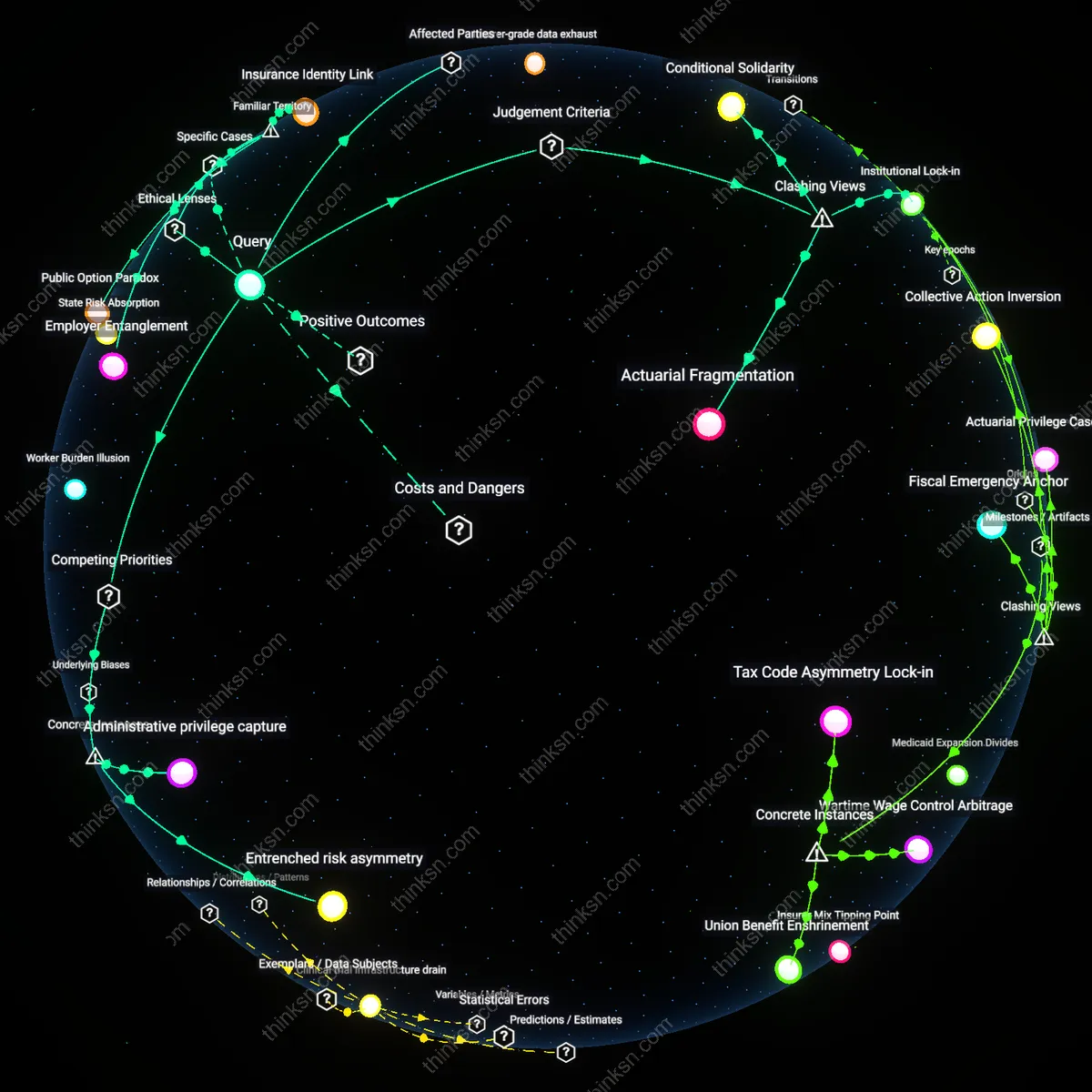
Analysis reveals 10 key thematic connections.
Key Findings
Medicare Part B creep
A 30-year-old worker today will face inadequate retirement income due to the automatic premium escalation of Medicare Part B, which has grown 73% in real terms since 2000 while wages stagnated, shifting increasing costs to beneficiaries through a mechanism indexed to medical inflation rather than wage growth. This dynamic is exemplified by the 2023 Medicare Trustee Report showing Part B premiums consuming 12% of the average Social Security check—up from 6% in 2000—driven by uncontrolled outpatient cost inflation that retirees must absorb directly. The underappreciated reality is that premium growth is structurally decoupled from wage growth, making cost-of-living adjustments insufficient for healthcare stability in retirement.
Long-term care cliff
A 30-year-old saving for retirement today is likely to face income inadequacy because private long-term care insurance markets have collapsed, as demonstrated by the 2018 Genworth Financial near-default and subsequent state bailouts, leaving few viable pathways to cover assisted living or home health expenses that now average $100,000 annually in states like Connecticut. This systemic withdrawal of private insurers from the risk pool has concentrated exposure on individuals without creating public alternatives, revealing a structural absence of intergenerational risk-sharing in U.S. elder care finance. The hidden mechanism is not inflation per se, but the failure to socialize predictable longevity risk, rendering even high-income retirees vulnerable to catastrophic drawdowns.
Employer liability migration
Retirement healthcare shortfalls for today’s 30-year-olds stem from the shift in employer liability from defined benefit health promises to high-deductible plans, as seen in AT&T’s 2011 decision to cap retiree HRA contributions at $1,000 annually regardless of actual cost, locking retirees into exposure to unchecked medical inflation beyond that ceiling. This capping mechanism, now adopted by over 60% of Fortune 500 companies, severs the historical link between employer support and actual cost trajectories, forcing retirees to absorb divergent price and coverage gaps. The non-obvious outcome is that even workers with strong employer ties are being progressively offloaded onto individual risk markets that assume sustained wage growth to keep pace—growth that has not materialized.
Medicare Fragility
The likelihood of inadequate retirement income due to underestimated healthcare cost inflation is increasing because Medicare’s financing model has shifted from a broad intergenerational compact to a strained, actuarially vulnerable system as life expectancy rose post-1980 without commensurate revenue reform. Since the 1983 Social Security Amendments recalibrated payroll taxes and benefits amid demographic anxieties, healthcare cost growth has consistently outpaced CPI inflation, yet retirement planning models remain anchored to CPI-based assumptions. This misalignment is driven by the institutional inertia of federal trust funds and private financial advisors who rely on federally published inflation metrics, obscuring the accelerating cost trajectory of post-65 care. The non-obvious insight is that the erosion of retirement security stems not from individual miscalculation but from a structural decoupling between public health financing timelines and private retirement planning horizons.
Medicare Coverage Gap
A 30-year-old's retirement healthcare costs will exceed expectations because Medicare does not cover long-term care, dental, vision, or hearing—services increasingly needed in later life. As life expectancy rises and out-of-pocket expenses grow, retirees must self-fund substantial portions of care not absorbed by public programs, relying on private insurance or savings that are often inadequate. This structural deficit in Medicare’s scope creates a predictable financial shortfall, especially as care inflation outpaces general inflation by 2–3 percentage points annually. The widespread assumption that ‘Medicare will cover my healthcare’ masks the reality of its limited benefits, making the resulting gap a silent drain on retirement security.
Employer Benefit Erosion
Future retirees face higher healthcare cost risk because employer-sponsored retiree health benefits are disappearing, shifting long-term cost exposure onto individuals. Since the 1990s, the share of large employers offering post-retirement health coverage has plummeted from over 60% to under 20%, driven by rising premiums and accounting liabilities. Workers now assume they will bridge decades of pre-Medicare coverage and supplemental needs through personal savings, yet few account for the compounding effect of healthcare inflation over a 30- to 40-year horizon. The erosion of this once-common benefit is rarely offset by equivalent individual planning, exposing a generation to unanticipated liabilities.
Healthcare Inflation Blindspot
Retirement savings plans systematically underestimate healthcare costs by anchoring projections to general inflation rather than the historically higher trajectory of medical price increases. Over the past four decades, U.S. healthcare inflation has averaged 5–6% annually, outpacing CPI by nearly 2%, yet financial planning models often default to 2–3% cost growth assumptions. This misalignment skews retirement income targets downward, leaving individuals unaware of the $200,000–$300,000 shortfall they may face in out-of-pocket medical and long-term care expenses. The blindspot persists because financial advice tools and retirement calculators are built on aggregates that smooth over category-specific volatility.
Pharmaceutical shelf-life decay
A 30-year-old today will face higher out-of-pocket costs in retirement due to the erosion of generic drug price suppression caused by repeated delays in FDA approvals for biosimilar insulin analogs. Regulatory bottlenecks and patent evergreening by originator firms like Eli Lilly and Novo Nordisk limit competitive market entry, keeping prices elevated for decades-long chronic care needs; this slow-moving institutional failure is rarely modeled in healthcare cost projections, which assume automatic price declines post-patent rather than accounting for regulatory attrition. This overlooked mechanism systematically understates late-life insulin and GLP-1 agonist expenses, distorting retirement affordability calculations for prediabetic and type 2 diabetic cohorts.
Medicare telehealth reimbursement fragmentation
Future retirees will experience higher effective healthcare costs because post-2030 telehealth coverage under Medicare Advantage plans will vary unpredictably by zip code due to state-level waivers and private plan formulary design, creating geographic arbitrage in access that retirees cannot anticipate at savings-accumulation stages. Most forecasting models assume uniform service cost declines from digital substitution, but in reality, rural enrollees in states like Mississippi or Wyoming will face higher cost-sharing for virtual care due to thin provider networks and narrow-network HMO dominance, increasing their out-of-pocket burden disproportionately. This spatially asymmetric reimbursement drift undermines the assumed efficiency gains from telemedicine, a factor absent in conventional retirement planning tools.
Hospital real estate debt pass-through
A 30-year-old’s future hospital care costs will rise faster than CPI due to municipal hospitals in midsize cities like Akron or Fresno refinancing decades of deferred facility maintenance through bond-issued debt, which gets amortized into patient billing via chargemaster upcoding that private insurers reject but Medicare Advantage and high-deductible plans partially absorb. Financial engineering in public hospital systems—masked as capital improvement—is becoming a stealth driver of cost inflation uncorrelated with medical innovation or labor costs, yet it is invisible in national health expenditure forecasts that focus on utilization or technology. This institutional balance sheet pressure creates a hidden cost wedge that retirement models fail to isolate or project.