Higher Costs, Bigger Payoff? Offshore Winds Long Game
Analysis reveals 9 key thematic connections.
Key Findings
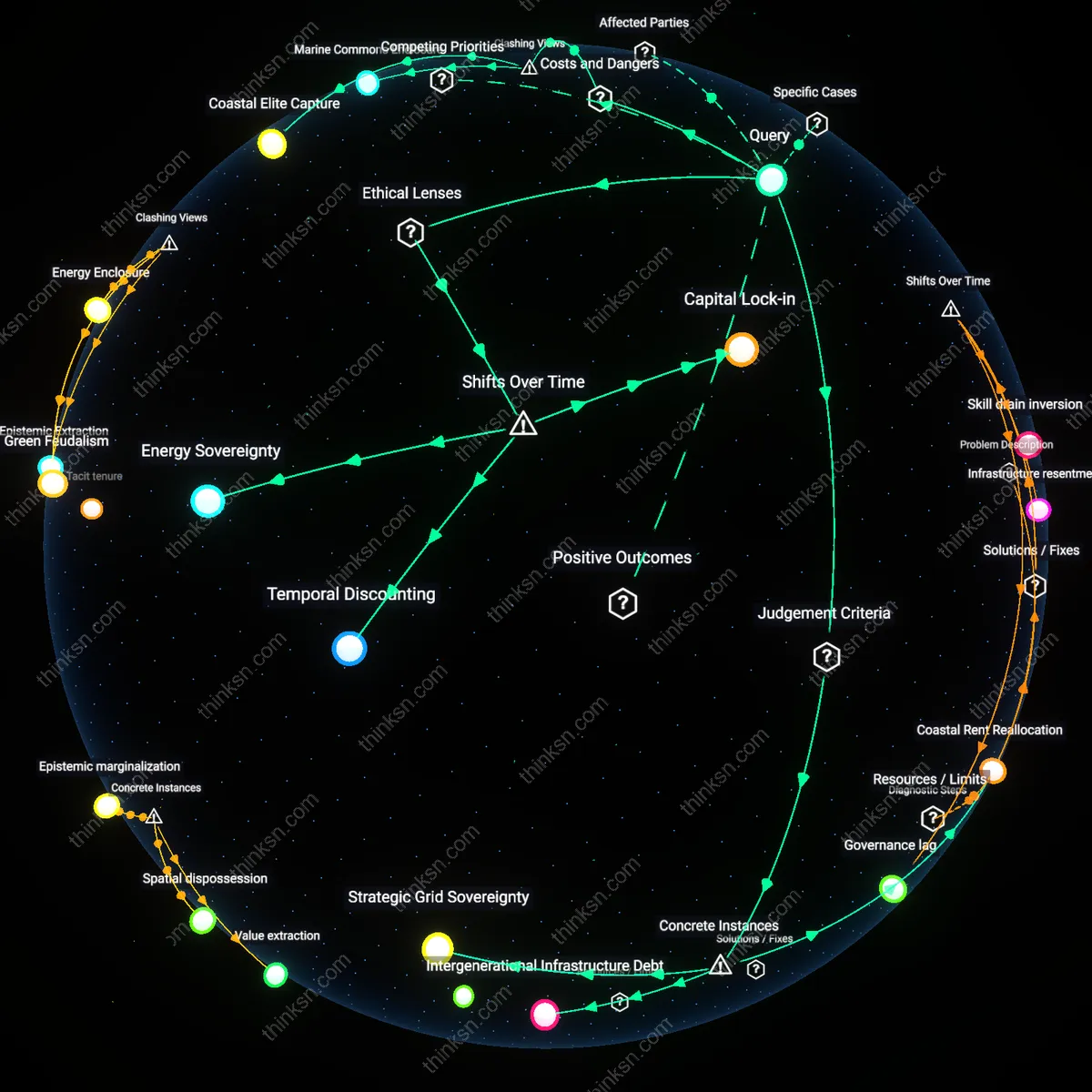
Intergenerational Infrastructure Debt
A state should prioritize offshore wind development because delaying it shifts disproportionate financial and environmental costs onto future generations, as seen in Germany’s Energiewende, where early investments in offshore wind after the 2011 nuclear phase-out decision locked in lower long-term electricity prices and grid resilience through state-backed contracts and seabed grid integration, revealing that upfront energy infrastructure costs function as a moral ledger across generations rather than a mere budgetary line item.
Coastal Rent Reallocation
A state should prioritize offshore wind because its development redistributes economic rent away from fossil fuel incumbents toward coastal communities with political agency, exemplified by Denmark’s ownership model in the Horns Rev projects, where regional cooperatives and municipal utilities secured equity stakes in turbines, enabling localized wealth capture through energy production and revealing that offshore wind’s value lies less in kilowatt-hour cost parity and more in its capacity to reconfigure who owns and profits from energy infrastructure.
Strategic Grid Sovereignty
A state should prioritize offshore wind to secure energy system autonomy against geopolitical supply shocks, as demonstrated by the United Kingdom’s North Sea expansion post-2022, where rapid permitting and Crown Estate leasing enabled offshore wind to displace Russian gas in grid dispatch during the European energy crisis, showing that the strategic value of offshore wind emerges not from levelized cost metrics but from its role in insulating national infrastructure from foreign energy leverage.
Coastal Elite Capture
A state should not prioritize offshore wind energy development because its initial cost burden disproportionately falls on inland ratepayers while coastal political and economic elites secure long-term control over energy assets and regulatory influence. This mechanism redirects public capital toward regions already privileged in infrastructure investment, leveraging federal subsidies and ratepayer-backed financing to lock in transmission advantages, which entrenches a system where energy democracy is undermined by spatialized power asymmetries. The non-obvious danger is not cost inefficiency but the consolidation of energy governance by a geographically concentrated class that shapes transition policies to exclude broader participation.
Marine Commons Enclosure
Prioritizing offshore wind development risks the systemic privatization of maritime space through de facto corporate occupation of federally managed waters under the guise of climate action, where profit-driven leasing processes by BOEM allow energy firms to claim vast swaths of ocean without commensurate public accountability. This redefines the Outer Continental Shelf as an extractive zone analogous to onshore mineral grabs, disrupting fishing grounds, Indigenous maritime practices, and naval mobility while externalizing ecological risks onto shared resources. The underappreciated danger is that green energy infrastructure, rather than displacing fossil imperialism, simply replicates its spatial logic of enclosure and dispossession under a renewable banner.
Grid Fragility Paradox
Investing heavily in offshore wind increases systemic risk by concentrating future baseload supply on a single, intermittently available source vulnerable to storm-induced outages and corrosion-related maintenance failures, thereby reducing the resilience of the regional grid despite claims of energy stability. The centralized nature of offshore farms—connected by long submarine cables and requiring massive synchronous inverter deployment—creates cascading failure points that challenge decentralized backup systems, exposing population centers to potentially prolonged blackouts during extreme weather events intensified by the very climate instability the projects aim to mitigate. The dissonant insight is that long-term economic benefit projections assume uninterrupted technological performance, yet ignore how offshore environments accelerate material degradation in ways that inland renewables do not.
Energy Sovereignty
A state should prioritize offshore wind energy development because the post-2015 shift from fossil fuel dependence to renewable infrastructure aligns with a cosmopolitan justice framework that redefines national responsibility in energy production. This transition reflects a move away from the Westphalian model of energy autarky—dominant from 1950 to 2000—toward a distributed, interdependent energy order where states ethically commit to reducing transboundary harm through decarbonization. The mechanism is state-led procurement of offshore wind via public-private tenders, as seen in Denmark’s Baltic Sea projects, which operationalize Rawlsian fair equality of opportunity across generations. What is underappreciated is that this is not merely an economic calculation but a reconfiguration of sovereignty itself—where legitimacy increasingly derives from ecological stewardship rather than resource control.
Capital Lock-in
A state should not prioritize offshore wind energy development when initial costs would exacerbate fiscal strain on public utilities historically shaped by neoliberal deregulation after the 1980s, as this risks deepening capital lock-in to large-scale infrastructure before distributed alternatives mature. The financial mechanisms required—such as state-guaranteed power purchase agreements—embed path dependency modeled on Cold War-era central planning, now repurposed for green megaprojects, which constrain future policy flexibility. In the U.S. Northeast, for example, commitments to offshore wind after 2020 have diverted budget allocations from grid modernization and energy efficiency, revealing how the ethical veneer of intergenerational equity masks a technocratic preference for visible, centralized solutions. The non-obvious insight is that this trajectory reproduces the very infrastructural rigidity that renewable transitions were meant to escape.
Temporal Discounting
A state should prioritize offshore wind energy development only when democratic institutions can overcome the electoral time horizon bias that emerged prominently after the 1990s, where short-term fiscal accountability eclipses long-term environmental investment. The ethical basis lies in deliberative democracy theory, which demands that policy reflect informed public reason across temporal scales, yet the institutionalization of cost-benefit analysis in energy planning—from the U.S. Federal Energy Regulatory Commission to EU state aid rules—systematically undervalues benefits accruing beyond a 20-year window. Germany’s Energiewende, post-2010, revealed this tension when offshore wind delays were justified by immediate household cost concerns despite long-term price stability forecasts. The overlooked dynamic is how procedural rationality in liberal democracies has become a temporal filter, privileging present consumers over future citizens.