Do Large Inheritances Stunt Heirs Long-Term Financial Growth?
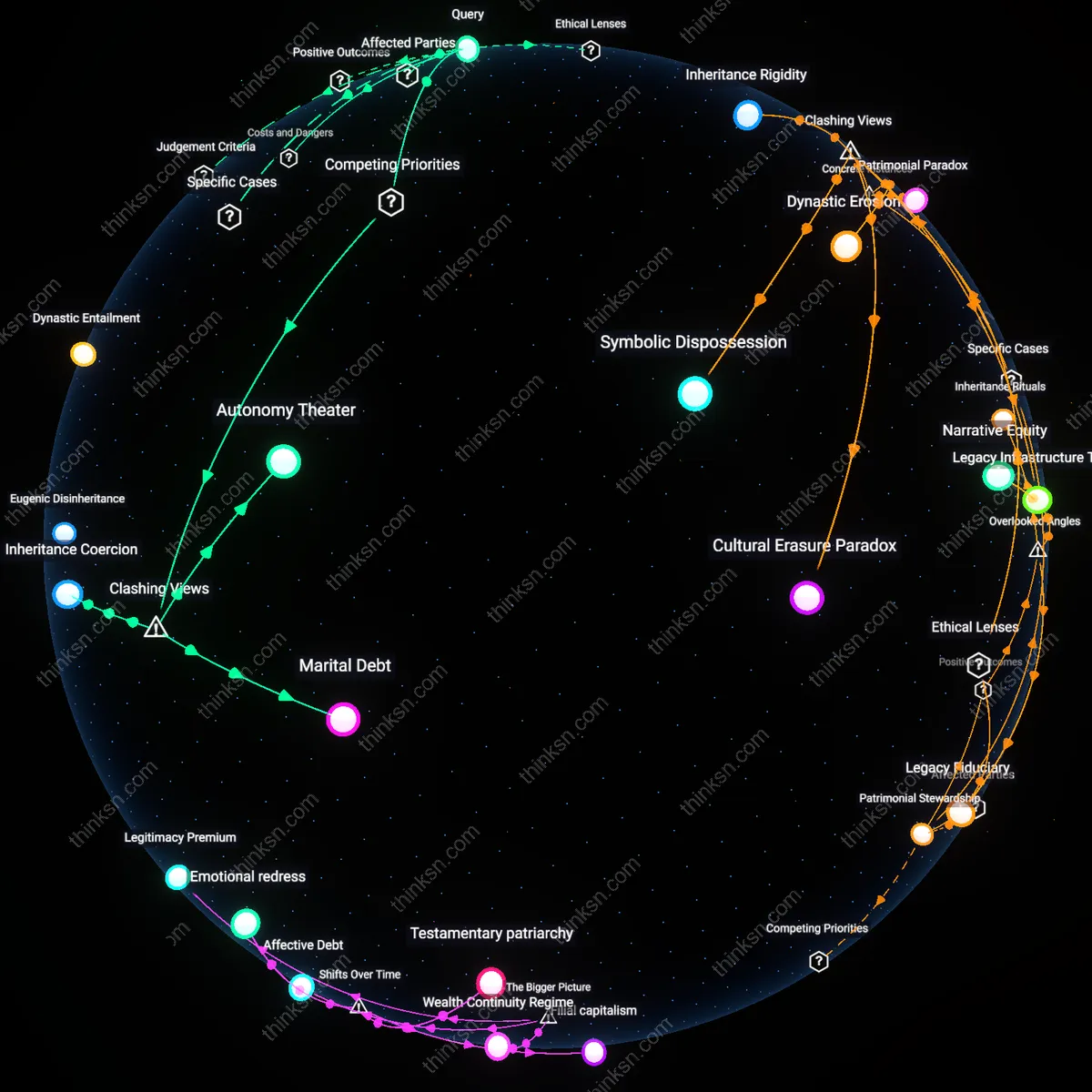
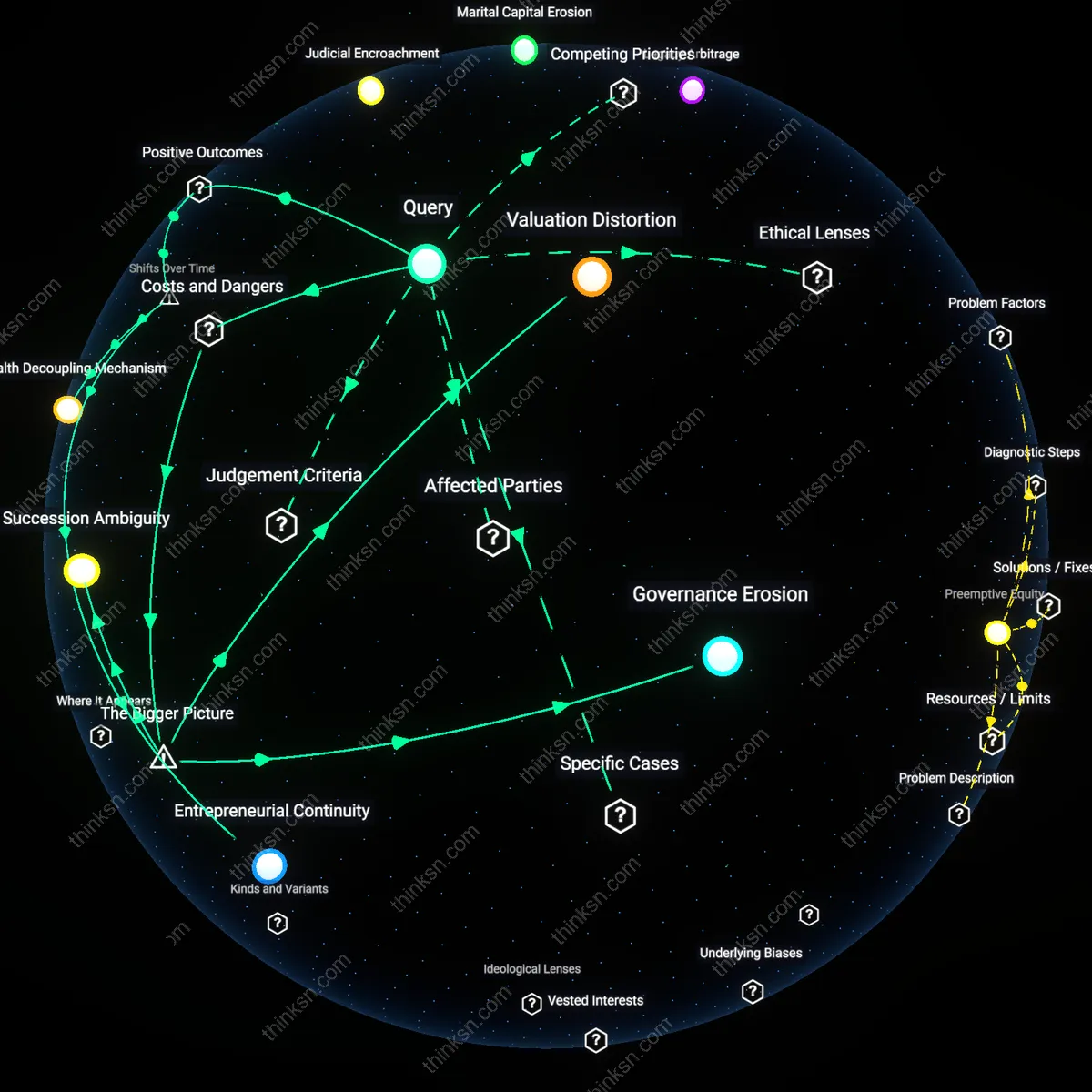
Analysis reveals 11 key thematic connections.
Key Findings
Privilege Velocity
Heirs who receive large inheritances outperform self-made individuals in long-term financial outcomes due to immediate access to compounding capital, as seen in 19th-century British aristocratic families who held land and titles that generated passive rents while industrialists faced market volatility. This mechanism—where wealth begets wealth without performance—operates through generational trust structures and asset appreciation untouched by entrepreneurial risk, a dynamic obscured by the cultural myth of meritocratic accumulation that dominates public discourse.
Wealth Feedback Loop
Individuals who accumulate wealth independently tend to develop financial discipline and reinvestment habits that lead to more resilient long-term outcomes compared to heirs, paralleling post-war American entrepreneurs like those in Silicon Valley who reinvested early gains into scalable ventures. This pattern emerges through iterative learning and adaptive risk-taking in competitive markets, a reality often overlooked because popular narratives equate sudden inheritance with lasting prosperity, when in fact self-made wealth often compounds more durably due to operational mastery.
Dynastic Drift
Heirs to large inheritances frequently experience long-term financial decline due to institutionalized spending and loss of productive engagement, mirroring the dissolution of Meiji-era Japanese zaibatsu families after World War II when centralized control eroded under unqualified heirs. This decay is driven not by mismanagement alone but by the systemic detachment from value creation, a truth masked in public imagination by glamour around inherited luxury, which presumes continuity rather than entropy.
Wealth dissipation trajectory
Heirs who receive large inheritances often experience downward wealth mobility over generations, as seen in the Rockefeller family's third- and fourth-generation descendants, where trusts, lifestyle inflation, and fragmented asset management eroded the initial capital concentration despite elite access and professional oversight, revealing that inherited wealth is structurally prone to dispersion rather than compounding when governance mechanisms fail to enforce long-term discipline.
Autonomous capital resilience
Individuals who accumulate wealth independently, such as Oprah Winfrey, demonstrate greater capital retention and strategic reinvestment because their accumulation is tied to sustained personal oversight, brand equity, and incremental risk management built through decades of market engagement, indicating that self-made wealth leverages experiential feedback loops which enhance fiscal durability beyond mere asset size.
Institutional mediation effect
In the case of the Tata family of India, where inherited wealth was preserved across generations not through individual stewardship but via entrenchment within a formalized corporate trust structure, the long-term financial outcome was determined not by the heir’s personal acumen but by the autonomy and governance strength of the mediating institution, showing that inheritance longevity depends less on the recipient and more on the depersonalized systems managing it.
Inheritance Dependence
Heirs receiving large inheritances in post-industrial Western economies exhibit lower long-term net worth growth compared to self-made accumulators because windfall wealth insulates them from market discipline, reducing incentive to develop financial literacy or entrepreneurial risk-taking; this divergence became pronounced after the 1980s financialization shift, when asset appreciation outpaced income, and those without self-reinforcing financial behaviors failed to compound capital effectively. The non-obvious insight is that sudden wealth in a high-opportunity-cost environment acts as a behavioral sedative rather than an accelerator.
Wealth Trajectory Inflection
Beginning in the late 1990s, heirs who inherited concentrated equity stakes in family-owned businesses underperformed independent wealth builders in liquid financial assets due to path dependency in asset allocation, where estate continuity obligations locked them into suboptimal portfolios amid the rise of diversified index investing; this created a structural drag visible in longitudinal studies of Forbes 400 members who inherited control versus those who built scalable ventures. The critical transition—when ownership rigidity met democratized finance—reveals how legacy wealth became a liability in rapidly re-valuing markets.
Autodidactic Capitalism
Self-accumulated wealth since the dot-com era has been sustained at higher rates over decades because its builders internalized iterative risk calibration through repeated exposure to failure and adaptation, particularly in tech and fintech sectors where volatility is generative; by contrast, large inheritances distributed after the 2008 crisis often coincided with risk aversion and institutional management, suppressing learning-by-doing. The underappreciated mechanism is not capital amount but experiential scaffolding—crisis navigation forged a new developmental mode where wealth creation became pedagogical.
Wealth Dissipation Trajectory
Heirs who receive large inheritances systematically experience downward wealth mobility within two generations due to institutional mismatch between inherited asset structures and heir capability networks, as seen in U.S. agricultural estates where non-farming heirs liquidate land for diversified portfolios, disrupting intergenerational compound growth; this reveals that transfer of capital does not transfer competence, challenging the assumption that large inheritances confer lasting advantage.
Patrimonial Illiquidity Trap
European heirs receiving titled estates or culturally designated assets—such as Tuscan vineyards bound by appellation laws—face long-term underperformance compared to self-accumulated wealth because legal and symbolic constraints block asset reallocation, demonstrating that socially embedded wealth often sacrifices financial optimization for legitimacy, a dynamic absent in meritocratic wealth narratives.