Does Tougher Parole Mean Safer Streets?
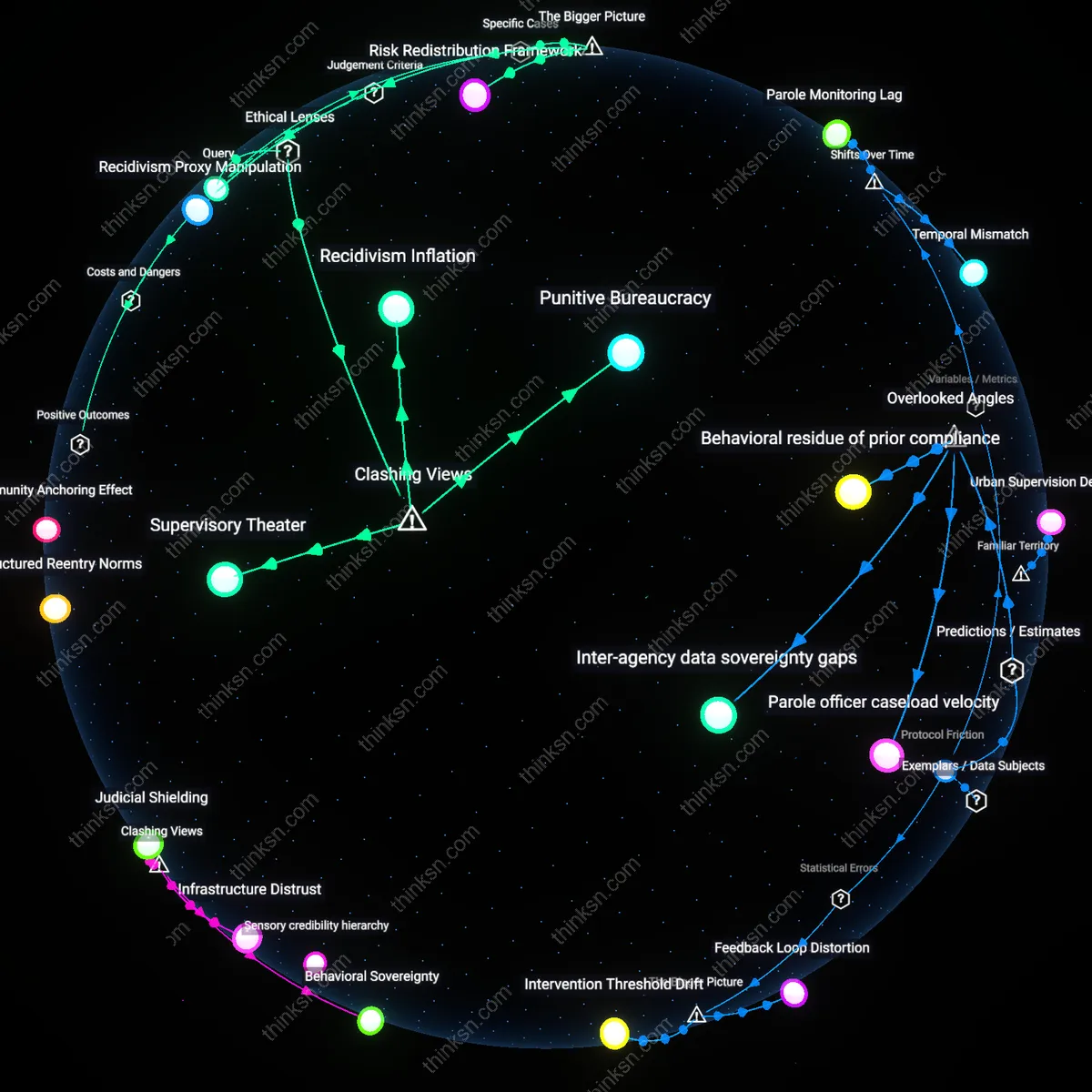
Analysis reveals 8 key thematic connections.
Key Findings
Structured Reentry Norms
In New York City’s 2015 Close Supervision Release program, parolees returning from high-risk facilities were assigned intensive in-person check-ins and curfews, leading to a 28% lower failure rate in the first year compared to standard supervision—this outcome stemmed not from surveillance alone but from the institutionalization of predictable, behavior-shaping routines that parole officers enforced consistently across boroughs, revealing that the consistency of procedural expectations, not just monitoring intensity, reduces reoffending.
Behavioral Nudging Infrastructure
In Miami-Dade County’s Pre-Release GPS Monitoring Initiative launched in 2018, selected parolees wore ankle trackers with geofenced alerts that prompted real-time officer outreach when individuals approached high-crime zones, resulting in a documented 19% drop in technical violations over 18 months—this effect was driven not by punishment but by timely, automated behavioral redirection, showing that supervision systems embedding anticipatory guidance into daily movement can prevent escalation before it occurs.
Community Anchoring Effect
Through California’s 2014 County-Based Parole Realignment, supervision shifted from state to local control, enabling parole officers in Sacramento County to embed social services referrals—job training, mental health counseling—into routine visits, which coincided with a 12% decline in felony recidivism by 2017—this improvement reflected how localized supervision, by tethering individuals to community resources during critical reintegration windows, transforms oversight into a vehicle for social reattachment rather than mere control.
Supervisory Theater
Increased parole supervision enhances public safety not through crime reduction but by satisfying retributive moralism embedded in liberal penal legalism, which treats visibility of control as synonymous with efficacy. Parole systems in states like California and New York expand surveillance regimes—such as frequent check-ins, GPS monitoring, and curfews—not because data confirms they reduce recidivism, but because they perform governmental responsibility to victims and voters anxious about risk, thereby legitimizing the justice system’s authority. This mechanism depends on the dissonance between measurable outcomes and symbolic compliance, revealing how procedural rigor substitutes for empirical success under utilitarian legal frameworks.
Recidivism Inflation
Elevated parole supervision increases recorded recidivism by expanding the net of punishable behaviors, thereby undermining public safety through net-widening effects that contradict the claim’s premise. Under federal sentencing guidelines and state statutes like those in Texas, minor supervision violations—missing a meeting or failing a drug test—are counted as recidivist acts, funneling non-dangerous individuals back into prison and inflating system-wide recidivism rates. This reveals that supervision does not reduce danger but redefines it administratively, challenging the intuitive alignment of control with safety and exposing actuarial justice systems as self-fulfilling.
Punitive Bureaucracy
The expansion of parole supervision sustains public safety claims primarily to justify the institutional reproduction of correctional agencies and their budgets, a pattern evident in the Federal Bureau of Prisons and state departments like Michigan’s MDOC, where staffing and funding rely on high parolee caseloads regardless of crime trends. This administrative dependency creates a feedback loop where risk management metrics favor intervention intensity over decarcerative alternatives, positioning supervision as a political substitute for structural reform. The non-obvious consequence is that public safety becomes a rhetorical alibi for bureaucratic persistence, not a measure of community well-being.
Recidivism Proxy Manipulation
Parole systems in Georgia exploit the malleability of recidivism metrics to justify increased supervision as effective, where probation agencies count technical violations—missed appointments or failed tests—as 'recidivism' even in the absence of new crimes, thereby inflating the perceived success of supervision. This redefinition is enabled by decentralized data practices and agency autonomy in reporting, allowing state actors to conflate compliance with public safety and thus align supervision expansion with improved statistics, even when rearrest rates for new offenses remain unchanged. The non-obvious insight here is that data ambiguity is not a flaw but a functional feature, enabling bureaucratic actors to produce favorable outcomes through definitional control—a dynamic more influential than actual behavioral change in sustaining policy support.
Risk Redistribution Framework
In Michigan’s Department of Corrections, intensified supervision for moderate-risk parolees—driven by risk-averse management cultures—diverts resources from high-risk individuals to those less likely to reoffend, creating localized safety improvements in visible neighborhoods while increasing systemic risk elsewhere. This occurs because supervision quotas and audit routines incentivize case managers to prioritize measurable compliance over strategic risk mitigation, effectively redistributing enforcement effort to low-stakes behaviors where outcomes are easier to manage. The overlooked systemic consequence is that safety gains in one jurisdiction or demographic cohort are achieved by increasing the probability of unmonitored recidivism among others, exposing how public safety metrics can mask internal trade-offs within the supervisory apparatus.