Do Abortion Shield Laws Tip the Scales Against Federal Oversight?
Analysis reveals 8 key thematic connections.
Key Findings
Judicial Sovereignty
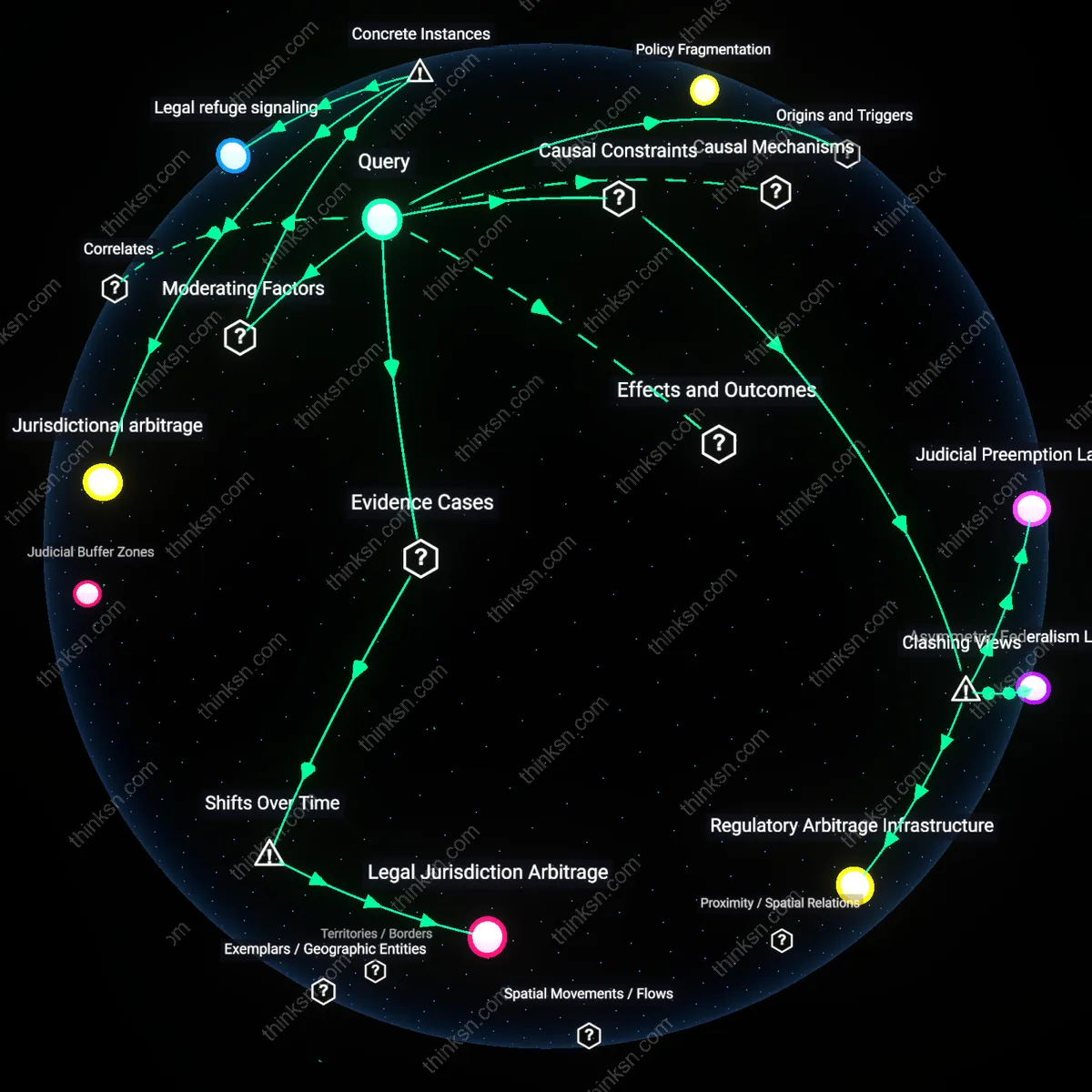
State-level abortion shield laws indicate that states are actively reclaiming legislative autonomy from federal judicial precedents, as seen in states like California and New York enacting statutes to protect providers and patients from out-of-state legal retaliation. This shift reflects a direct challenge to the historical centralization of reproductive rights under federal constitutional interpretation, particularly post-Roe v. Wade, by establishing state-defined legal safe harbors. The mechanism is statutory insulation—embedding legal protections within state civil and criminal codes to resist extraterritorial enforcement. What is underappreciated is that this is not merely reactive legislation but a deliberate assertion of judicial authority at the state level, reframing states as sovereign legal shelters rather than passive implementers of federal doctrine.
Policy Fragmentation
The emergence of abortion shield laws reveals a deep fracture in national policy coherence, where states such as Massachusetts and Colorado pass laws enabling telemedicine abortions while others like Texas criminalize assisting residents who seek them. This condition arises from the collapse of a uniform federal standard after Dobbs v. Jackson, enabling divergent state regimes to treat abortion as a matter of local moral governance rather than national right. The dynamic operates through conflicting statutory jurisdictions—each state's legal reach now extends beyond its borders, attempting to enforce or protect conduct across state lines. What is often missed is that this is not just legal variation but systemic incoherence, where the federal judiciary’s withdrawal has produced legal zones of contradiction rather than a patchwork.
Jurisdictional arbitrage
The passage of California’s SB 244 in 2022, which protects out-of-state patients and providers from civil liability stemming from abortions conducted legally in California, demonstrates that state shield laws function as tools for states to assert regulatory authority beyond their borders, exploiting federal inaction and the absence of a national standard. This mechanism enables states like California and New York to create legal safe harbors that attract residents from restrictive states, thereby transforming state law into a de facto interstate regulatory counter-system. The significance lies in how this dynamic reveals a non-legislated form of jurisdictional competition—one not imposed by federal structure but emergent through conflict between state policies and federal judicial withdrawal, particularly after Dobbs v. Jackson.
Legal refuge signaling
When Vermont passed its 2023 Reproductive Liberty Law, explicitly declaring its courts would not cooperate with subpoenas or evidence requests from states prosecuting abortion-related acts, it turned state judicial infrastructure into a shielded zone, signaling to both residents and external actors that Vermont would actively resist extrajurisdictional enforcement. This form of legislative theater—where law functions as both policy and declarative stance—reveals how states now use shield laws not just to protect but to project sovereignty in the absence of federal adjudicative clarity. The non-obvious insight is that such signaling alters behavior not through legal inevitability but through perceived sanctuary, making the law’s expressive function as consequential as its enforceable content.
Judicial Preemption Latency
State-level abortion shield laws indicate that federal judicial control is not automatically authoritative, because enforcement of Supreme Court rulings requires functional cooperation from state executive and legislative branches; without immediate federal mechanisms to override state noncompliance, there is a temporal and procedural bottleneck in judicial preemption, allowing states to de facto nullify federal standards through legislative inertia and jurisdictional shielding. This dynamic reveals that the judiciary’s power is bottlenecked by the lack of direct enforcement capacity—its authority depends on state actors to operationalize rulings, and when those actors resist, the federal legal order exhibits latency rather than supremacy. The non-obvious insight is that judicial finality does not equate to legal immediacy, and shield laws exploit that delay to create zones of de facto autonomy.
Asymmetric Federalism Leverage
The emergence of abortion shield laws demonstrates that state governments can exploit constitutional ambiguity to asymmetrically reconfigure federalism in their favor, not through defiance per se, but by proactively constructing legal architectures that make federal judicial mandates prohibitively complex to enforce. States like Massachusetts and California do this by embedding medical licensing, liability protections, and telehealth provisions into shield laws, creating interdependencies that federal courts lack the administrative granularity to unwind. This contradicts the view that federal courts centrally calibrate state power, showing instead how states can seize agenda-setting power in federalism disputes—turning judicial review into a reactive, resource-intensive effort rather than a preemptive authority.
Regulatory Arbitrage Infrastructure
Abortion shield laws reveal that state authority is being reconstituted not as resistance but as infrastructure for legal arbitrage, where states actively create regulatory safe zones that attract cross-border rights-preserving activities, thereby redistributing de facto constitutional access based on state legislative posture. These laws enable providers in shield states to offer teleabortion services to residents of restrictive states, bypassing federal inaction by turning state statutes into functional surrogates for national rights—circumventing judicial control not by challenging court rulings directly, but by making compliance with restrictive regimes materially obsolete. This undercuts the assumption that judicial supremacy governs reproductive rights distribution, showing instead how states can become nodes in a shadow federalism that operates beneath the level of constitutional adjudication.
Legal Jurisdiction Arbitrage
Abortion shield laws in states like Vermont and Connecticut demonstrate that state governments now treat legal jurisdiction as a fungible asset to be weaponized against federal judicial retrenchment, particularly by enacting statutes that invalidate enforcement actions from states where abortion is banned. This represents a sharp break from the post-Roe era, when federal judicial authority functioned as a uniform limit on state action; now, states actively construct legal barriers to nullify the extraterritorial reach of other states’ laws, relying on conflicts of law and prosecutorial non-cooperation. The underappreciated development is that this is no longer about policy preference but about states engineering legal arbitrage—exploiting discrepancies in state and federal authority to create de facto safe zones. The result is not federalism as balance, but as a competitive legal marketplace shaped by judicial fragmentation.