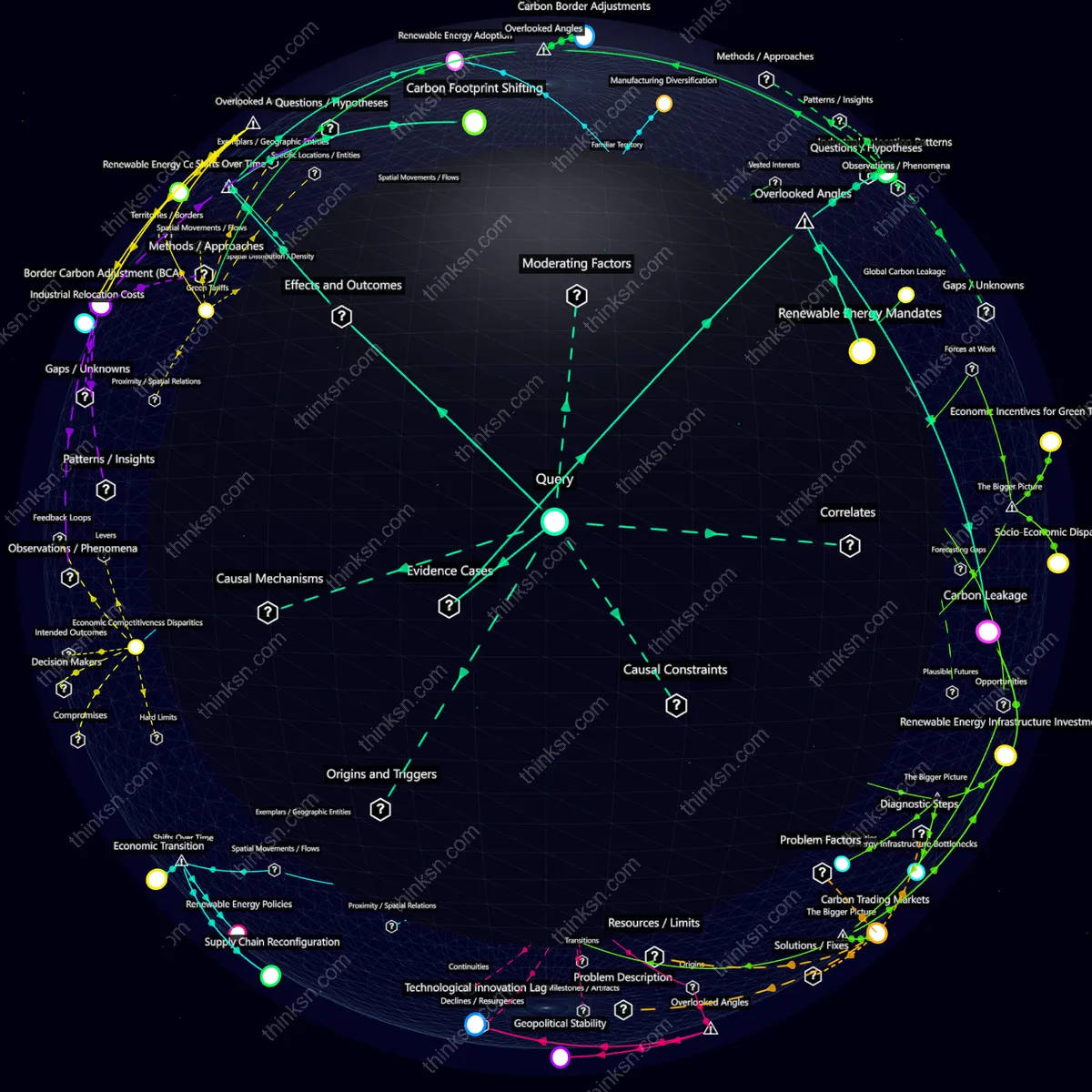
The Global Emissions Paradox of Renewable Energy Mandates
Key Findings
Dirty Industry Move
Heavy industries move to countries with weaker climate rules because uneven policies create cost advantages, so local decarbonization often increases global emissions unless carbon pricing is widely harmonized.
Some rich countries now enforce strict rules to cut carbon emissions. At the same time, many fast-growing economies have weaker climate rules. This gap creates an incentive for heavy industries to move production to countries with lower compliance costs. As a result, factories relocate to places with looser climate policies. This shift means emissions rise globally even if they fall locally. The problem grew after the Kyoto Treaty. Binding targets for rich countries but not for others encouraged companies to move manufacturing. Without strong global cost for carbon, companies will keep shifting production. Only when carbon pricing is broadly adopted across countries will this trend reverse. Measures like carbon border taxes help level the playing field. Until then, cutting emissions in one region mainly shifts dirty production elsewhere.
Pollution Moves When Rules Differ
Uneven climate rules cause pollution to shift to weaker-regulation countries because high-cost producers move to avoid economic pressure.
Climate rules vary widely between major industrial countries. This imbalance allows pollution to shift across borders. It happens most in industries like steel, cement, and aluminum. These sectors rely heavily on energy. When rich countries set strict renewable energy rules on their own, it raises costs for local producers. If there are no border adjustments, this creates a strong incentive to move production. Firms shift to regions with weaker climate rules and dirtier power supplies. This effect is strongest in open, trade-exposed markets. It also occurs when production can easily move and cleanup costs differ greatly between regions. As a result, heavy industries relocate instead of cutting emissions. This undermines global climate progress. Without global coordination or trade tools, emissions simply move abroad. Rules like the EU’s Carbon Border Adjustment help reduce this risk. Without such measures, lower emissions in one country can mean higher emissions elsewhere. Uncoordinated policies can lead to more pollution overall. This result is supported by the latest IPCC climate assessments.
Pollution Point Shift
Dirty industries move to weak-regulation countries when clean energy policies are not globally aligned, increasing total emissions.
Climate agreements without strong enforcement can backfire. Renewable energy rules in rich countries may push dirty industries to poorer nations. This happens when clean energy policies are not matched globally. Countries with weak climate rules attract carbon-heavy production. The move increases total global emissions. This effect was strongest from 1990 to 2015. During that time, climate rules varied widely. Big polluters could escape strict laws by relocating. This was most common in industries that use a lot of energy. Lower energy costs and lighter regulations pulled factories abroad. The result was a shift in where pollution was counted. Emissions rose because production moved, not ended. The problem fades when carbon rules become more uniform. Systems like the EU's post-2021 carbon market reduce the incentive to relocate. They do this by making pollution costly everywhere. Border adjustments also help. They remove the advantage of moving production. When major economies align their policies, pollution shifting drops.
Dirty Industry Moves
Renewable energy mandates cause dirty industries to move abroad when no low-carbon alternatives exist and carbon rules do not follow trade, shifting emissions instead of cutting them.
Renewable energy mandates in rich countries assume all regions will follow strict climate rules. But heavy industries face high costs to comply. When they cannot reduce emissions easily, they move production. Factories relocate to countries with looser climate rules. This shift lowers their costs but increases global pollution. A clear example is aluminum smelting leaving Europe for Southeast Asia. There, fossil fuels power the grid and rules are weaker. Emissions do not disappear. They shift to other regions. This happens because companies can move freely across borders. Carbon pricing in one country cannot control emissions abroad. Without tools like border taxes, domestic climate laws fail. They do not cut total emissions. They only push them elsewhere. The result is emissions trading places, not shrinking. For industries needing lots of power, few clean options exist. Low-carbon power at scale is still rare worldwide. Without support or strong global coordination, relocation increases. Production stays polluting. Climate mandates alone cannot stop this. Only measures that match domestic rules at borders can prevent it.