Why Small Credit Card Debts Can Cost You More Mentally and Financially?
Analysis reveals 5 key thematic connections.
Key Findings
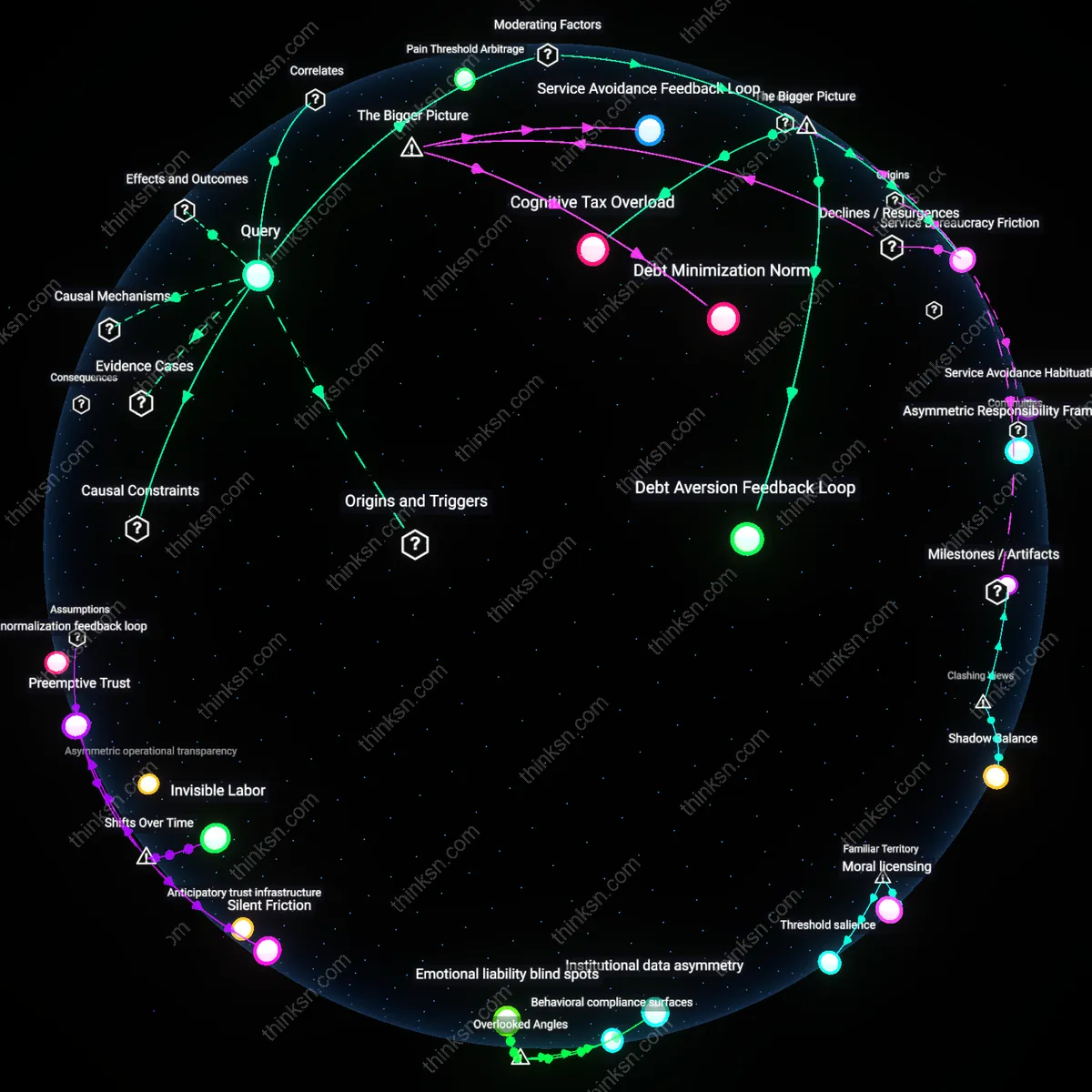
Debt Aversion Feedback Loop
Psychological stress from a small credit-card balance causes overpayment when borrowers associate any outstanding debt with identity threat in financially stigmatized communities. In neighborhoods with high visible inequality and social monitoring of consumption, even minor balances trigger anticipatory shame, activating automatic repayment behaviors that override interest-minimizing logic. This response is amplified by social comparison mechanisms embedded in dense community networks where financial 'cleanliness' signals moral responsibility, making the avoidance of psychological discomfort a higher priority than cost-efficiency. The non-obvious element is that the overpayment is not driven by the balance itself but by the social identity risk it symbolizes, transforming repayment into a reputational hygiene practice.
Cognitive Tax Overload
Borrowers overpay on small credit-card balances when concurrent financial complexity—such as managing multiple debts or irregular income—increases cognitive load, reducing capacity to optimize payment strategies. Under conditions of persistent scarcity, attention becomes a taxed resource, leading individuals to adopt simplifying heuristics like 'eliminate any balance quickly' to offload mental burden, even when this incurs higher opportunity costs. This mechanism operates through the executive function strain induced by structural precarity, where the cognitive toll of juggling bills, jobs, and family needs reshapes financial decision architecture. The overlooked insight is that overpayment functions as a cognitive relief tactic, not a financial choice, revealing how scarcity distorts cost-benefit analysis via mental bandwidth depletion.
Service Bureaucracy Friction
Credit-card holders overpay small balances when customer service systems are perceived as unresponsive or punitive, making negotiated resolutions seem riskier than full repayment. In markets where lenders have asymmetric power and dispute processes are opaque or historically unreliable—such as subprime card networks with automated collections—borrowers preempt potential escalations by overpaying to avoid triggers like late flags or credit-reporting events. This occurs within a regulatory environment that enables algorithmic enforcement without sufficient appeal channels, causing individuals to internalize compliance as self-protection. The underappreciated dynamic is that overpayment becomes a defensive maneuver against institutional unpredictability, not a reflection of financial literacy or preference.
Debt Identity Anchor
Psychological stress from a small credit-card balance causes overpayment because the debt functions as a persistent marker of financial self-concept, where even minor balances activate identity-based discomfort rather than financial inefficiency calculations. For cardholders immersed in financial shame narratives—especially those with prior over-indebtedness—the presence of any balance disrupts a hard-won self-image of control, triggering accelerated repayment as identity repair. This mechanism operates through internalized financial morality systems prevalent in consumer credit counseling cultures, particularly in middle-income U.S. households, where 'being debt-free' is coded as ethical hygiene. Contrary to the assumption that overpayment reflects rational cost minimization, this reveals the non-obvious role of debt not as a financial variable but as an emotional reference point.
Pain Threshold Arbitrage
Borrowers overpay small credit-card balances because the psychological stress of carrying *any* balance interacts with nonlinear pain perception, where the emotional cost of a $50 debt is nearly equivalent to larger amounts below a salience threshold. For underbanked populations facing irregular income—such as gig workers in urban Texas—this stress is amplified by housing or medical precarity, making even minimal debt feel existentially volatile. The mechanism functions through affective forecasting, where individuals mispredict future emotional relief from debt elimination, treating payoff as a fixed psychological investment rather than a marginal financial one. This challenges the dominant rational actor model by showing that overpayment stems not from miscalculation but from emotional hedging against anticipatory distress.