Why Low-Income Neighbors Resist Dense Affordable Housing?
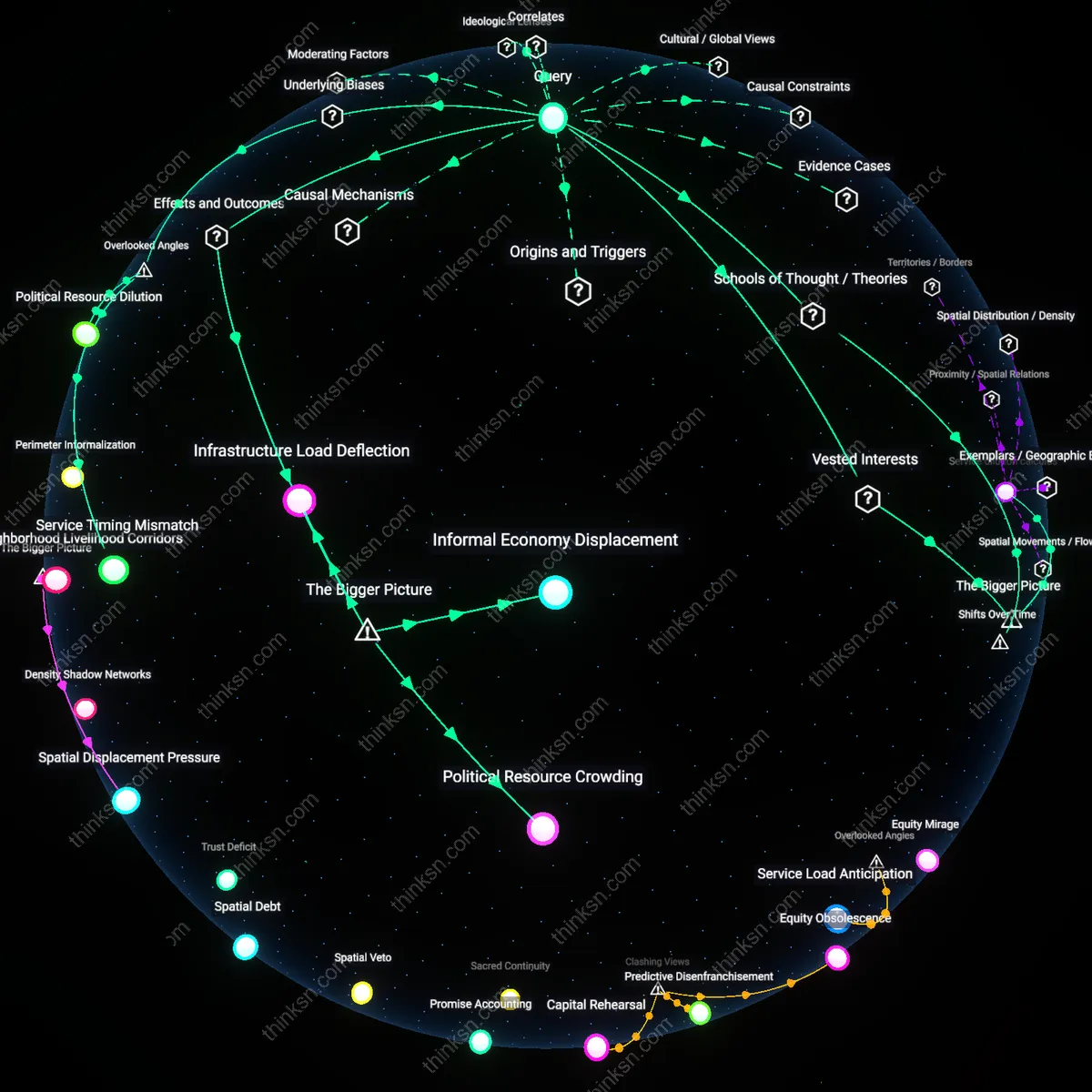
Analysis reveals 8 key thematic connections.
Key Findings
Service Gap Polarization
Low-income residents oppose high-density affordable housing because the neoliberal turn in urban governance since the 1980s shifted responsibility for service delivery from the state to community-based nonprofits and public-private partnerships, creating a fragmented, underfunded patchwork that cannot scale with population density. In cities like Oakland or Philadelphia, school districts and health clinics reliant on fluctuating grants and local taxes face intensified demand with new housing, turning classrooms into crisis zones and clinics into triage points. The opposition reflects a rational assessment that more residents will not bring proportionally more state capacity—since the post-welfare-era state acts as a curator of scarcity rather than guarantor of equity—making density feel like a threat to existing access. This exposes how decentralization under austerity has produced service gap polarization, where new development strains existing users rather than relieving systemic burdens.
Informal Economy Dependence
Low-income residents may oppose high-density affordable housing because new development threatens informal economic networks tied to existing low-density spatial conditions, such as unpermitted home-based businesses, street vending routes, or shared housing arrangements that rely on under-monitored spaces. Municipal upgrades accompanying density—like formal zoning enforcement, increased code inspections, or intensified policing of land use—can dismantle livelihoods that depend on regulatory gray zones, particularly in neighborhoods with weak formal job markets. This dynamic is systematically overlooked because planning discourse assumes density inherently benefits the poor, while ignoring how institutional formalization erodes adaptive survival economies. The mechanism operates through regulatory intensification that shadows density-increasing redevelopment, altering the very conditions that enable informal value extraction in marginalized communities.
Service Timing Mismatch
Low-income residents may resist high-density affordable housing because infill density is often implemented without synchronized expansion of time-sensitive public services, especially school enrollment capacity, clinic appointment availability, and transit frequency, creating peak-load crises that degrade service quality for existing residents. Density increases population mass quickly, but bureaucratic service provision adjusts incrementally, leading to multi-year lags where new residents strain fixed-capacity systems, disproportionately affecting those already dependent on public infrastructures. This temporal misalignment is rarely addressed in housing debates, which assume infrastructure scales proportionally, when in practice budget cycles, civil service hiring, and equipment procurement respond too slowly to absorb sudden demand spikes. The overlooked system is the administrative inertia embedded in municipal service delivery, which turns density gains into immediate losses for incumbent low-income users.
Political Resource Dilution
Low-income residents may oppose high-density affordable housing because increased population density in their neighborhoods can fragment established community organizations’ influence over local decision-making by introducing new, potentially disengaged or transient residents who dilute collective political voice. Existing tenant associations or block groups that have spent years building leverage with city officials risk seeing their hard-won advocacy power dispersed when new developments bring in residents with different priorities or lower civic participation, undermining targeted demands for sanitation, safety, or capital improvements. This erosion of political concentration is rarely acknowledged in planning discussions that celebrate density as civic empowerment, when in reality, organizing power often depends on stable, low-turnover populations. The hidden dependency is on demographic continuity as a precondition for sustained political efficacy, not just population count.
Service dilution calculus
Low-income residents oppose high-density affordable housing because expanding housing without synchronized public investment risks overwhelming fixed-capacity urban services like water, transit, and waste management. Municipal agencies often approve denser developments while maintaining flat budgets for service provision, forcing existing residents to absorb longer wait times and degraded quality—especially in neighborhoods where infrastructure was already under-resourced. This creates a rational calculus among low-income households who anticipate bearing the costs of expansion without guaranteed upgrades, revealing how fiscal austerity at the city level transforms housing equity initiatives into localized threats to service access.
Infrastructure Load Deflection
Low-income residents may oppose high-density affordable housing because immediate strain on overtaxed utilities and public services—such as sewage systems, transit, and schools—diverts maintenance and capital funding from existing households to new developments in cities like Detroit or Baltimore, where municipal budgets are already constrained by declining tax bases. This reallocation occurs through city capital planning processes that prioritize expansion over repair, disproportionately burdening current residents who experience delayed repairs and service cuts. The non-obvious force here is not opposition to housing per se, but a defensive response to systemic disinvestment, where new development accelerates the deflection of limited infrastructure resources away from established communities.
Informal Economy Displacement
In dense urban neighborhoods such as parts of Brooklyn or East Harlem, low-income residents often rely on informal economic networks—unlicensed childcare, home-based businesses, street vending—that occupy underutilized spaces in low-rise buildings and sidewalks, and high-density housing replaces these spatial conditions with regulated, monitored, and privatized environments, disrupting livelihoods before formal alternatives exist. This shift is amplified by zoning upgrades and increased police or code enforcement that accompany densification projects, even when those projects include affordable units. The overlooked consequence is that infrastructure strain includes not only pipes and transit, but the erosion of informal socio-economic infrastructure that sustains survival in marginalized communities.
Political Resource Crowding
When high-density affordable housing is introduced in cities like Los Angeles or Austin, it concentrates publicly subsidized residents in single developments, increasing competition for finite social services—such as Section 8 vouchers, food distribution, or mental health outreach—administered by understaffed county agencies, thereby reducing per-capita access for both new and pre-existing low-income households. This crowding effect intensifies due to funding models that tie service allocation to geographic need but fail to scale with sudden population density increases, making current residents perceive new housing as a threat to their entitlements. The underappreciated dynamic is not physical infrastructure, but the saturation of political-administrative capacity, which turns housing as policy into a zero-sum claim on state attention.