Is a Climate Commission Worth the Democratic Cost?
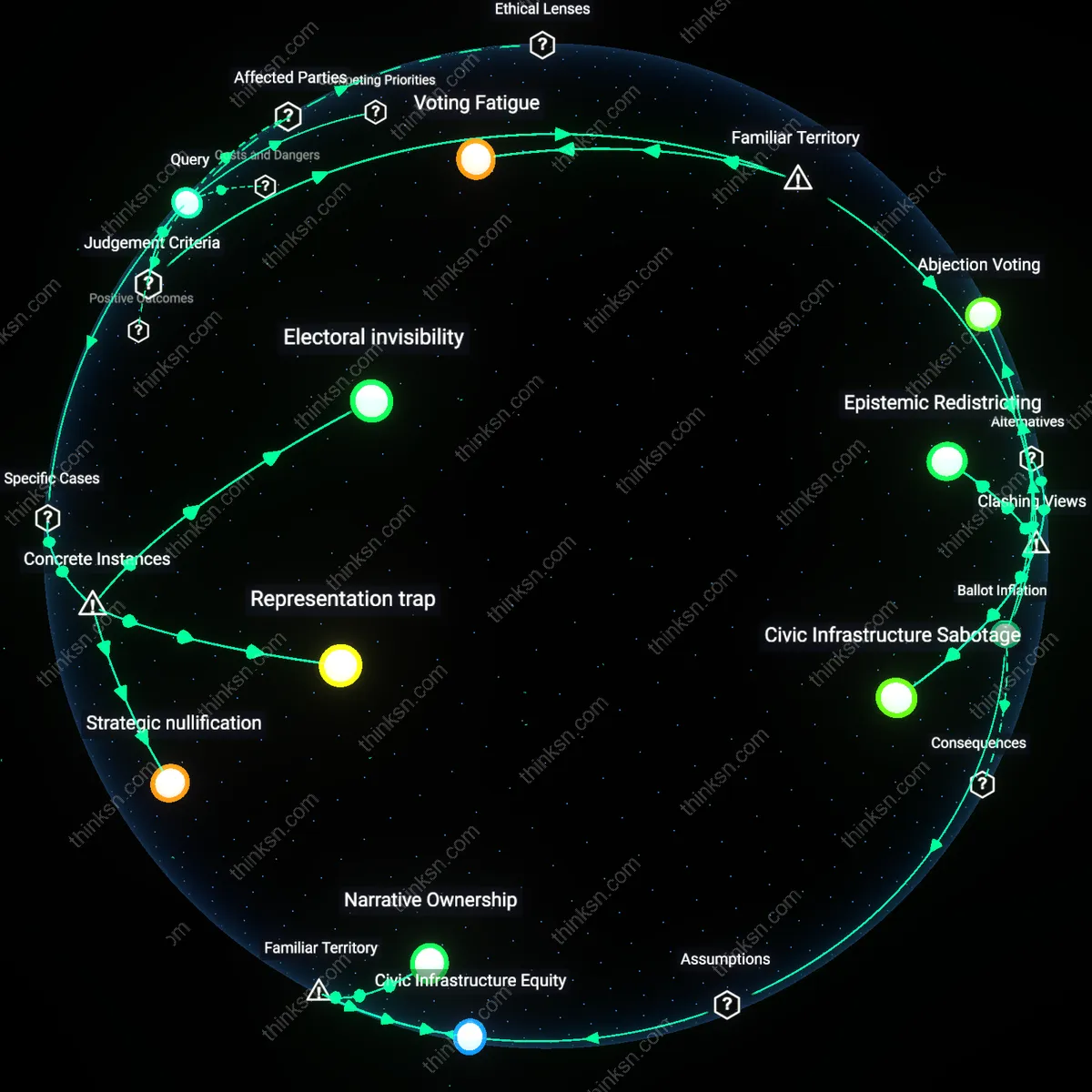
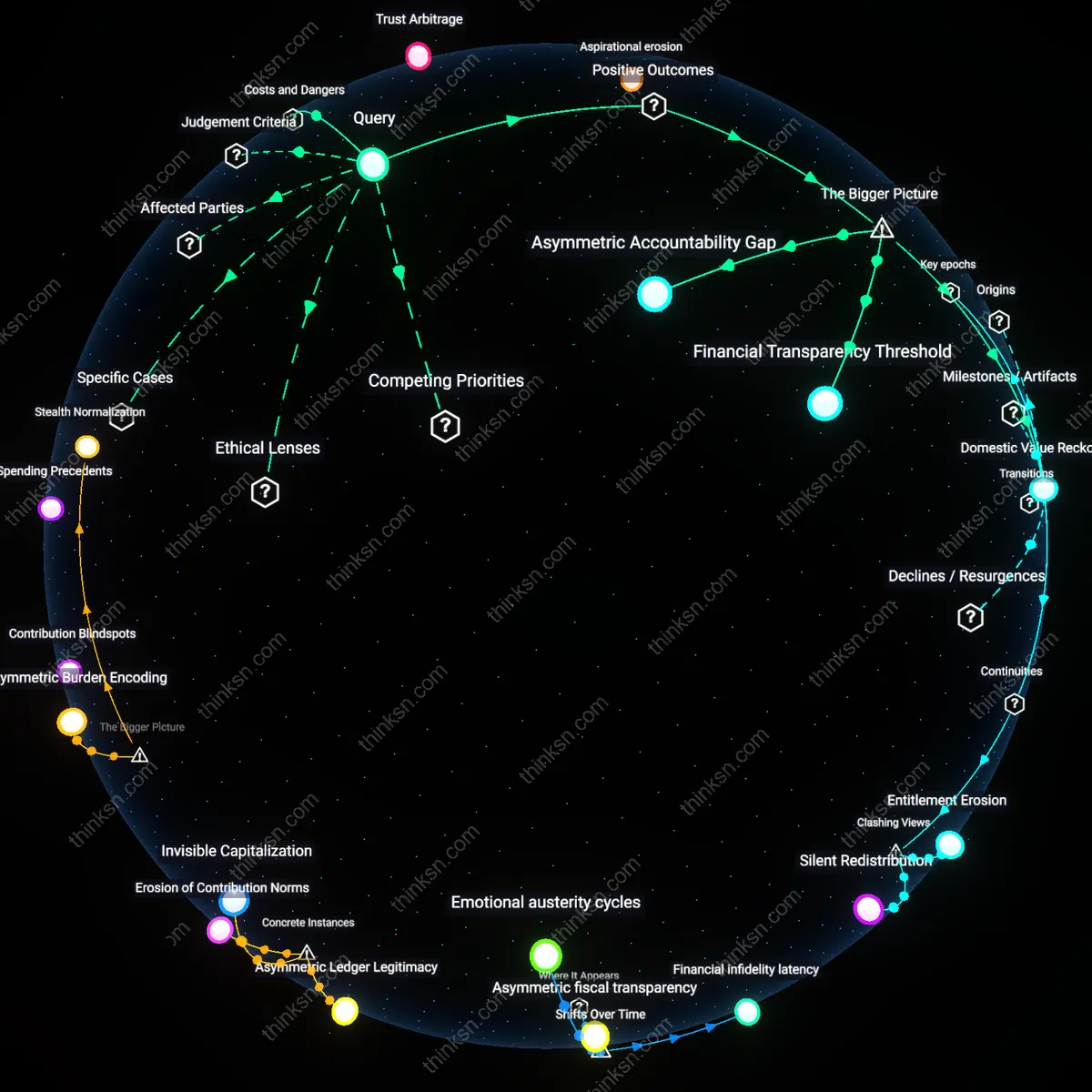
Analysis reveals 9 key thematic connections.
Key Findings
Epistemic Arbitrage
Delegating climate policy to an independent commission amplifies epistemic arbitrage by enabling technocratic bodies to reframe climate inaction as a failure of public irrationality rather than political obstruction. Agencies like the UK Climate Change Committee gain authority by positioning themselves as neutral arbiters of long-term risk, yet their models systematically discount socio-political feasibility, allowing them to declare aggressive targets while insulating elites from accountability when implementation lags. This dynamic privileges a narrow form of scientific legitimacy that delegitimizes democratic contestation as noise, revealing how purported solutions to short-termism can exploit knowledge asymmetries to sideline dissent.
Accountability Loophole
Independent commissions exacerbate the accountability loophole by fragmenting responsibility across entities that are neither electorally constrained nor legally liable for policy failure, as seen in Germany’s Intergovernmental Panel on Climate Change-inspired advisory bodies that issue binding emission benchmarks without fiscal or enforcement powers. Elected officials can endorse commission recommendations to signal action while blaming the same bodies for unpopular measures, enabling a transfer of political risk without transfer of real authority. This arrangement does not resolve democratic deficits—it formalizes them through plausible deniability, exposing how institutional 'solutions' can codify irresponsibility.
Temporal Displacement
Climate commissions enable temporal displacement by shifting the political burden of sacrifice onto future populations while immediate beneficiaries remain concentrated in the present, as demonstrated by Canada’s Net-Zero Advisory Body recommending stringent near-term regulations that disproportionately impact fossil fuel-dependent communities in Alberta, with compensation promised in distant fiscal reallocations. The commission’s legitimacy rests on representing intergenerational equity, yet its recommendations are structurally decoupled from the spatial and social immediacy of those bearing the costs. This reveals how long-termism, when institutionalized, can become a tool for deferring distributive conflict rather than resolving it.
Credible Commitment Mechanism
Establishing climate targets through the UK Climate Change Committee reduces partisan short-termism by binding successive governments to legally enforceable carbon budgets, as demonstrated by the cross-party acceptance of its 2050 net-zero recommendation despite electoral cycles; this mechanism functions through statutory independence combined with expert transparency, making reversal politically costly and thus transforming climate policy into a durable commitment rather than a negotiable platform, which reveals that insulation from elections can enhance long-term democratic will when accountability is redirected toward outcomes rather than votes.
Deliberative Mandate Expansion
Ireland’s Citizens’ Assembly on climate change legitimized bold policy recommendations like carbon taxation by embedding public deliberation within an independent process, leading to parliamentary adoption of measures previously deemed electorally toxic; here, the commission acted as a conduit for popular sovereignty rather than a replacement, using representative mini-publics to articulate long-term public interest that elected officials could then safely enact, showing that democratic accountability can be deepened through delegated deliberation when the commission amplifies marginalized voter preferences across time.
Technocratic Legitimacy Trap
Poland’s National Council for Climate Strategy, staffed largely by energy industry appointees, stalled meaningful decarbonization despite formal independence, illustrating how commissions can entrench short-term economic interests under the guise of technical neutrality; its lack of pluralistic input and enforcement power allowed it to serve as a democratic alibi for policymakers while producing minimal policy impact, exposing how delegated authority without transparent participation criteria risks capturing long-term goals within narrow, immediate industrial logics under cover of expertise.
Temporal decoupling
Shifting climate policy to an independent commission amplifies long-term planning by insulating decisions from electoral cycles, thereby weakening voter-driven short-termism. Technocratic bodies like the UK Climate Change Committee operate under mandates that prioritize intergenerational equity over immediate public opinion, leveraging scientific modeling and binding carbon budgets that elected officials cannot override without parliamentary supermajorities. This mechanism functions through institutional time horizons disaligned from party politics, making democratic responsiveness a casualty of strategic consistency—the non-obvious trade-off being that reduced political vulnerability enables bolder emissions pathways at the cost of public contestation over trade-offs like energy pricing or land use, revealing how separation in time alters power in policy.
Accountability deflection
Establishing an independent climate commission risks hollowing out legislative responsibility by shifting blame for unpopular measures to apolitical experts, thus preserving electoral viability for governing parties while eroding transparent oversight. When Germany’s Council of Experts on Climate Change recommends sectoral phaseouts, coalition governments can endorse the advice symbolically while avoiding ownership of implementation costs—a dynamic sustained by media narratives that frame political non-compliance as institutional weakness rather than democratic choice. The systemic leverage lies in multiparty consensus governments using commissions as scapegoats, which subtly transforms accountability from elected representatives to unelected assessors, exposing how diffusion of blame becomes a survival tactic in fragmented democracies balancing climate urgency against voter backlash.
Epistemic capture
Independent climate commissions consolidate decision-making within technical elites fluent in modeling and cost-benefit analysis, systematically marginalizing localized knowledge and distributive justice concerns from rural or disadvantaged communities. In Canada, Indigenous land stewardship practices are excluded from federal emissions reduction strategies crafted by the Net-Zero Advisory Body, whose mandate privileges macroeconomic simulations over place-based resilience, a bias enabled by access to centralized data infrastructures controlled by federal agencies. This exclusion persists because standardization is functionally necessary for national policy coherence, rendering visible trade-offs around energy sovereignty invisible in technocratic modeling—highlighting how the very epistemology of scalability discredits alternative ways of knowing, turning methodological necessity into democratic erosion.